

Roche Announces Phase III Success of Glofitamab in Relapsed/Refractory DLBCL

Roche
Oncology Drug Research, Development, and Manufacturing
On April 15, Roche announced that the Phase III STARGLO study of CD3/CD20 bispecific antibody Glofitamab (brand name: Columvi) for relapsed or refractory diffuse large B-cell lymphoma (DLBCL) met the primary endpoint of overall survival. Compared with the rituximab plus oxaliplatin treatment group, patients receiving Glofitamab combined with gemcitabine and oxaliplatin showed a statistically significant improvement in overall survival.
The Phase III STARGLO study, recently published, is a randomized, multicenter, open-label clinical trial designed to evaluate the efficacy and safety of Gefitumab in combination with Gemcitabine + Oxaliplatin compared to Rituximab + Oxaliplatin in patients with DLBCL who have previously received at least one therapy and are ineligible for autologous stem cell transplantation.
The endpoint indicators of this study include overall survival (OS, the primary endpoint), progression-free survival (PFS), complete response rate (CR), objective response rate (ORR), duration of objective response, and other secondary endpoints, as well as safety and tolerability. The study results show that the combination therapy group with Glesatinib significantly improved patient OS, and its safety is consistent with the known safety profile of the individual drugs. Roche will report this research data at a future medical conference.
What is special about Gefitumab?
According to publicly available information from Roche, Glofitamab is a bispecific T-cell engager targeting CD20 and CD3. It has a unique 2:1 structure, comprising two protein domains that can bind to CD20 and one protein domain that can bind to CD3. This dual-targeting strategy brings T cells close to B cells and activates T cells to release cytotoxic proteins against cancer cells. Additionally, it shows better efficacy when used in combination with already approved anti-CD20 monoclonal antibodies.
Columvi is also the first bispecific antibody with a fixed-duration treatment to receive accelerated approval from the U.S. FDA and conditional marketing authorization from the European Commission, for the treatment of R/R DLBCL patients who have received two or more lines of systemic therapy. This approval is based on the positive results achieved by Columvi as a monotherapy in the pivotal Phase 1/2 study NP30179.
On March 25, 2023, Glofitamab received its first global approval in Canada. On June 16, 2023, it gained regulatory approval in the United States. On November 8, 2023, Glofitamab was approved by the China National Medical Products Administration (NMPA) for marketing, indicated for adult patients with relapsed or refractory diffuse large B-cell lymphoma (DLBCL) who have previously received at least two lines of systemic therapy. As the world’s first bispecific antibody to offer fixed-cycle treatment for R/R DLBCL patients, the approval of Glofitamab in China also marks the entry of China’s lymphoma treatment into the bispecific era.
Glofitamab is the second CD3/CD20 bispecific antibody successfully developed by Roche after Mosunetuzumab, marking another major breakthrough in Roche's T-cell engager bispecific antibody portfolio.
Both drugs have achieved significant results in the treatment of lymphoma. Although both can enhance the killing effect of T cells on malignant B cells, they differ in molecular structure, potency, targeted lymphoma types, and application scenarios. Therefore, they can complement each other to cover a broader population of lymphoma patients.
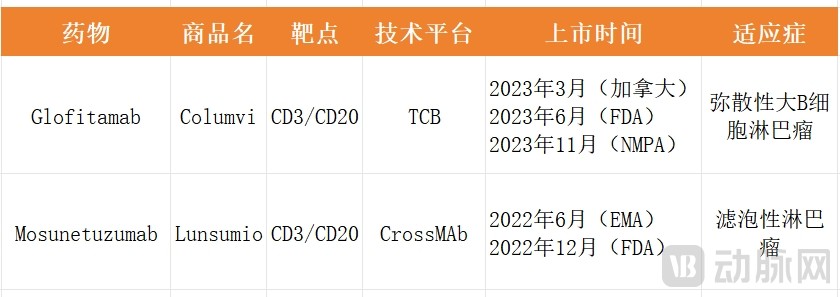
In terms of structural design, Glofitamab adopts a 2:1 asymmetric bispecific antibody structure, where two Fabs can bind to CD20 on the surface of tumor cells, and another Fab binds to the CD3 antigen on the surface of T cells, thereby enhancing the binding of the antibody to the antigen on the surface of tumor cells. Mosunetuzumab, on the other hand, adopts a 1:1 type, IgG1-like bispecific antibody structure, where one Fab binds to CD20 on the surface of tumor cells, and another Fab binds to the CD3 antigen on the surface of T cells.
Due to the 2:1 format of the antibody having a stronger killing effect, glofitamab exhibits greater potency and can enhance the ability to kill tumor cells under the premise of safety and tolerability, proving effective against aggressive and refractory lymphomas. In contrast, mosunetuzumab has relatively milder efficacy with a lower probability of cytokine release syndrome (CRS), making it more suitable for treating indolent lymphomas such as follicular lymphoma (FL).
Due to the high potency of glofitamab, the probability of cytokine release syndrome (CRS) is relatively high (around 70%), requiring safety monitoring of patients during treatment; thus, hospitalization is necessary. On the other hand, mosunetuzumab has a lower incidence of CRS (approximately 39%), with most cases being low-grade. Therefore, the application scenario for mosunetuzumab is more flexible, making it suitable for outpatient and community hospital settings, which aligns better with the actual conditions of patients in China.
These two drugs are, in fact, developed by Roche through different technology platforms with deep roots in molecular design according to various clinical scenarios. They complement each other to address more real-world treatment situations, achieving broader coverage of the lymphoma patient population.
CD20/CD3 Bispecific Antibody Battle
At the 2018 ASH conference, five CD20/CD3 bispecific antibodies were showcased, demonstrating clinical efficacy comparable to CAR-T therapy, making CD20/CD3 bispecific antibodies a major focus for pharmaceutical giants in China and abroad in the field of hematological tumor bispecific antibodies.
Currently, the FDA has approved 3 CD20×CD3 TCEs for marketing, 2 from Roche and 1 from AbbVie, all granted accelerated approval for the treatment of FL and DLBCL. With additional CD20/CD3 drugs in the pipeline, a wave of intense market competition is expected.
Roche was the first company to bring a CD20/CD3 bispecific antibody drug to market. In June 2022, Roche's first CD20/CD3 bispecific antibody, Mosunetuzumab (brand name Lunsumio), received conditional marketing approval from the European Commission (for third-line and above relapsed/refractory follicular lymphoma), becoming the world’s first approved CD20/CD3 bispecific antibody. Subsequently, Epcoritamab from Genmab/AbbVie and Roche's second CD20/CD3 bispecific antibody, Glofitamab, were successively approved for marketing.
The main difference between Genmab/AbbVie's Epkinly and Roche's two CD20/CD3 bispecific antibodies lies in the method of administration; the former is administered via subcutaneous injection, offering greater clinical convenience. However, Roche is also developing a subcutaneous formulation of Lunsumio.
The launch of Rituximab opened the door to the lymphoma treatment market for Roche and laid a solid foundation for Roche's research and development in the field of lymphoma treatment. Based on this, the two CD3/CD20 bispecific antibodies developed by Roche aim to meet different needs and clinical scenarios in lymphoma treatment, complementing each other to cover a broader population of lymphoma patients.
In China, there are also many players in the field. CD20/CD3 bispecific antibodies from companies such as Genor Biopharma, CT Tianqing, and Junshi Biosciences are all in the clinical stage. In the increasingly intense competition of the CD20/CD3 track, newcomers face a higher threshold for differentiation to pose a substantial challenge to already marketed competitors.
References:
Why Did Roche Develop Two Successful CD3xCD20 Bispecific Antibodies? —— VCBeat Editor