

AbbVie Partners with MedinCell in $1.9 Billion Deal to Develop Up to Six Long-Acting Injectable Therapies

MedinCell
Injectable Sustained-Release Drug Supplier

AbbVie
Innovative Drug Developer
On April 16, 2024, Medincell (Paris: MEDCL), a French publicly traded company specializing in the development of long-acting controlled-release injectables, announced that it had entered into a strategic collaboration and license agreement with AbbVie to develop a new generation of long-acting injectable therapies. According to reports, the two parties will jointly develop up to six long-acting injectables (LAI) across multiple therapeutic areas and indications, which will be commercialized by AbbVie.
According to the terms of the agreement, Medincell will receive an upfront payment of $35 million and is eligible for up to $1.9 billion (approximately 13.8 billion RMB) in development and commercial milestones ($315 million per project). Meanwhile, Medincell is also eligible to receive mid-single-digit to low-double-digit royalties on net sales.
After the news was released, both Medincell and AbbVie's stock prices rose.
MedinCell will leverage its commercially staged, long-acting injectable technology platform BEPO® to formulate innovative therapies. MedinCell will carry out formulation activities and preclinical studies, including supportive CMC work, to advance the candidate drug into clinical trials. AbbVie will fund and conduct the clinical development for each program and be responsible for regulatory approval, manufacturing, and commercialization.
Multi-line Layout, MedinCell Enters the US Market
MedinCell was born in 2003 in Montpellier, a major economic center in southern France, with its headquarters located in Jacou and incubated by Cap Alpha. Despite its early establishment, MedinCell focused on the research and development of its long-acting drug delivery technology platform for a long time until it officially went public in France in 2018, when its BEPO® technology platform finally gained public attention.
According to MedinCell, its patented BEPO® technology can control and ensure the regular administration of drugs at optimal therapeutic doses over several days, weeks, or months. Upon injection, the BEPO® technology forms a polymer deposit just a few millimeters under the skin, exerting either systemic effects or localized targeted action. The deposit releases the active ingredient through absorption over the required period, functioning like an injectable and bioresorbable micropump.
In addition, the BEPO® technology platform is compatible with a wide range of small molecules, peptides, and biologics, which is expected to further reduce the development cost of new drugs and increase the R&D speed.
Initially, MedinCell focused on long-acting contraceptive injectables, a project that received $3.5 million in funding from Bill and Melinda Gates. MedinCell conjugated progesterone molecules with its BEPO® technology platform to design a long-acting contraceptive injectable with a six-month duration of efficacy, which is expected to enter clinical trials within two years.
In 2019, MedinCell received the second round of funding from Bill and Melinda Gates, aiming to promote the long-acting contraceptive injection into the developed markets.
However, despite MedinCell's continuous efforts, and the high feasibility of developing long-acting contraceptives with significant market demand, existing long-acting contraceptive biologics still face challenges such as inconvenient delivery methods and relatively severe side effects. In the future, MedinCell’s products will also compete with gastric-retentive controlled-release tablets or non-hormonal injectables.
However, the long-acting contraceptive market is not the only layout for MedinCell.
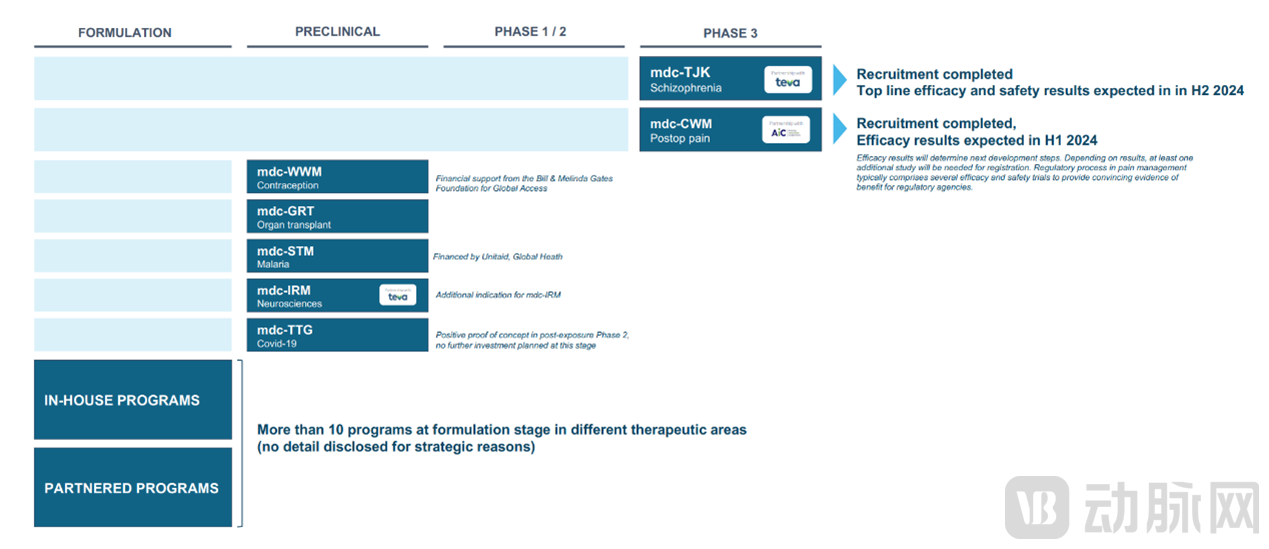
While continuously refining its technology, MedinCell is also developing long-acting formulations for malaria and has intensified its fundraising efforts during the global response to the COVID-19 pandemic. The company's other product research has been relatively low-key, with MedinCell announcing in 2021 a collaboration with Teva Pharmaceuticals to develop a long-acting injectable for adult schizophrenia.
In April 2023, the FDA approved UZEDY®, a risperidone extended-release injectable suspension developed by Teva Pharmaceutical and MedinCell. This is the first subcutaneous long-acting formulation of risperidone, administered once every one to two months. Utilizing MedinCell's proprietary BEPO® technology, it enables controlled and sustained release of risperidone without the need for oral supplements or loading doses. Therapeutic blood concentrations are reached within 6 to 24 hours after a single dose.
Notably, UZEDY® was approved based on data from two Phase 3 clinical trials, which evaluated the efficacy of UZEDY in patients with schizophrenia. In one Phase 3 clinical trial, UZEDY® reduced the risk of schizophrenia relapse by up to 80% compared to placebo.
Meanwhile, UZEDY® is also the first treatment approved by the FDA based on BEPO® technology. UZEDY has been distributed by Teva Pharmaceuticals in the United States since May 2023.
For MedinCell, this move marks a historic moment for the company, signifying its official entry into the U.S. market. For the birthplace of MedinCell, it holds an additional layer of significance: establishing Montpellier as a global center of excellence in the health sector.
In addition, MedinCell's another R&D product, mdc-TJK, is an investigational once-a-month subcutaneous long-acting injectable of olanzapine, an atypical antipsychotic drug for the treatment of schizophrenia. It has the potential to become the first long-acting olanzapine with good safety, as other long-acting injectables of olanzapine carry a FDA black box warning for PDSS (Post-injection Delirium/Sedation Syndrome), which limits their use. MedinCell's technology is expected to address this issue.
Long-Acting Formulations Make a Splash Landing
Currently, long-acting injectables, compared with oral preparations, feature stable blood drug concentration, an effective duration of weeks to months, and reduced dosing frequency. The targeted development of such formulations not only brings convenience to patients' treatment but also generates significant social impact.
It should be noted that LAI technology can maintain the long-term continuous therapeutic effect of drugs in the body, providing excellent treatment support for conditions such as schizophrenia, hormonal imbalances, and drug abuse over the past few decades. Particularly in the field of schizophrenia treatment, the proportion of patients using long-acting injectable antipsychotic drugs among those receiving community-based rehabilitation globally is 20%-40%, and in some developed countries, it even reaches 80%-90%.
In the long-acting injectables market for schizophrenia, international leading companies still maintain their dominance. Johnson & Johnson's paliperidone palmitate extended-release injectable has shown strong sales growth over the past decade, and with the launch of its six-month formulation, this growth trend is expected to continue. Similarly, Otsuka Pharmaceutical/Lundbeck's aripiprazole long-acting injectable has also maintained steady growth since its market introduction. In China, companies such as Luye Pharma and Livzon Pharmaceutical have achieved breakthroughs in long-acting formulations in recent years.
And with the deepening of human understanding of diseases, the huge potential of LAI in treating chronic diseases such as Parkinson's disease and Alzheimer's disease has made the development of LAI a "must-contest area" for foreign pharmaceutical companies. Chinese companies such as Luye, Luzhu, Shiyao, and Hengrui have also made efforts in this field and achieved certain results.
AbbVie is no exception. As early as 2016, the FDA approved Biogen/AbbVie's once-a-month subcutaneous injection for multiple sclerosis drug Zinbryta, which stands out for its ability to reduce the annualized relapse rate (AAR) and the risk of 24-week confirmed disability progression.
Recently, in January 2024, AbbVie launched Produdopa (a levodopa prodrug/carbidopa prodrug, previously known as ABBV-951) for the treatment of Parkinson's disease in the EU market. It has become the first and only therapy that enables continuous 24-hour subcutaneous infusion of levodopa through a pump connected subcutaneously to treat neurodegenerative diseases.
Considering that long-acting formulations, due to their high technical barriers, long life cycles, high added value, and lower R&D costs compared to innovative drugs, can easily become a favored track for major pharmaceutical giants.
This generous move by AbbVie is not only expected to further stimulate MedinCell's capabilities in the fields of mental health and contraception, but also has the potential to tap into promising markets such as autoimmune diseases.