Sanofi's Anti-CD40L Monoclonal Antibody Frexalimab Granted Clinical Trial Approval in China for Multiple Sclerosis

Sanofi
Pharmaceutical R&D Developer
Today (April 17), the official website of the Center for Drug Evaluation (CDE) of the China National Medical Products Administration (NMPA) announced,Sanofi(Sanofi)Class 1 New DrugFrexalimab InjectionReceived two clinical trial implied permits, respectively intended for development to treatAdult Relapsing Multiple Sclerosis (RMS), Adult Non-Relapsing Secondary Progressive Multiple Sclerosis (nrSPMS). Public information shows that frexalimab is aA monoclonal antibody targeting CD40L. The product has previously reached the primary endpoint in a Phase 2 clinical study for the treatment of multiple sclerosis, and the study results have been published in The New England Journal of Medicine.
 Screenshot source:CDE Official Website
Multiple Sclerosis (MS) is a chronic disease.When MS occurs, the immune system abnormally attacks the myelin (which insulates and supports the axons of nerve cells) of nerve cells in the central nervous system (brain, spinal cord, and optic nerves), causing inflammation and damage.This damage can lead to a series of symptoms, including muscle weakness, fatigue, and vision difficulties, which may eventually result in disability.Most MS patients first experience symptoms between the ages of 20 and 40, making the disease a leading cause of non-traumatic disability in young adults.
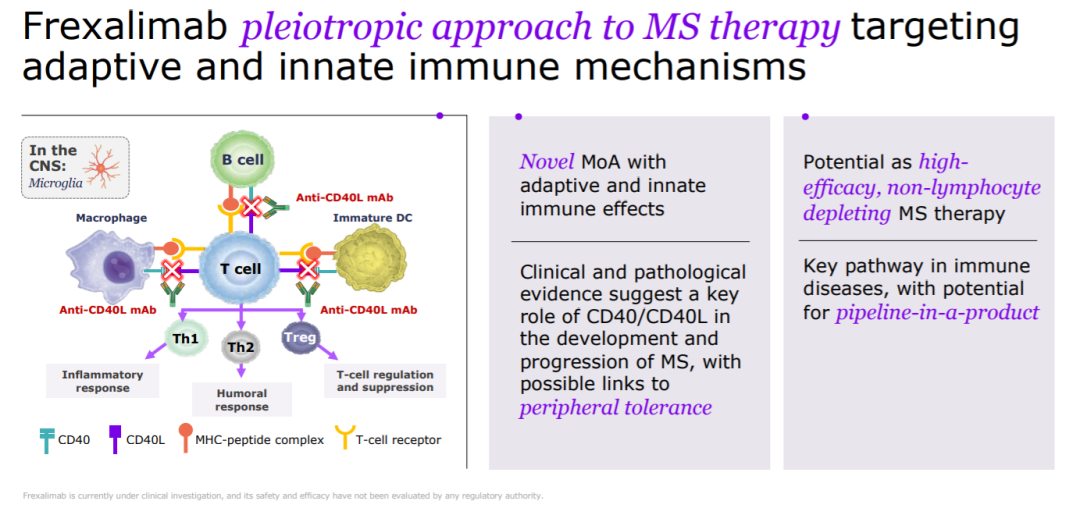
Clinical and pathological evidence suggests that,The CD40/CD40L pathway plays a key role in the onset and progression of multiple sclerosis., may be related to peripheral immune tolerance.CD40LThrough its interaction with the receptor CD40, it plays a crucial role in regulating the interactions between T cells and other immune cells (particularly B cells and antigen-presenting cells), thereby influencing some important functions related to autoimmune diseases.
Frexalimab (SAR441344) is a novel monoclonal antibody under research by Sanofi.. The productConsideredCapable of blocking the co-stimulatory CD40/CD40L cellular pathway essential for the activation and function of adaptive (T and B cells) and innate (macrophages and dendritic cells) immune cells., without causing lymphocyte depletion.
Screenshot source: Reference [2]
In February this year, Sanofi announcedPositive Results from Phase 2 Trial of Frexalimab in Patients with Multiple Sclerosis Published in The New England Journal of MedicineThe study randomly assigned 129 adults with relapsing multiple sclerosis to receive one of two doses of frexalimab (high-dose and low-dose groups) or a matching placebo. In the high-dose treatment group, participants received 1200 mg of frexalimab intravenously every 4 weeks. In the low-dose treatment group, participants received 300 mg of frexalimab subcutaneously every 2 weeks.
Analysis results after 12 weeks of treatment showed,Both doses of frexalimab significantly reduced the number of new GdE T1 high-signal MRI brain lesions in patients.Compared with placebo, the ratios of new GdE T1 lesion counts in patients receiving higher and lower doses of frexalimab were 0.11 and 0.21, respectively, indicating that higher and lower doses of frexalimab reduced new GdE T1 lesion counts by 89% and 79%, respectively, achieving the primary endpoint of the trial.In addition,Both doses of frexalimab significantly reduced the number of new/enlarged T2 lesions in patients, achieving the secondary endpoint of the trial.
According toClinicalTrialsOfficial website,Sanofi has already launchedfrexalimabThe two itemsPhase 3Clinical studies, respectively, for the treatment of adult non-relapsing secondary progressive multiple sclerosis(nrSPMS) and Relapsing Multiple Sclerosis (RMS).In addition to targeting multiple sclerosis,Sanofi is currently evaluating in Phase 2 clinical trialsThe potential of frexalimab in treating other autoimmune diseases, includingSjögren's Syndrome, Systemic Lupus Erythematosus, Type 1 Diabetesetc.
This article is from the content team of WuXi AppTec. Individuals are welcome to share it on their social media platforms, but unauthorized reproduction by media or institutions in any form to other platforms is prohibited. For authorization to reproduce, please contact us via a message on the "MedView" WeChat Official Account. For other collaboration inquiries, please contact wuxi_media@wuxiapptec.com.
Disclaimer: The content team of WuXi AppTec focuses on introducing the research progress in global biopharmaceuticals and health. This article is for the purpose of information exchange only. The views expressed in the article do not represent the position of WuXi AppTec, nor does it imply that WuXi AppTec supports or opposes these views. This article is not a recommendation for treatment plans. For guidance on treatment options, please visit a正规 hospital.