Disclaimer: Due to limited proficiency, errors are inevitable, and some information may not be the most up-to-date. Corrections are welcome in the comments. This article is only an introduction to medical and health-related drugs, not a recommendation of treatment plans (if involved); this article does not constitute any investment advice.
Recently, Bayer AG and its wholly-owned, independently operated subsidiary Asklepios BioPharmaceutical (AskBio) announced that their Parkinson's disease gene therapy, AB-1005 (AAV2-GDNF), has entered Phase II clinical trials. Patient recruitment is expected to begin later this year in the United States, the European Union, and the United Kingdom.
The latest epidemiological statistics show that the prevalence of Parkinson's disease is 1.37% in the population aged 60 and above in China, and 1.63% in the population aged 65 and above. Based on this estimation,The total number of Parkinson's disease patients in China has reached 3.62 million.By 2030, the number of Parkinson's disease patients in China will reach 5 million, accounting for nearly half of the global patient population.Parkinson's disease has a long and irreversible course of progression. Currently, the cause and pathogenesis of Parkinson's disease remain unclear, and traditional treatments mainly involve medication and surgery.
AB-1005 (AAV2-GDNF) is an investigational gene therapy based on the adeno-associated virus serotype 2 vector (AAV2).Containing human glial cell line-derived neurotrophic factor (GDNF) transgene. After direct neurosurgical injection via convection-enhanced delivery monitored by magnetic resonance imaging (MRI), GDNF can achieve stable and continuous expression in local brain regions.As early as January, Bayer announced that the Phase Ib clinical trial of AB-1005 (AAV2-GDNF) had met its primary endpoint.The trial lasted for 18 months, with 11 patients divided into two groups: mild Parkinson's disease (6 patients) and moderate Parkinson's disease (5 patients).All patients tolerated the neurosurgical administration of AB-1005 well., the target shell-core coverage rate was 63%±2%, exceeding the goal of more than 50% coverage.No serious adverse events occurred with AB-1005, currently continuing with 5 years of clinical follow-up after drug administration.
Krystof Bankiewicz, Scientific Lead for Parkinson's Disease and Multiple System Atrophy at AskBio, once stated"Early data are encouraging, indicating that AB-1005 is well-tolerated in patients with mild to moderate Parkinson's disease in this study."
About AskBio
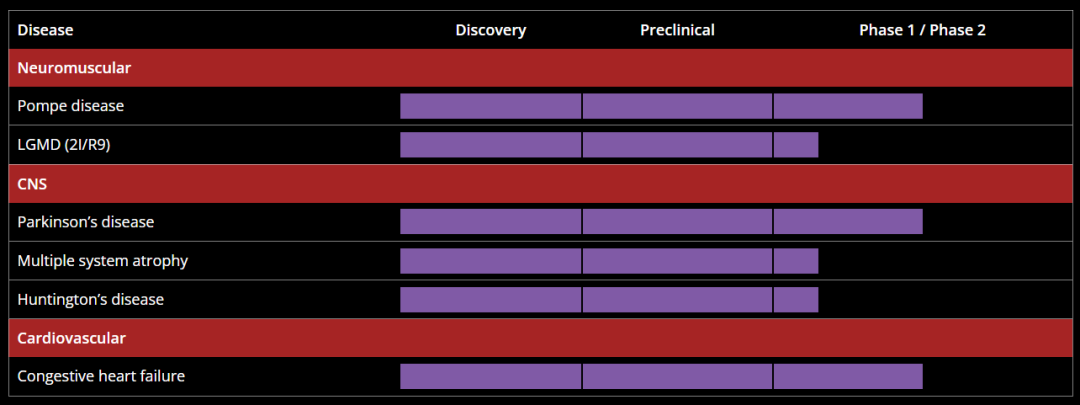
Asklepios BioPharmaceutical, Inc. (AskBio), a wholly-owned and independently operated subsidiary of Bayer AG, is a company fully dedicated to gene therapy, committed to developing life-saving drugs and transforming patients' lives. The company has a range of clinical programs covering neuromuscular, central nervous system, cardiovascular, and metabolic disease indications, as well as a clinical-stage R&D pipeline that includes congestive heart failure, Huntington's disease, limb-girdle muscular dystrophy, multiple system atrophy, Parkinson's disease, and Pompe disease.
R&D Pipeline
References:
https://www.bayer.com/media/en-us/askbio-presents-18-month-phase-ib-trial-results-of-ab-1005-gene-therapy-for-patients-with-parkinsons-disease/