April 17,Abbott Releases First Quarter 2024 Financial Report, Total Revenue of $9.964 Billion, Up 2.2% Year-over-Year, Revenue Returns to Growth; However, Net Profit Attributable to Shareholders is $1.23 Billion,A 7% year-over-year decline。Perhaps for this very reason, by the close of trading that day, Abbott's stock price fell by 3%.Specifically, IVD remains the hardest-hit area for its performance, while the medical device business maintains double-digit growth:- Medical DeviceRevenue of 4.45 billion US dollars, year-on-year+14.2%;
- In Vitro DiagnosticsRevenue of $2.21 billion, year-over-year-17.6%, including the rapid diagnostic business in the U.S. market-40%;
- Nutritional ProductsRevenue of $2.06 billion, a year-on-year increase of 5.1%;
- Mature DrugRevenue of $1.23 billion, a year-on-year increase of 3.1%;
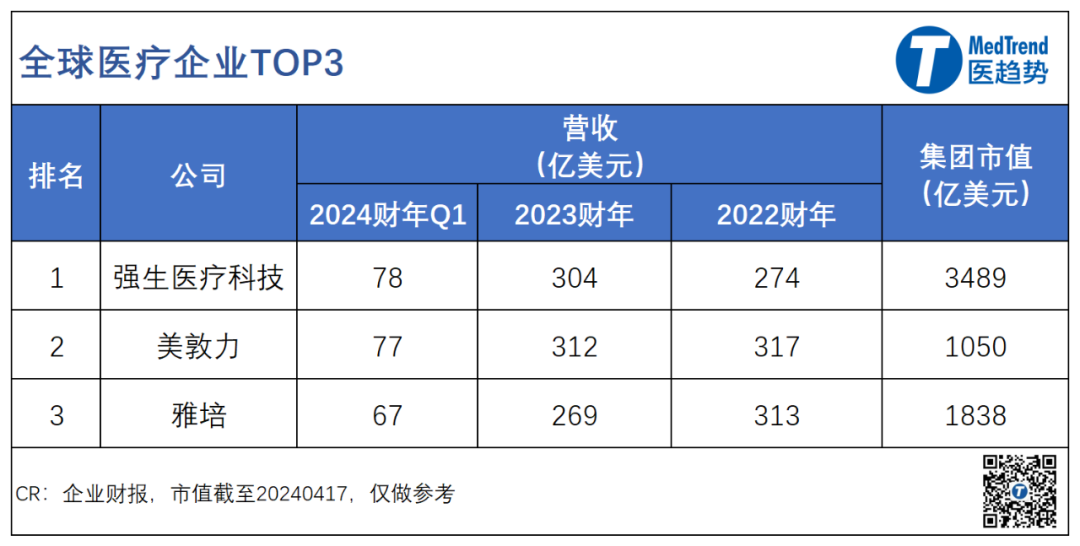
As one of the top three global medical device companies, Abbott came closest to reaching the top position in the 2022 fiscal year, ranking second globally with only a $400 million difference in revenue compared to Medtronic. However, by the 2023 fiscal year, the gap between Abbott and Medtronic had widened to $4.4 billion.From the Q1 data of fiscal year 2024, Abbott's gap with the top two has not shown significant changes.
*** Abbott Medical Devices Business Calculates "Medical Devices" and "In Vitro Diagnostics"And its CEO Robert Ford is an exception,In Q1, the sales and profit forecast for the entire year of 2024 was raised, with organic sales expected to grow by 8.5% to 10% (excluding COVID-19 testing).。Because,On the one hand,Q1 Abbott's medical device sales surged, driving the group's performance beyond the company and Wall Street's expectations; this was mainly due toStructural Heart Disease、Electrophysiology, and double-digit high growth in areas such as diabetes.On the other hand,The CEO believes that Abbott's innovative medical device products, which are expected to be launched in the near term and in the future, will create an incremental market worth billions of dollars.Tricuspid Valve Repair and Replacement, Head-On Challenge to Edwards
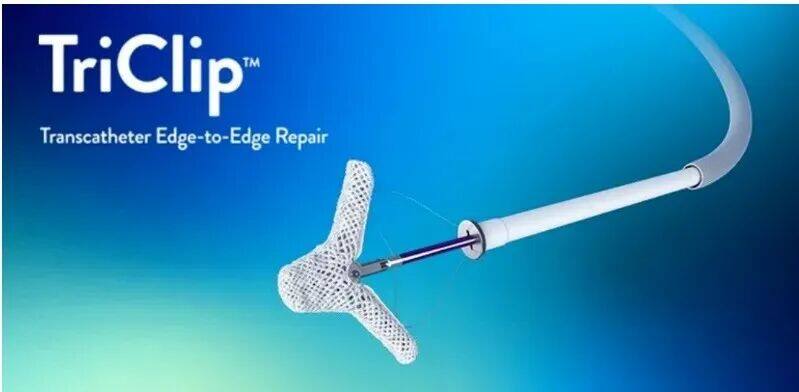
Structural heart disease is a field where Abbott has heavily invested in recent years, aiming to build a diversified product portfolio capable of sustaining double-digit growth. In the past, this area almost entirely relied on the transcatheter mitral valve repair device MitraClip. However, in Q1 of the 2024 fiscal year, its product portfolio and growth have become more balanced, with revenue increasing by 12% to reach $510 million. This growth was mainly driven by strong performances in areas including LAA, mitral valve, and tricuspid valve repair.On April 8, Abbott announced that its transcatheter tricuspid valve repair product (TriClip G4) received FDA approval for market release, becomingThe World's First Transcatheter Tricuspid Valve Edge-to-Edge Repair Technology Product to Receive FDA Approval, applicable for the treatment of tricuspid regurgitation (TR) or tricuspid leakage.Its CEO in the latest earnings callCalling it a "billion-dollar opportunity"In the United States, there are at least 2 million patients with tricuspid regurgitation.This is another major breakthrough in the field of structural heart disease following the FDA approval of Edwards' transcatheter tricuspid valve replacement, EVOQUE.Its biggest competitor remains Edwards' transcatheter edge-to-edge repair product, PASCAL Precision. PASCAL Precision received CE approval in 2022 and is capable of being used for the treatment of both mitral regurgitation and tricuspid regurgitation.Ford said that safety will play a "key role" when doctors decide whether to repair or replace the valve, and TriClip G4 has certain advantages.Join the Electrophysiology BattlePulsed Field Ablation, Applied for Marketing Authorization This Year
In Q1 2024, Abbott's electrophysiology business achieved a 16.2% revenue increase to $5.9 billion, driven by cryoablation, radiofrequency ablation products, and the 3D mapping system.
The world's top three medical device giants—Medtronic, Johnson & Johnson, and Abbott—and China's top medical company, Mindray, have all coincidentally placed their future bets on the electrophysiology field.Cardiac electrophysiology is the third major track in the field of cardiovascular interventional treatment devices, as well as an important method for treating arrhythmia.- Atrial fibrillation is the most common type of arrhythmia in clinical practice, affecting a large population, and is also an important factor leading to heart failure and even sudden cardiac death; apart from medication, cardiac electrophysiology procedures are currently the best approach for treating atrial fibrillation. There are more than 38 million atrial fibrillation patients worldwide.
As cardiovascular interventional treatment devices enter the "pulsed field ablation" era, this competition has become even more intense.As of April 2024, there are 7 pulsed field ablation products that have been launched globally, namely:- Boston ScientificFarapulse PFA (Received EU CE Certification in 2021) (Received US FDA Approval in 2023);
- Galvanize Therapeutics(Galaxy Medical) CENTAURI Pulsed Electric Field (PEF) System (Received EU CE Certification in 2022);
- MedtronicAbbott's Affera Sphere series (received EU CE certification in 2023) and Pulse Select (received U.S. FDA approval in 2023);
- Johnson & JohnsonThe first PFA product of its subsidiary Biosense Webster — VARIPULSE (received EU CE certification in 2024);
- Jinjiang ElectronicsLEAD-PFA Cardiac Pulse Field Ablation System and Pulsed FA Single-Use Cardiac Pulse Field Ablation Catheter(Approved by NMPA in 2024);
- Denovo EP"Single-Use Cardiac Pulsed Field Ablation Catheter"(Approved by NMPA in 2024)。
Previously, Wall Street believed that Abbott, as the leading company in electrophysiology, might "sit out" this heated battle.Because Abbott's Volt pulse field ablation system has just begun clinical trials. This might cause Abbott to miss the "first-mover advantage," and subsequently, Abbott may face two waves of competitive challenges.- The first wave is set to begin in 2024, as products from Boston Scientific and Medtronic have already been launched in the U.S. market; analysts predict that these devices could capture 60% of the cardiac electrophysiology procedure market.
- The second wave will come at the end of 2024, impacting Abbott's EnSite X mapping system as PFA products are used in conjunction with mapping systems.
However, the CEO of Abbott does not think so. Because the progress of its product launch is much faster than Wall Street expected.In March 2024, Volt has completed the recruitment for clinical studies in the European market.Expected to apply for listing by the end of this year.And has begun recruiting patients for the U.S. clinical trial named VOLT-AF.The reason for choosing to enter from Europe,On the one handThis is because the market is more receptive to new ablation technologies, such as cryoablation being more clinically popular than radiofrequency ablation in the European market.On the other handAbbott has accumulated a high-quality and extensive clinical customer base in the European market, with a large installed base. In Q1 2024, Abbott also achieved double-digit high growth in the European ablation catheter market. Additionally, Abbott's ablation terminal system architecture is open, allowing for excellent integration with pulsed field ablation (PFA) catheters in the future.Innovative Pipeline Supports Growth for the Next Three YearsUnlike Johnson & Johnson's continuous mergers and acquisitions policy, at the JPM Healthcare Conference earlier this year, CEO Robert Ford stated that Abbott had made two acquisitions last year to expand its portfolio. With a currently healthy pipeline, Abbott is fully capable of maintaining high single-digit organic growth. Therefore, it doesn’t need to rely on acquisitions to sustain a high-growth model and is more capable of proactively positioning itself in a favorable stance to flexibly evaluate different opportunities.And the innovative pipeline is also its confidence to support Abbott's long-term growth.For example,2024Q1FreeStyle Libre Continuous Glucose Monitoring System Generated $1.5 Billion in Revenue, a 22.4% Increase from the Same Period Last Year.Driven by Eterna, a rechargeable nerve stimulation device used for pain treatment, sales of the neuromodulation business grew by up to 17% in Q1 2024. In addition, in January 2024, Liberta, the world's smallest rechargeable deep brain stimulation device for treating movement disorders such as Parkinson's disease, was launched.In the future, dual-analysis sensors, a new generation of below-the-knee arterial bioresorbable stents (a first-of-its-kind innovation), the all-new Alinity system (targeting niche markets currently untapped by Abbott), a next-generation leadless pacemaker system, the second-generation Amulet cardiac pacemaker, and various applications in the biowearable devices market.Will be launched within 12 to 18 months, opening a new growth curve for Abbott.--Featured Recommendations--