FDA Approves Roche's Alecensa (Alectinib) as Adjuvant Therapy for ALK-Positive NSCLC Following Tumor Resection
Roche
Oncology Drug Research, Development, and Manufacturing

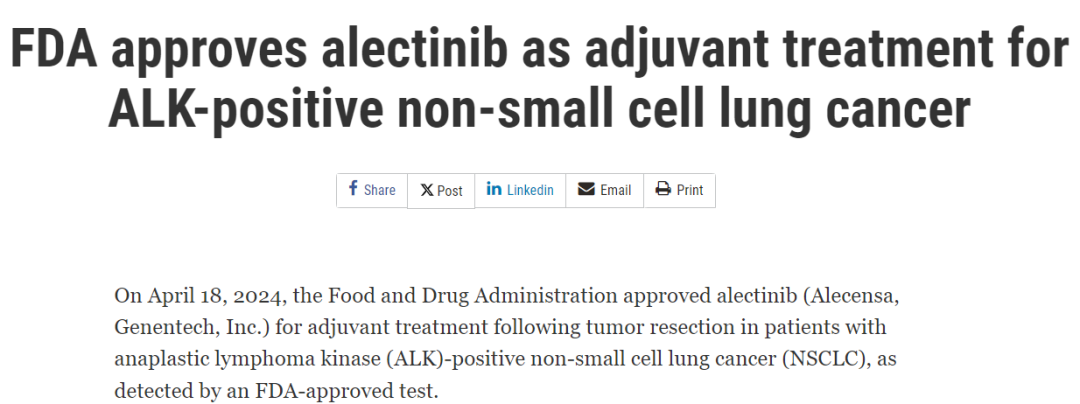
This approval is mainly based on aData from the Phase III ALINA study. The study included a total of257 patients, they were divided according to1:1FollowMachineAllocation,After tumor resection, respectivelyTake twice dailyAlectinibOr platinum-based chemotherapy.Investigator AssessmentTheThe main efficacy endpoints includeSubgroups of Stage II-IIIA NSCLC PatientsDisease-Free Survival (DFS) and the Total Study Population (IB-Stage IIIA) of DFS.
The results showed that, in patients with stage II-IIIA NSCLC,AlectinibThe median DFS was not reached in the group, and the median DFS in the chemotherapy group was 44.4.Months (95% CI: 27.8, NE)(HR 0.24 [95% CI: 0.13, 0.45]; p<0.0001). In the overall population, the median DFS was not reached in the alectinib group, while it was 41.3 months (95% CI: 28.5, NE) in the chemotherapy group (HR 0.24 [95% CI: 0.13, 0.43]; p<0.0001).
Previously announced results at the 2023 ESMO Congress showed that, compared with platinum-based chemotherapy, adjuvant treatment with alectinib in patients with completely resected IB-IIIA stage ALK-positive NSCLC reduced the risk of disease recurrence or death by 76% (HR=0.24, 95% CI: 0.13-0.43, p<0.0001).At the same time,Current ResearchThe results also observed a clinically significant improvement in central nervous system (CNS)-DFS (HR=0.22).;95% CI:0.08-0.58)。
The safety and tolerability profile of Alectinib in this study were consistent with previous research, and no new unexpected safety signals were observed. The most common adverse events in the Alectinib group were...(≥20%) of adverse reactions are hepatotoxicity, constipation, and myalgia., COVID-19, fatigue, rash, and cough, etc.
Exciting Preview
 ↑ Long pressScan the code, Registration Activity ↑