

Roche Develops a Mass Spectrometry-Based Strategy to Identify Off-Target Sites of TCR-like Antibodies

Roche
Oncology Drug Research, Development, and Manufacturing
Although human primary cells and organ models provide a unique opportunity to evaluateTCRDoes the combination also trigger any relatedTCellular effector functions, such asTCell-dependent lysis, but establishing causality of cross-reactivity in primary healthy human tissues remains a challenge. Moreover, most available human model systems still exhibit physiological and cellular gaps, increasing the necessity for in situ rather than in vitro evaluation of off-target binding.
In the absence of cross-reactive toxicology species relevant to humans, the non-clinical safety assessment of TCR-like molecules is supported by new alternative methods. In the early stages of development, a computational strategy combining structural computational modeling, peptide binding prediction, and TCR/antibody contact profiling is used to predict potential off-target effects. The computational strategy for interrogating the TCR repertoire relies on interactome data obtained from large peptide or HLA-peptide complex libraries, which can determine the specificity profile of TCRs or TCR-like antibodies.However, the progress achieved through bioinformatics methods fully relies on the prediction of TCR interactomes based on TCR sequence features and their interacting peptide targets. Yet, these methods remain limited.
Recently, researchers from Roche and the Oxford Jenner Institute published a research paper titled "The physiological interactome of TCR-like antibody therapeutics in human tissues" in the journal Nature Communications.The study adopted a mass spectrometry-based approach to identify off-target peptide-HLA complexes bound by TCR-like molecules. This technology was utilized to support the non-off-target binding of TCR-like antibodies targeting MAGE-A4 HLA-A*02:01. The method was then applied to define the off-target sites of ESK1 (which targets the HLA-A*02:01 and WT1 (WT1126-134: RMFPNAPYL) complex), and structural studies were combined to demonstrate how mimotopes enable off-target interactions with ESK1 and T-cell activation. Finally, the high binding selectivity of the MAGE-A4 antibody and the off-target profile of ESK1 were further validated. Overall, the developed platform represents an additional strategy for evaluating the cross-reactivity of TCR-like molecules, which may aid in the development of highly specific and safe immunotherapies.
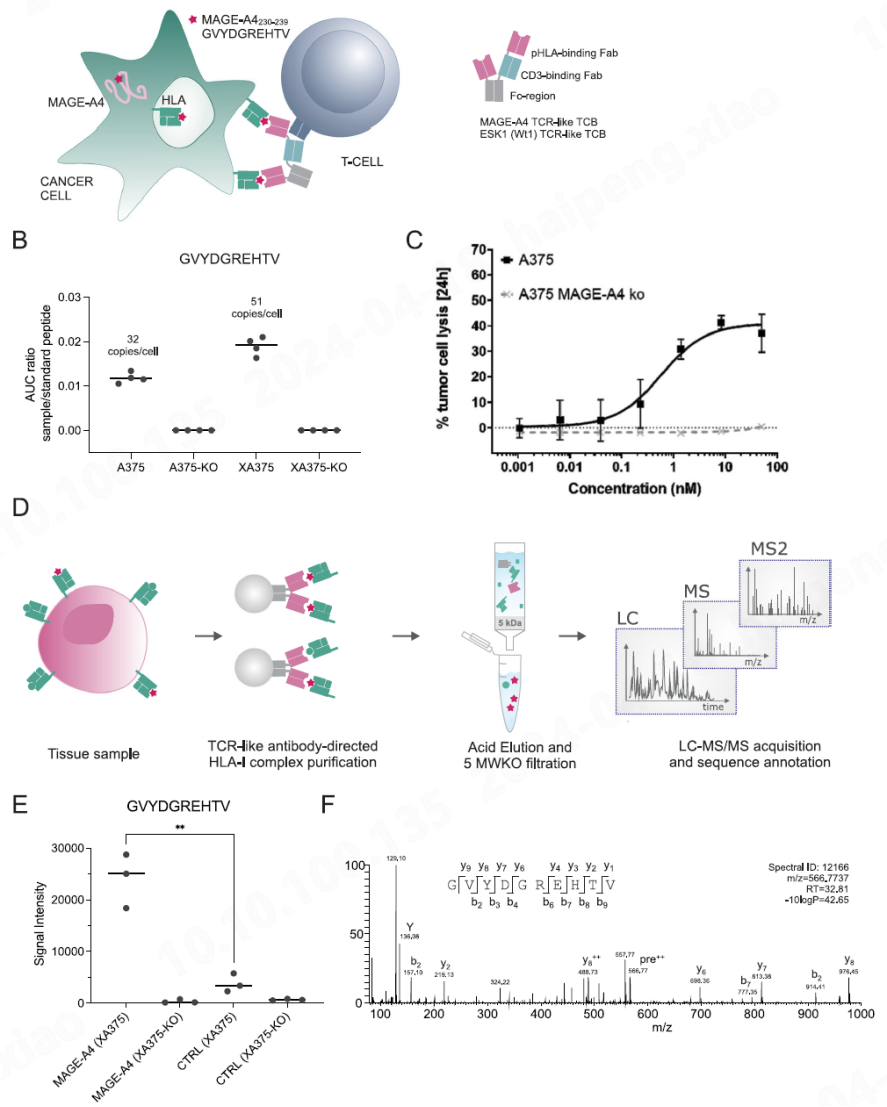
A method based on mass spectrometry technology was used to systematically and robustly identify physiological relevant off-target peptide-HLA complexes bound by TCR-like molecules. This technique was first applied to develop and validate a TCR-like antibody (targeting the complex of HLA-A*02:01 with the peptide GVYDGREHTV derived from MAGE-A4) to ensure no off-target effects.
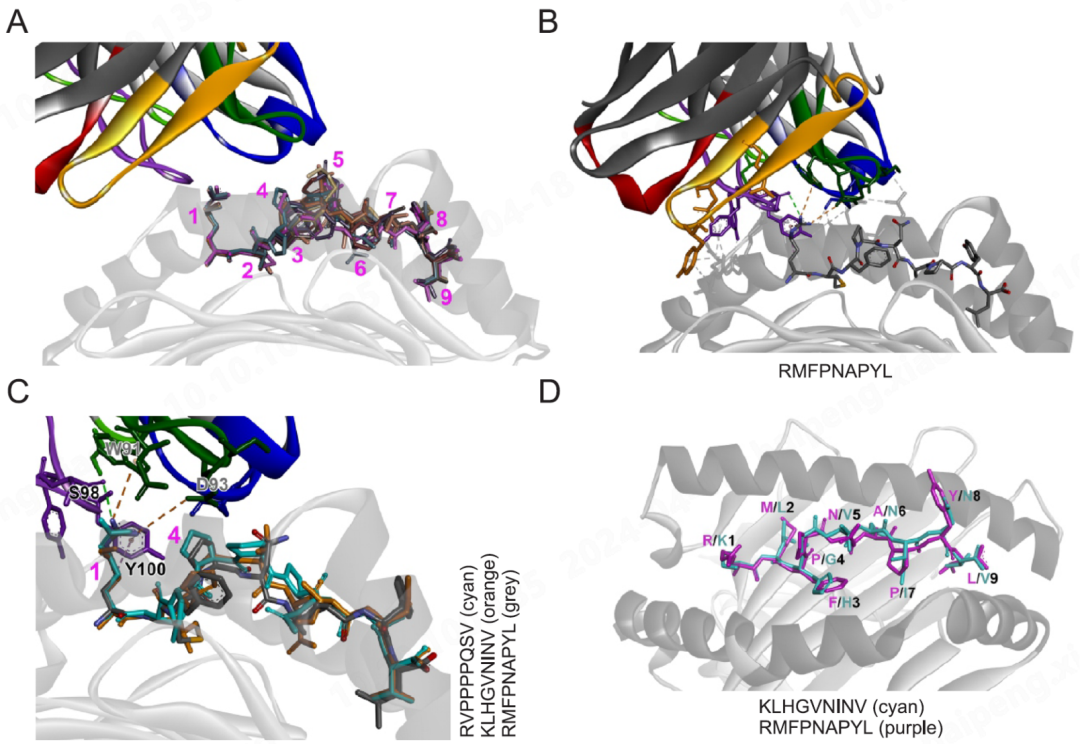
ESK1, developed in the early stage, is a well-characterized TCR-like bispecific antibody that selectively targets the intracellular oncoprotein WT1 (WT1126-134: peptide RMFPNAPYL) presented by HLA-A*02:01 with high specificity.Using the aforementioned mass spectrometry-based method, the off-target sites of ESK1 were further defined. Mass spectrometry studies identified cross-reactive peptide sequences of ESK1 in human liver tissue, with results confirming ESK1's off-target induction of T-cell activation and mediation of hepatocyte spheroid killing. Structural simulation studies showed that the off-target sequence of ESK1 contains an amino acid motif that allows it to mimic the structural groove coordination of the target peptide, thereby enabling interaction with adaptor molecules and facilitating off-target interactions.
To confirm that MAGE-A4 TCB does not activate T cells in primary human PBMCs in these tissues, in vitro killing assays were performed again. MAGE-A4 TCB and ESK1 TCB were tested in parallel with the negative control DP47 TCB (a non-tumor-targeting TCB) to control the in vitro assay. Neither MAGE-A4 nor WT1 was expressed in the lung or colon 3D models.The results showed that no significant off-target effects were detected for MAGE-A4 TCB, reflecting the lack of specific peptide enrichment in any tissue observed with the MAGE-A4 antibody. In contrast, ESK1 TCB again demonstrated off-target activity in the lung and colon 3D models.
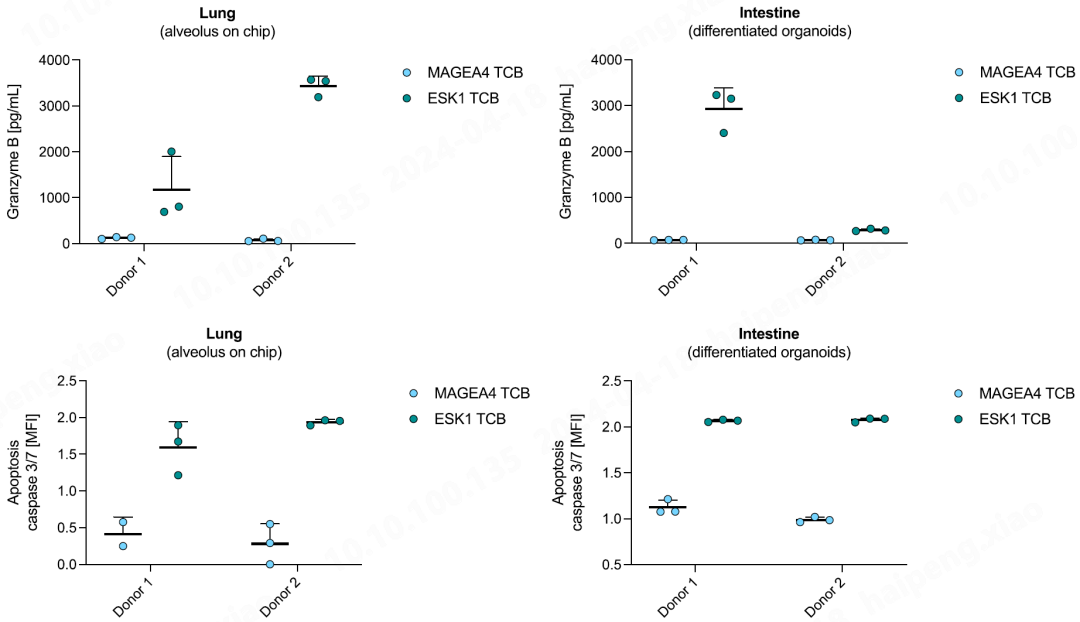
Indicates that MAGE-A4 TCB is a therapeutic bridging molecule, with no off-target activity observed in liver, lung, and colon tissues. Meanwhile, before the first clinical application of TCB in humans, this research strategy provides an accurate and scalable approach for evaluating the non-clinical safety of TCR-like antibody therapies.
Thinking
The pressing challenge in developing HLA peptide-specific immunotherapies is establishing off-target screening strategies to mitigate risks before advancing to human clinical trials, particularly given the lack of suitable in vivo strategies. The effectiveness of animal models is limited due to species-specific MHC binding specificities and alterations in antigen processing mechanisms.By integrating library data, predictions, and structural modeling to define off-target peptide sequences, the understanding of TCR interactions is facilitated, but it is insufficient to define physiologically relevant risk antigens in populations.
In summary, computer predictions and biostructure modeling are not sufficient to reduce risks. To overcome these limitations and support the development of new candidate drugs, this study proposes that functional interactome characterization can successfully evaluate and optimize TCR-like antibody therapies and ultimately minimize patient risks if ex vivo testing is performed in human primary cells and tissues.
Reference:Marrer-Berger, E., Nicastri, A., Augustin, A.et al. The physiological interactome of TCR-like antibody therapeutics in human tissues. Nat Commun 15, 3271 (2024). https://doi.org/10.1038/s41467-024-47062-5