On April 18, SanofiWell-known foreign media Endpoints NewsSaid,Is restructuring its vaccine commercial operations in the U.S. and implementing layoffs, with the specific number of layoffs unknown.
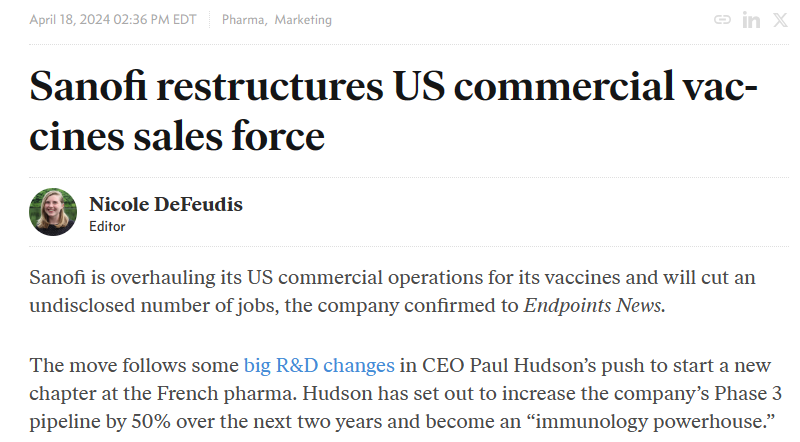
Sanofi said,This moveFor RealImplement a "streamlined strategic sales structure",To better support its customers and patients, but did not discloseNumber and Timing of LayoffsDetails such as...According to the statistics from Yaoyan Network, this is alsoSanofi Announces Layoffs for the Fourth Time This Year.

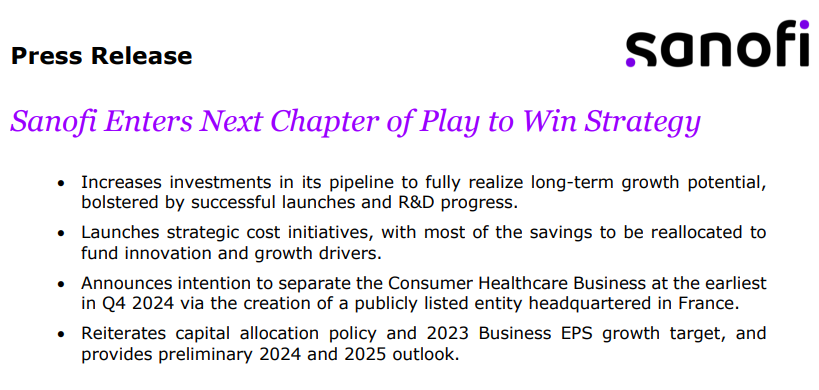
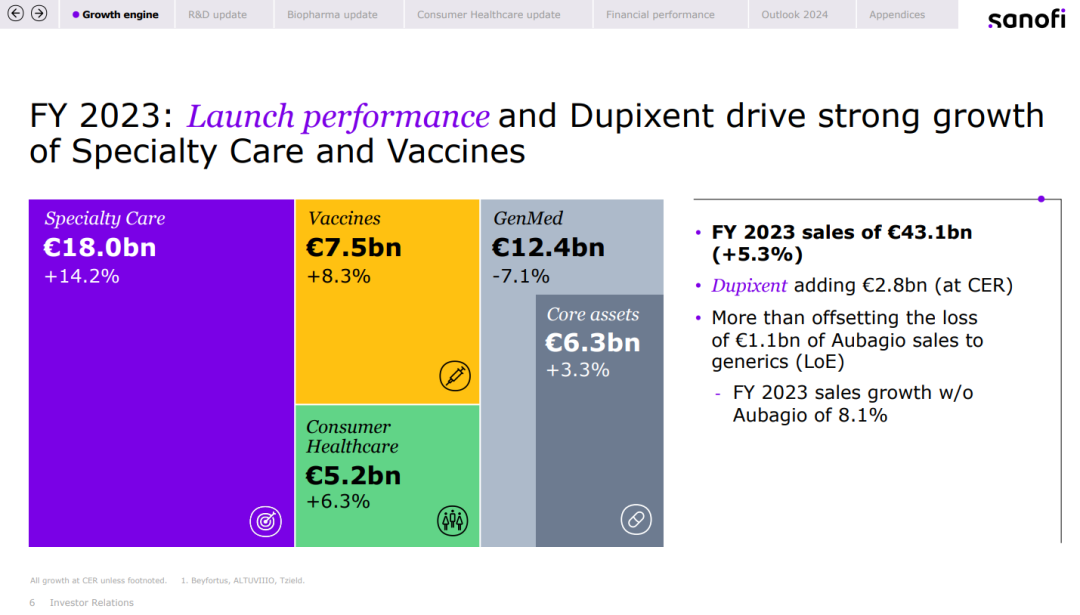
Sanofi's Multiple LayoffsIn fact, as early as October 2023, when Sanofi released its third-quarter financial report and announced a downgrade of its 2024 profit forecast, its CEO Paul Hudson reiterated“Play to Win”Strategy.In support of this strategy, Sanofi not only launchedPipeline Priority AdjustmentAndCost Reduction Plan, and also releasedSpin-off of Consumer Healthcare BusinessThe signal.At that time, Paul Hudson said,The "pipeline resource reallocation" from oncology to immunology alone can benefit the company.Save 700 million euros ($751.9 million)It is expected that by the end of 2025Save approximately 2 billion euros。In fact, for Sanofi itself, the restructuring plan is both a helpless move and a rational one.Sanofi2023 Financial ReportShow that itsTotal revenue of 43.07 billion euros (approximately 47.1 billion US dollars), increased by 5.3% year-on-year.Among them,
Pharmaceutical business revenue was 37.89 billion euros (approximately 41.4 billion US dollars), a year-on-year increase of 5.1%.
Vaccine business revenue: 7.474 billion euros (approximately 8.173 billion US dollars, +8.3%)
- Consumer Health Business Revenue: €5.18 billion (approximately $5.664 billion, +6.3%)
From the perspective of individual products, Dupilumab, which broke through the billion-dollar revenue mark for the first time, accounted for nearly one-third of the sales. Besides,No Next Drug with Sales Exceeding $2 BillionIn other words, among Sanofi's pharmaceutical products, the only "heavy-hitting" blockbuster drug now is Dupilumab.The vaccine field involved in this restructuringIn China,A monoclonal antibody for the prevention of RSV, Beyfortus, has shown strong growth with sales reaching 547 million euros (approximately 598 million US dollars). However, the product is also facing supply issues, which Sanofi attributes to "excess demand" following its launch in July 2023. Due to declining vaccination rates and increasing competition,The Fourth QuarterEnhanced EpidemicSales of Miao and influenza vaccines also declined.The pressure on Sanofi is understandable, whether it is in expanding the pipeline with some potential products or reducing some non-potential products.As early as December last year, Sanofi articulated its ambition to increase the number of Phase III projects by 50% over the next two years during its Research and Development Day, with a focus on immunology, neurology, and vaccines.Based on this, some research projects will be reduced, and more funds will be allocated to advance high-potential projects.Since the beginning of 2024, Sanofi's difficulties have not been resolved.It has successively abandoned oncology projects obtained from Denali, Kymab, and Amunix.FebruaryDenali disclosed in its SEC filing that the Phase II HIMALAYA study of DNL788, a drug co-developed with Sanofi for the treatment of amyotrophic lateral sclerosis (ALS),Failed to achieve the primary endpoint of significantly improving the revised ALS Functional Rating Scale (ALSFRS-R) score.MarchSanofi disclosed the layoff plan for its UK plant acquired from Kymab in 2021.Will cut 90 jobs.April 9,Sanofi Shuts Down NK Cell Therapy Company Acquired for Nearly $400 Million, Parts Ways with It.This move was quietly announced recently when the clinical trial information of SAR445419 was updated. SAR445419 is an allogeneic NK cell therapy developed by Sanofi for the treatment of relapsed/refractory acute myeloid leukemia. According to the information from the U.S. clinical trial database, the phase I study of SAR445419 was terminated due to Kiadis' withdrawal of investment.Kiadis itself was also forced to "disappear" due to Sanofi's priority adjustments.April 10,Sanofi Spins Off Another Intangible Asset Impairment Project: Amunix。It announced that it will sell a production base located in San Francisco.This production base was acquired by Sanofi when it spent 1 billion US dollars to acquire Amunix Pharmaceuticals. It was also revealed thatLay Off 100 People in California。ForIn response to the "Play to Win" plan,Multiple tumor research projects planned to be canceled,AndLayoff Plan, AlsoBecome a part of it.Placing a Big Bet on the Next Decade of Development
While adjusting its pipeline, Sanofi also reconsidered its development strategy.On the one handMaking a big push into the artificial intelligence (AI) pharmaceuticals track, while simultaneously building up an immune kingdom.Paul Hudson stated that the company is facing a criticalDuring the window period, Sanofi has almost no drugs with expiring patents, while many pharmaceutical companies are facing a patent cliff. From now until 2030, Sanofi must seize this opportunity to accelerate the development of more innovative drugs for market launch and quickly capture the market.Expect sales in the immunology and vaccine fields to exceed €22 billion and €10 billion, respectively.In January this year, Sanofi entered into a global collaboration with Synthekine,Development and Commercialization of IL-10 Receptor Agonists for the Treatment of Inflammatory DiseasesAccording to the agreement, Sanofi will take full responsibility for the subsequent preclinical, clinical, and commercialization activities of the IL-10 drug. Synthekine will receive a $40 million upfront payment from Sanofi and is eligible for additional payments and other rights. This move is also likely part of Sanofi's preparation for the upcoming patent cliff of Dupixent."We are continuously adapting to the evolving dynamics of the U.S. vaccine market to better support our customers and patients. These changes are designed to optimize our commercial structure for enhanced efficiency and effectiveness."
In the past half century, streamlining has become a trend among TOP pharmaceutical companies.One company after another has exited the consumer, animal health, and generic drug business sectors to focus on high-risk, high-reward innovative drugs.Including:PfizerIt merged its generics business with Mylan, formed a joint venture with GSK, and spun off its consumer business division. GSK subsequently listed this business as an independent company named Haleon and plans to use the proceeds to expand its product pipeline.
- NovartisCompleted the spin-off of its generics business, Sandoz, last October, becoming a "pure" pharmaceutical company.
Johnson & JohnsonThe consumer healthcare division was also split off early last year.
About "Play to Win"
In September 2019, Paul Hudson left Novartis to join Sanofi as CEO.Paul HudsonShortly after joining Sanofi, the vision of "developing first-in-class or best-in-class drugs and vaccines" was proposed, followed by the 2020-2025 five-year strategy — Play to Win, which includes four key modules: focus on growth, lead innovation, improve efficiency, and reshape the way of working.Plans to become an "immunology giant."
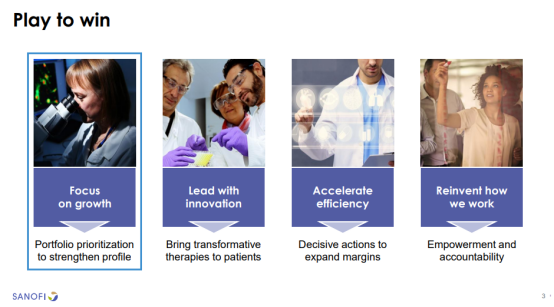
Sanofi's Play to Win Strategy
Cell Line Product Inquiry
Submission | Business Cooperation
Reprint | Join the Communication Group
Click "PharmResearch Network" below to follow more exciting content.