

Three Challengers vs. Novartis: Intensifying Competition in the Ophthalmic Anti-VEGF Drug Market
Harrow
Ophthalmic Drug Developer

Novartis
Drug Development and Manufacturing
Regeneron
Biopharmaceutical Manufacturer
At the beginning of this month, Regeneron filed a lawsuit against Novartis in the United States, alleging that Novartis obtained patents through fraudulent means and used these patents to prevent Regeneron from entering the prefilled syringe market.
Regeneron believes that as early as 2005, it signed a contract with Vetter, a company providing drug filling services, to develop a pre-filled syringe for its anti-VEGF product Aflibercept (EYLEA), which was co-developed with Bayer, and that it owns the relevant patents. Later, Vetter reached an agreement with Novartis to develop a pre-filled syringe for Ranibizumab (Lucentis), which infringed on that patent.
The lawsuit reflects the intense competition between two major anti-VEGF drugs, Aflibercept (Eylea) and Ranibizumab (Lucentis). These two drugs have been competing fiercely in the ophthalmology field for many years. The outcome of this patent lawsuit may influence the market trends of the two drugs.
In China, the anti-VEGF drug market has long been dominated by a tripartite rivalry between Novartis (ranibizumab), Bayer (aflibercept), and Kanghong (conbercept). However, with the entry of Roche and Qilu Pharmaceutical, the once stagnant field of retinal treatment is set to become a battleground involving five major players. The main highlight may come from a showdown between Roche, Kanghong, and Qilu against Novartis. The VEGF drug market is on the verge of an intense battle.
As competition in the ophthalmology field becomes increasingly fierce, Novartis has begun to divest its ophthalmology assets.
By the end of June 2023, Novartis announced an agreement with Bausch + Lomb to sell part of its ophthalmology assets for $2.5 billion, including $1.75 billion in upfront cash and additional milestone payments.
This transaction includes Xiidra, the first prescription drug approved for treating the signs and symptoms of dry eye disease, the investigational drug SAF312 (libvatrep) being developed for chronic ocular surface pain (COSP), the rights to use the AcuStream delivery device for dry eye indications, and OJL332, a second-generation TRPV1 antagonist currently in preclinical development.
Previously, Novartis also divested Alcon and transferred the exclusive commercialization rights of five ophthalmic products approved by the U.S. FDA in the United States to Harrow Health, an eye care pharmaceutical company.
From the annual report data, Novartis reported full-year revenue of $45.44 billion in 2023, a year-on-year increase of 10%; net profit was $8.572 billion, a year-on-year increase of 62%. Among this, Entresto, used for treating heart failure, generated sales revenue of $6.035 billion, a year-on-year increase of 31%. Meanwhile, the former star product Lucentis (ranibizumab) only achieved sales of $1.5 billion, a year-on-year decrease of 20%, and has been declining for three consecutive years after the patent expiration.
Previously, Novartis had hoped that the AAV gene therapy GT005 could take over, but due to unsuccessful development, this pipeline was announced to be discontinued in September of last year. Brolucizumab, the next-generation VEGF inhibitor for treating retinal vascular diseases which had been highly anticipated, despite previously receiving FDA approval for wet age-related macular degeneration and diabetic macular edema, has not received a positive market response.
Novartis had originally hoped that Brolucizumab could be used as a supplementary and upgraded treatment for Ranibizumab. However, after its launch, some patients experienced adverse reactions such as retinal vasculitis, with severe cases even leading to vision loss, sparking controversy. In 2023, the drug's global sales reached only $200 million, and its market share showed no improvement two years after its launch. Although the marketing application for Brolucizumab Injection in China has been accepted by the CDE, even if it is approved in the future, it will be difficult to replace Ranibizumab as a significant revenue contributor.
Previously, there were three VEGF drugs for ophthalmology available in China: ranibizumab, aflibercept, and conbercept. The patent protection periods for the first two have expired, while the patents for the latter will begin to expire from 2025. In response, Bayer hopes to enhance clinical efficacy by increasing the dosage; its 8mg high-dose formulation of aflibercept has been approved by the FDA. On the other hand, Kanghong Pharmaceuticals aims to address the issue through gene therapy. KH631, a next-generation ophthalmic gene therapy product developed by Kanghong Pharmaceuticals for the treatment of AMD, is expected to achieve the potential effect of "one treatment, lifelong cure."
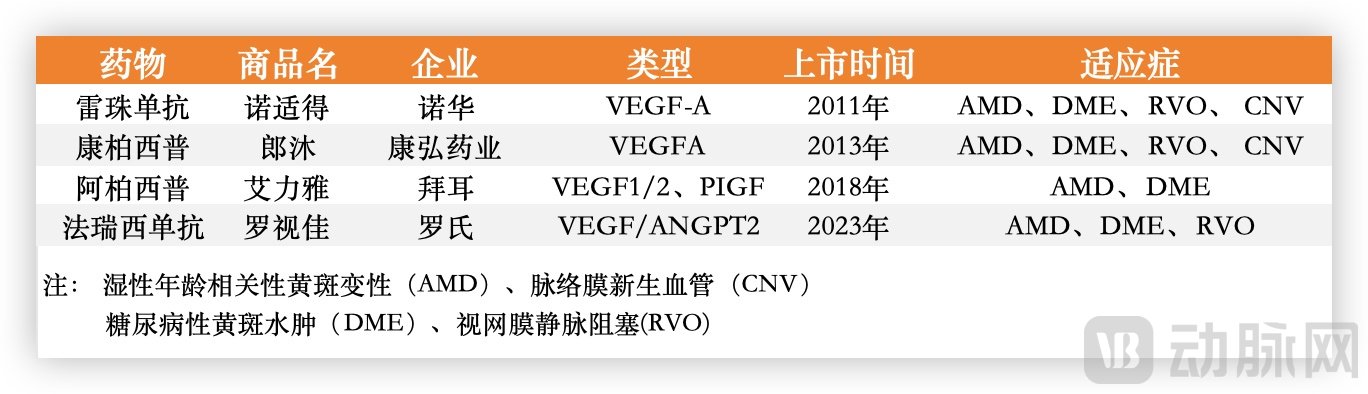
Data on the four approved anti-VEGF drugs in China sourced from public information
In contrast, Novartis has few cards to play. Although Lucentis has captured a significant market share due to its first-mover advantage, the growth rate of Eylea has surpassed it in recent years. Additionally, the approval of Roche's Vabysmo and Qilu Pharmaceutical's Eylea biosimilar further intensified competition. With slow progress in ophthalmology R&D, Novartis naturally became the target of encirclement by Roche, Qilu, and Kanghong.
Not only in the Chinese market, but another biosimilar drug Lucentis (ranibizumab) from Qilu has been successively approved for marketing in the EU and the UK, becoming the first overseas-successful ophthalmic biosimilar. This means that whether in China or overseas, Novartis is facing increasingly fierce competition in the ophthalmology field.
As 2023 came to an end, Roche's Faricimab received formal approval from the National Medical Products Administration for market launch, marking another significant product for Roche China.
The recently approved faricimab is the world's first bispecific antibody specifically designed for ocular use, being hailed as the first new therapy with a novel mechanism of action in the ophthalmology field in over a decade. Faricimab was approved in the United States in January 2022, also marking the first ophthalmic bispecific antibody drug approved by the FDA. Subsequently, it received approvals in multiple countries and regions including Japan, the United Kingdom, and Canada. Within just two years, more than 2 million injections have been administered cumulatively, with global sales exceeding $2.6 billion in 2023, representing a year-over-year increase of 324%.
The reason for the sharp increase in sales lies in its unique innovative mechanism. Faricimab, as a bispecific antibody, can target two pathways involved in causing various retinal diseases: vascular endothelial growth factor A (VEGF-A) and angiopoietin-2 (ANG-2). Faricimab effectively controls the formation of new blood vessels by blocking the VEGF-A signaling pathway, while also inhibiting ANG-2 signaling to improve vascular stability and reduce retinal inflammation.
In addition, improvements in the drug delivery mechanism have further enhanced the competitiveness of Faricimab. Previously, the dosing frequency of similar drugs was maintained at about once every 3 months, while the injection frequency of Faricimab has been reduced to once every 4 months, which not only improves patient compliance but also reduces usage costs.
In addition to the diabetic macular edema (DME) indication approved at the end of 2023, faricimab was also approved by the National Medical Products Administration (NMPA) in January 2024 for the treatment of neovascular age-related macular degeneration (AMD).
In the field of ophthalmology, Roche has adopted a strategy of focusing on key areas and deploying blockbuster products, primarily concentrating on indications such as Diabetic Macular Edema (DME), Age-Related Macular Degeneration (AMD), Geographic Atrophy (GA), Retinal Vein Occlusion, and Diabetic Retinopathy (RVO). In addition to Faricimab, Roche is also steadily advancing the development of more than 10 new molecular entities or indications in the ophthalmology field.
It can be seen that, amidst the declining sales of Roche's "old trio" — bevacizumab, trastuzumab, and rituximab — the company has swiftly introduced its "new triad" to take the lead in sales, thanks to its forward-looking strategic layout: Tecentriq for PD-L1 in solid tumors, Ocrevus for multiple sclerosis (MS), and faricimab.
Of course, Roche's sales strategy also plays an important role. Take the European market as an example: Roche set the price of faricimab in Germany at around 1,100 euros, approximately 40% lower than in the U.S., and in its second year on the market, global sales surpassed those of ranibizumab. In 2023, Roche’s sales revenue in China grew by 6%. If Roche continues to adopt such an aggressive sales strategy in the Chinese market, it will undoubtedly disrupt the existing landscape of the VEGF drug market.
The entry of such a competitor with a blockbuster product into China's ophthalmology market is a headache for any company.
In addition to Roche, a long-time rival, Novartis also faces competition from local pharmaceutical companies in the Chinese market.
On April 17, a refrigerated truck loaded with China's first exported ophthalmic biologic and Shandong's first exported biosimilar, Ranibizumab Injection, departed from Qilu Pharmaceutical Biomedical Industrial Park. This batch of Ranibizumab preparations will be transported to Europe via air-controlled temperature containers.
In January this year, the ranibizumab injection developed by Qilu Pharmaceutical received marketing approval from the European Medicines Agency (EMA), becoming the first successful overseas ophthalmic biosimilar. Just half a month later, Qilu Pharmaceutical received orders from EU countries. In February, the ranibizumab injection was also approved in the UK. Coupled with the approval of the aflibercept biosimilar in China, Qilu Pharmaceutical has begun to participate in the competition for VEGF drugs.
Developing a biosimilar of aflibercept is not particularly surprising, but if the company behind it is Qilu Pharmaceutical, the subsequent developments become quite intriguing.
Over the more than forty years since its establishment, Qilu Pharmaceutical has grown from an obscure small factory to the fifth largest pharmaceutical company in China's pharmaceutical industry, and further into a pharmaceutical enterprise that exports formulations to regulated markets in Europe, the United States, the United Kingdom, Japan, and Australia. What is commendable is not only its solid pharmaceutical manufacturing capabilities but also its strong sales ability.
At the end of 2019, Qilu Pharmaceutical successfully launched China's first biosimilar Bevacizumab. Prior to this, Roche's original Bevacizumab, Avastin, had been marketed in China for several years, with sales approaching 3 billion yuan. However, just two years after Qilu entered the market, according to data from Sino Health KESHI, in 2022, Qilu Pharmaceutical surpassed Roche's original product with a 54% market share. Qilu’s sales capability is evident.
According to data from VCBeat, the sales of Aflibercept immediately exceeded 100 million after being included in the medical insurance. The growth rates from 2020 to 2022 were 106.52%, 59.40%, and 18.69%, respectively. By 2023, Aflibercept had become one of the top three ophthalmic drugs in China, accounting for approximately 25% of the fundus medication market, with a growth rate higher than that of Ranibizumab and Conbercept.
With the approval of Qilu Pharmaceutical's ranibizumab biosimilar in Europe, its approval in China is also approaching. At that time, Qilu Pharmaceutical, with its strong sales capabilities and two powerful products, will once again stir up the domestic VEGF drug market.
Another major rival of Novartis is Kanghong Pharma, whose core product, Conbercept, not only filled the market gap for domestically produced drugs treating wet age-related macular degeneration when it was launched in China but also broke Novartis' monopolistic position in the domestic market. In 2017, after both Conbercept and Ranibizumab were included in the national medical insurance, Ranibizumab sales exceeded 1 billion yuan in 2018. However, in 2020 and 2021, Conbercept successfully outperformed in sales. Additionally, Bayer's Aflibercept entered the medical insurance system in 2019, and the competition among them will continue.
According to research data from the Chinese Journal of Ocular Fundus Diseases in 2023, the prevalence of AMD in people over 70 years old in China is 20.2%. With the intensification of China's aging population, the number of patients with age-related macular degeneration (AMD) continues to rise. Therefore, the future ophthalmic drug market has become a key focus for many pharmaceutical companies.
With three multinational pharmaceutical companies plus two domestic pharmaceutical companies, a fierce battle in China's VEGF field is imminent. If Kanghong Pharmaceutical was previously struggling alone as the only domestic player, the entry of Qilu Pharmaceutical will undoubtedly escalate market competition. A showdown among Kanghong, Qilu, and Roche against Novartis is about to unfold. How long can Novartis, relying solely on ranibizumab, hold its ground? Let’s wait and see.
Even if the current melee yields results in the short term, it doesn't mean the victor can rest easy, as more participants are waiting to take their turn.
The success of Roche's Faricimab serves as a beacon in the dark, guiding the development of anti-VEGF ophthalmic drugs towards bispecific and even trispecific antibodies, presenting a flourishing landscape. Chinese pharmaceutical companies are deeply involved in this field. In China’s VEGF monoclonal antibody R&D, companies such as Zaoke Ophthalmology, Mabwell, Taikang Bio, and Bio-Thera are already in Phase 3 clinical trials.
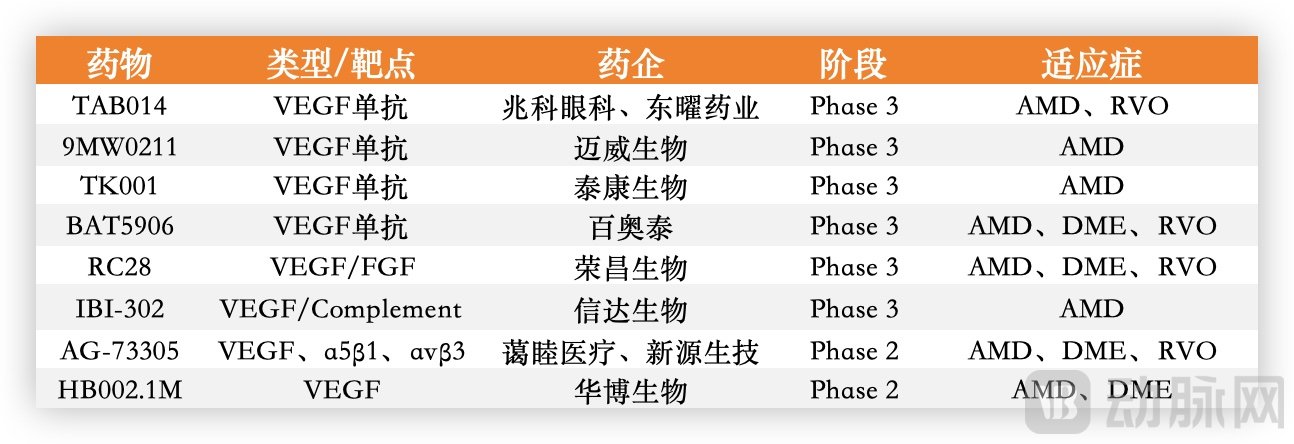
VEGF drugs with advanced R&D progress in China, data sourced from corporate official websites
Among them, Zhejiang Zorya Pharmaceutical's TAB014 is the first domestically produced antibody based on bevacizumab for the treatment of AMD to enter the clinical stage in China. Maiwei Biotech’s 9MW0211 is a recombinant anti-VEGF humanized monoclonal antibody developed using rabbit monoclonal antibody and humanization reengineering technology. Bio-Thera’s BAT5906 is currently undergoing clinical research for two indications in China, with its treatment for AMD now in Phase 3 clinical trials.
In the development of dual-target anti-VEGF drugs, IBI302 from Innovent Biologics and RC28 from RemeGen are at the forefront. IBI302 is the world's first bispecific fusion protein targeting both VEGF and complement. In 2023, Innovent Biologics initiated a Phase 3 clinical trial comparing IBI302 with Aflibercept for the treatment of AMD. In addition, Innovent Biologics has two other pipelines, IBI333 and IBI324, in Phase 1 clinical trials. Notably, Dechao Yu, the founder of Innovent Biologics, previously led the development of Conbercept at Kanghong Pharmaceuticals, making his continued focus on this field a natural progression after starting his independent venture.
RC28 is a first-in-class VEGF/FGF dual-target fusion protein drug developed by Rongchang Bio for the treatment of ophthalmic diseases. It can simultaneously block angiogenic factors in the VEGF and FGF families, thereby more effectively inhibiting abnormal blood vessel growth. Interestingly, one of the founders, Dr. Fang Jianmin, was also an early developer of Conbercept, and Rongchang Bio's RC28 and Innovent’s IBI302 are the only domestically produced bispecific molecules related to VEGF in ophthalmology that have entered Phase 3 clinical trials in China.
Of course, the pipeline in the field of ophthalmic VEGF targeting is not limited to this. Many frontier areas such as gene therapy and RNA also have numerous players, and some MNCs like Boehringer Ingelheim are also involved. The turmoil in the field of fundus treatment will not end anytime soon.