Johnson & Johnson Reports Strong Q1 2024: Revenue Exceeds $21 Billion, Carvykti Sales Surge by 118%

Johnson & Johnson
Medical Device R&D and Manufacturer
 On April 16, Johnson & Johnson announced its 2024 Q1 results, with revenue of $21.383 billion in the first quarter, a year-on-year increase of 2.3%;Innovative drug business Q1 revenue was $13.562 billion, a year-on-year increase of 1.1%, while the medical device division's Q1 revenue reached $7.821 billion, a year-on-year increase of 4.5%.
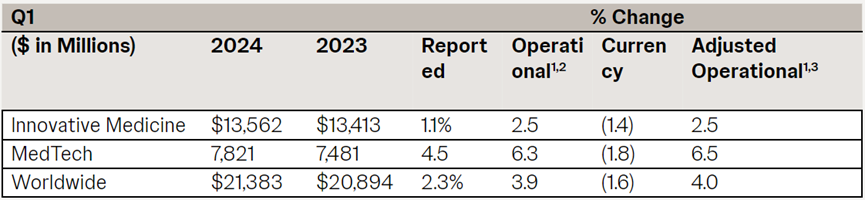
Excluding the impact of the COVID-19 vaccine, the global operational sales of Johnson & Johnson's innovative drugs grew by 8.3% in Q1 2024. The main drivers of growth were the oncology drugs Darzalex (daratumumab), Erleada (apalutamide), Carvykti (ciltacabtagene autoleucel), and Tecvayli (teclistamab-cqyv), pulmonary arterial hypertension treatments Uptravi (selexipag) and Opsumit (macitentan), immunology product Tremfya (guselkumab), and Spravato (esketamine) in the neuroscience field.
Autoimmunity and oncology are the two core segments of Johnson & Johnson's innovative pharmaceuticals, with revenues of $4.247 billion and $4.814 billion respectively in Q1 2024, accounting for the majority of the innovative pharmaceuticals sector (Figure 2).[1,2]。
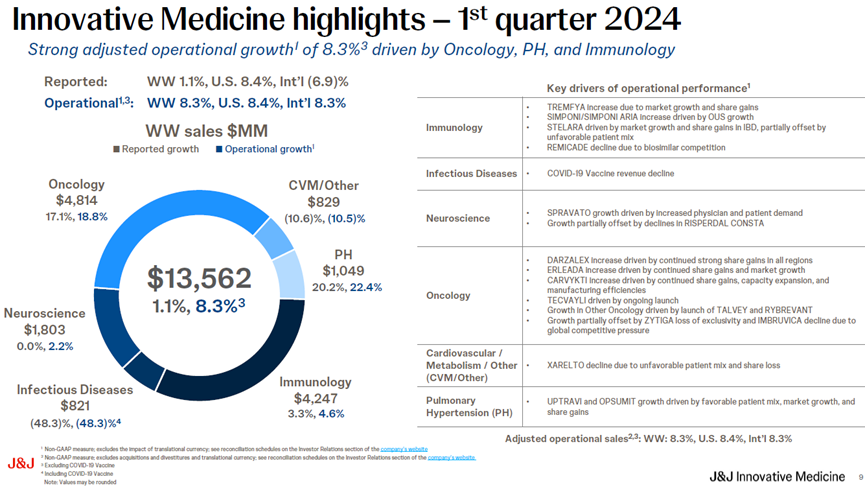
Figure 2. Johnson & Johnson Q1 Innovative Drug Revenue Distribution
Johnson & Johnson's main products in the immunology field include Stelara, Tremfya, Simponi/Simponi Aria, and Remicade, with first-quarter sales of $2.451 billion (+0.3%), $808 million (+26.3%), $554 million (+3%), and $434 million (-10.9%), respectively (Table 1).
Table 1. Johnson & Johnson's Main Autoimmune Drugs

Stelara is a drug targeting IL-12 and IL-23, which was approved for marketing in the United States in 2008 and in China in 2017. It has been approved for several indications, including moderate to severe plaque psoriasis (PsO), active psoriatic arthritis (PsA), moderate to severe Crohn's disease (CD), and moderately to severely active ulcerative colitis (UC) in adult patients.
However, the U.S. patent protection for Stelara expired in September 2023, and the development of biosimilars for Stelara is in full swing.
In August 2023, the Stelara biosimilar QX001S, co-developed by Quanxin Biotech and Huadong Medicine, had its BLA accepted by the NMPA for the treatment of psoriasis. QX001S is expected to become the first Stelara biosimilar approved in China.
In September 2023, Samsung Biologics of South Korea announced a commercialization agreement with Sandoz for the Stelara biosimilar candidate SB17 in Europe and North America, jointly advancing the commercialization of the Stelara biosimilar.
Due to the impact of patent expiration and competition, Stelara's sales growth has been sluggish, with a downward trend expected in the future. Fortunately, Tremfya has successfully taken over. Its sales reached $3.147 billion in 2023, marking an 18% year-over-year increase, becoming the main driver of Johnson & Johnson's immunology portfolio sales growth.
Tremfya is the first FDA-approved selective IL-23 inhibitor. It is a monoclonal antibody that selectively binds to the p19 subunit of interleukin-23 (IL-23) and inhibits its interaction with the IL-23 receptor.
To date, Tremfya has been approved in many countries and regions worldwide for the treatment of adult patients with moderate to severe plaque psoriasis (PsO) and active psoriatic arthritis (PsA), among others.
On March 11, 2024, Johnson & Johnson announced the submission of a supplemental Biologics License Application (sBLA) to the FDA for Tremfya for the treatment of adult patients with moderately to severely active ulcerative colitis (UC).
This application is based on the results of the Phase 3 QUASAR trial, which evaluated the efficacy and safety of Tremfya in patients with moderate to severe active ulcerative colitis (UC) who had an inadequate response or were intolerant to conventional therapies, prior biologics, and/or JAK inhibitors.
The experimental results showed that patients receiving Tremfya treatment experienced statistically and clinically significant improvements in endoscopic and histologic remission, with safety outcomes consistent with the known safety profile of Tremfya in its approved indications.[3]。
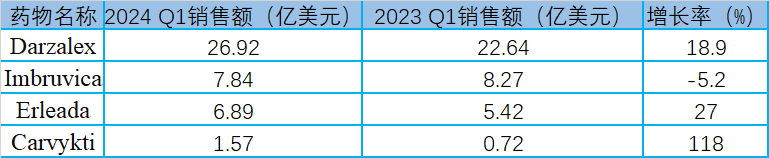
The oncology sector is another core pillar of Johnson & Johnson, with key products including Darzalex, Imbruvica, Erleada, and Carvykti. Their sales in the first quarter were $2.692 billion (+18.9%), $784 million (-5.2%), $689 million (+27%), and $157 million (+118%), respectively (Table 2).
Darzalex is the world's first approved humanized anti-CD38 monoclonal antibody, successively approved for marketing in the United States in November 2015 and in China in July 2019. It has now become a backbone therapy for the clinical treatment of multiple myeloma (MM), widely used in first-line, second-line, and multi-line treatments.
In 2023, the sales of Darzalex reached $9.744 billion. In the first quarter of this year, the sales reached $2.692 billion. The sales volume is expected to exceed $10 billion in the whole year, making it another $10-billion product for Johnson & Johnson.
In tumor products, Carvykti has shown explosive growth. Carvykti, originally developed by Legend Biotech, is a CAR-T therapy targeting BCMA. It modifies the patient's own T cells using transgenes encoding chimeric antigen receptors (CAR) to recognize and eliminate cells expressing BCMA.
Johnson & Johnson signed a global exclusive license and collaboration agreement with Legend Biotech for Carvykti in December 2017 to co-develop and commercialize Carvykti.
On February 28, 2022, Carvykti was approved by the FDA for the treatment of adult patients with relapsed or refractory multiple myeloma who have received four or more prior lines of therapy, including a proteasome inhibitor (PI), an immunomodulatory agent (IMiD), and an anti-CD38 monoclonal antibody, becoming the first cell therapy independently developed in China to be approved for marketing overseas.
On February 23, 2024, Johnson & Johnson announced that the Committee for Medicinal Products for Human Use (CHMP) of the European Medicines Agency (EMA) has recommended the approval of the Type II variation for Carvykti, intended for the earlier treatment of relapsed and refractory multiple myeloma (RRMM).[4]。
On April 15, 2024, Johnson & Johnson announced that the FDA had approved Carvykti for second-line and above treatment of adult patients with relapsed or refractory multiple myeloma who have previously received at least one therapy, including a proteasome inhibitor and an immunomodulatory agent, and are lenalidomide-refractory [5].
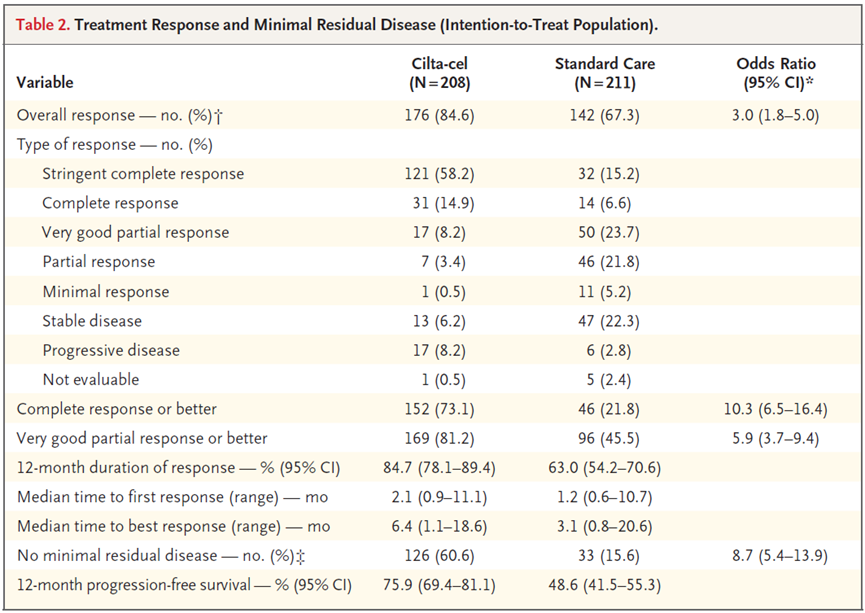
This approval is based on the positive results of the Phase 3 CARTITUDE-4 study, which showed that, compared with standard therapies (pomalidomide, bortezomib, and dexamethasone (PVd) or daratumumab, pomalidomide, and dexamethasone (DPd)), early use of Carvykti in adult patients with relapsed and lenalidomide-refractory multiple myeloma who had received one to three prior lines of therapy reduced the risk of disease progression or death by 59%.
The study results were presented at the 2023 American Society of Clinical Oncology (ASCO) Annual Meeting and published in The New England Journal of Medicine, also incorporating and reporting key secondary outcomes such as overall response rate (ORR) and overall survival (OS) (Figure 3).[6]。
Carvykti generated sales of $133 million in its first year on the market, surged 276% to $500 million in 2023, and saw a 118% year-over-year increase to $157 million in the first quarter of this year, with full-year sales expected to surpass the $1 billion mark.
Pulmonary Arterial Hypertension (PAH) is a rare, progressive, and life-threatening vascular disease characterized by pulmonary artery constriction and elevated blood pressure in the pulmonary circulation, ultimately leading to right heart failure. It is estimated that 500 to 1,000 new cases of PAH are diagnosed each year in the United States.
Common targeted therapeutic targets for PAH include prostacyclin and its analogs, endothelin receptor antagonists, phosphodiesterase-5 inhibitors, and guanylate cyclase activators, among others.
Johnson & Johnson has endothelin receptor antagonist Opsumit (macitentan) and prostacyclin IP receptor agonist Uptravi in the PAH field, with sales in Q1 2024 reaching $524 million and $468 million respectively, representing year-over-year growth of 19.1% and 29.2% (Table 3).

Opsumit, originally developed by Actelion Pharmaceuticals, was approved by the FDA on October 18, 2013, for the treatment of PAH as an oral medication. It was subsequently approved by the European Medicines Agency on December 20, 2013, becoming the first oral formulation approved for PAH. In 2017, Johnson & Johnson acquired Opsumit through the acquisition of Actelion.
Uptravi tablets were first approved by the U.S. FDA in 2015 for the treatment of PAH, to delay disease progression and reduce the risk of hospitalization due to PAH.
In July 2021, Uptravi intravenous injection (IV) was approved by the FDA for the treatment of adult patients with pulmonary arterial hypertension (PAH, WHO Group I) who are currently prescribed oral therapy but are temporarily unable to receive oral therapy and have WHO functional class II-III.
Although Opsumit is effective, it also faces the issue of patent expiration. Johnson & Johnson is actively seeking solutions, such as developing combination formulations of Opsumit.
On March 22, 2024, Johnson & Johnson announced that the FDA approved its Opsynvi single-tablet combination therapy (a combination of Opsumit and Tadalafil) for the long-term treatment of adult patients with pulmonary arterial hypertension (PAH) classified as World Health Organization (WHO) functional class (FC) II-III, becoming the first FDA-approved PAH single-tablet combination therapy.[7]。
The approval of Opsynvi enables Johnson & Johnson's PAH portfolio to cover all guideline-recommended PAH-targeted pathways.
Summary
Johnson & Johnson Maintains Positive Revenue Growth in Q1 2024; Autoimmune and Oncology Remain Pillars, Neurology and Pulmonary Hypertension Each Generate Over $1 Billion in Revenue as Key Segments.
Meanwhile, Johnson & Johnson has raised its full-year operational sales growth forecast to 5.5%-6% ($88.7 billion to $89.1 billion), up from the previous expectation of 5%-6% ($88.2 billion to $89.0 billion).