

AstraZeneca, AbbVie, and GSK Report Multiple Phase III Updates; Lilly’s GLP-1 Therapy Poised to Unlock Billion-Dollar OSA Market; Two Domestic mRNA Vaccines Enter Clinical Trials

GSK
Pharmaceutical R&D Manufacturer
AlphaNa
Developer and Manufacturer of mRNA Preventive Vaccines and Therapeutic Drugs

Welcome to follow Asymchem Pharma News
(Collection period: 4.15-4.19, the part in China includesFirst application for clinical,First Application for ListingInnovative drugs)
Summary of IND for Innovative Drugs in China
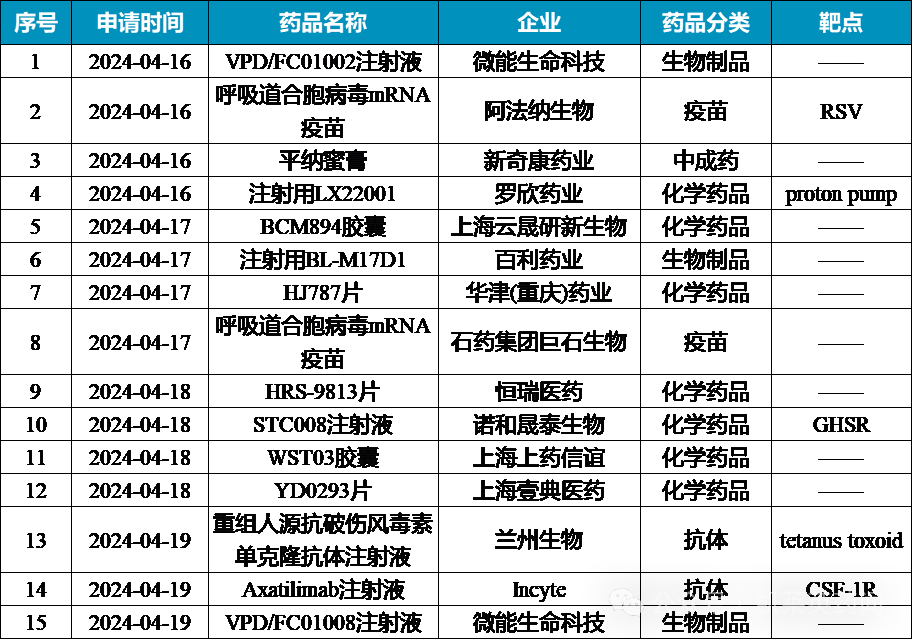
1. CSPC, Afana Bio: Respiratory Syncytial Virus mRNA Vaccine
Mechanism of Action: ——
Indications: RSV Infection
Recently, the clinical trial applications (IND) for the respiratory syncytial virus (RSV) mRNA vaccines developed by CSPC and Hefei Afana Biotechnology Co., Ltd. have been successively accepted by the CDE. Respiratory syncytial virus (RSV) is a highly common and contagious enveloped RNA virus that typically initiates infection in the upper respiratory tract, with symptoms easily confused with the common cold. Due to the lack of specific treatment drugs, although there are established methods to detect the RSV virus, healthcare institutions rarely conduct specific etiological diagnoses for infected patients under normal circumstances. If left untreated, RSV infections in the upper respiratory tract can progress to more severe lower respiratory tract infections, primarily manifesting as bronchiolitis or pneumonia, and may further develop into chronic respiratory and pulmonary diseases.
Previously, there were no drugs on the market that could cure RSV. The only treatment drug available for controlling symptoms, ribavirin, has disadvantages such as numerous side effects and restricted usage in certain populations. Meanwhile, palivizumab, a monoclonal antibody drug used for RSV prevention, has issues such as a narrow range of application. In May and June 2023, GSK's Arexvy and Pfizer's Abrysvo were successively approved, gradually opening up the market for RSV vaccines/drugs. Regarding mRNA vaccines developed for RSV, Moderna, the global leader in mRNA technology, has reached the primary endpoint in the phase III clinical trial of its RSV mRNA vaccine mRNA-2345, which has already been submitted for marketing approval and is expected to be launched this year. In China, companies at the forefront of RSV mRNA vaccine development include Starry Medicine and Shenzhen Faithful Biotechnology, both of which have been approved to conduct clinical trials. Additionally, Jiachen West Sea, Aim Vaccine, Stemirna Therapeutics, Aim Vaccine Weixing, Qichen Bio, Blue鹊/Watson, and Abogen Biosciences are also actively involved in this field.
2. Lanzhou Biotechnique Development Co., Ltd.: Recombinant Human Anti-Tetanus Toxin Monoclonal Antibody Injection
Mechanism of Action: ——
Indications: Tetanus
On April 19, the clinical trial application for Lanzhou Biotechnique Development Co., Ltd.'s recombinant human monoclonal antibody injection against tetanus toxin was accepted by the CDE. Currently, passive immunization agents used clinically for the prevention and treatment of tetanus mainly include Tetanus Antitoxin (TAT) and Human Tetanus Immunoglobulin (HTIG). TAT is a protein preparation made from horse plasma that has been immunized with tetanus toxoid, with a relatively high incidence of allergic reactions, and it requires a skin test before clinical use. HTIG is prepared from the plasma of donors immunized with the tetanus vaccine, offering high-titer specific immunoglobulin with a low incidence of allergic reactions but carries the risk of transmitting certain known or unknown blood-borne pathogens. Additionally, factors such as plasma shortages limit its production and clinical application. Lanzhou Biotechnique Development Co., Ltd.'s monoclonal antibody against tetanus toxin is expected to enable large-scale industrial production based on market demand, improving drug accessibility.
Summary of NDAs in China
1. Kexay Pharmaceutical: Injectable Triptorelin Acetate Microspheres (Class 2.2)
Mechanism of Action: Gonadotropin-Releasing Hormone Agonist
Indications: Central Precocious Puberty in Children
On April 18, the marketing application for Jin Sai Pharmaceutical's injectable Triptorelin Acetate Microspheres was accepted by the CDE. Triptorelin is an analog of Gonadotropin-Releasing Hormone (GnRH) used to treat patients who require the reduction of steroid hormones, such as androgens and estrogens, to low levels. This includes men with prostate cancer and women facing infertility; additionally, it can be used for conditions like endometriosis, uterine fibroids, and precocious puberty in women. The company’s microsphere product improves drug release properties, optimizes formulation and process, enhancing the safety of the medication, making fixed-dose administration possible for pediatric patients. Supported by evidence-based medicine, this more convenient method of administration brings more treatment options for children with Central Precocious Puberty (CPP).
2. Aobang Pharmaceutical: Propranolol Hydrochloride Drops (Class 2.2)
Mechanism of Action: Beta-Blockers
Indications: Hemangioma
On April 19, the marketing application for Aobang Pharmaceutical's Propranolol Hydrochloride Oral Solution was accepted by the CDE. Infantile hemangioma is a benign tumor caused by excessive growth of blood vessels and is often referred to as a "strawberry mark" due to its color and appearance being similar to typical birthmarks. Infantile hemangiomas are the most common vascular lesions in infants, affecting 4.5% of infants under one year old and are more frequently seen in premature infants. This product has been improved to address the usage deficiencies of existing products on the market, resolving clinical pain points for use in infants and young children. It better meets the clinical needs of the target user group and enhances patient medication safety and compliance.
Global Phase III Clinical Summary
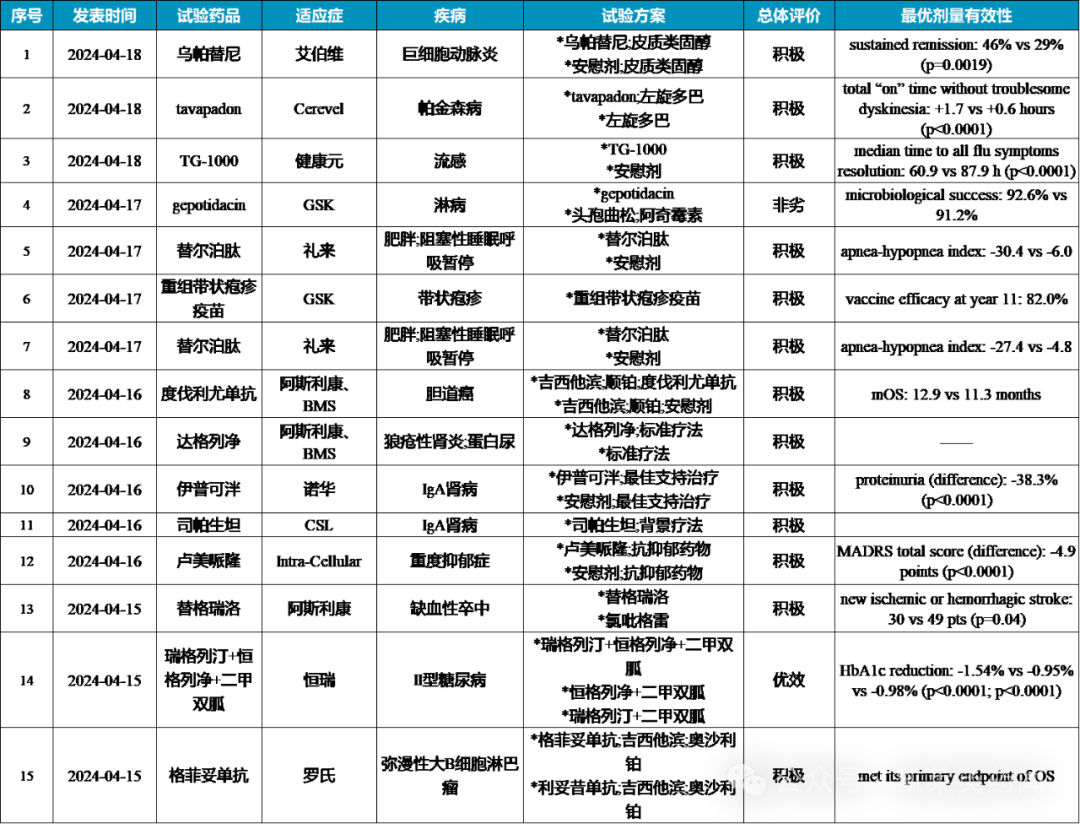
On April 19, Cerevel (acquired by AbbVie) announced positive topline results from the pivotal Phase 3 trial, TEMPO-3, for its small molecule investigational drug tavapadon. Tavapadon is a selective D1/D5 receptor partial agonist currently being developed as an adjunctive therapy to levodopa (LD); as a partial agonist with a half-life of 24 hours, tavapadon can be taken once daily, thereby avoiding dyskinesia caused by overactivation of dopamine receptors. The disclosed Phase 3 TEMPO-3 study is a 27-week, double-blind, randomized, placebo-controlled, parallel-group, flexible-dose trial designed to evaluate the efficacy, safety, and tolerability of tavapadon as an adjunctive therapy to LD in adult patients. The results showed that patients receiving tavapadon in addition to LD experienced an increase of 1.1 hours in "ON" time without troublesome dyskinesia compared to those treated with LD and placebo; additionally, a significant reduction in "OFF" time was observed in the tavapadon treatment group.
On April 19, AbbVie's Rinvoq (upadacitinib) achieved positive topline results in the Phase 3 clinical trial SELECT-GCA for the treatment of adult patients with giant cell arteritis (GCA). Upadacitinib is an oral Janus kinase subtype 1 (JAK1) selective inhibitor currently approved for autoimmune diseases such as atopic dermatitis, rheumatoid arthritis, psoriatic arthritis, and ulcerative colitis. GCA is an autoimmune disease that causes inflammation of the temporal arteries, cranial arteries, and aorta, commonly seen in elderly patients over 50 years old, especially those aged 70-80; women are at higher risk of developing GCA and may experience symptoms such as headaches, jaw pain, vision changes, or even loss of vision. In this Phase III clinical trial, after receiving once-daily 15mg upadacitinib combined with a 26-week tapering steroid regimen, 46% of patients achieved sustained remission compared to only 29% in the placebo group with the same steroid regimen (p=0.0019). Additionally, a higher proportion of patients in the upadacitinib group achieved complete sustained remission compared to the placebo group (37% vs. 16%; p<0.0001). The proportion of patients experiencing at least one disease flare within 52 weeks was lower in the upadacitinib group compared to the placebo group (34% vs. 56%; p=0.0014). Overall safety and tolerability were favorable.
On April 18, Joincare announced that the multi-center Phase III clinical trial of its innovative drug product TG-1000 capsules had reached the primary endpoint. TG-1000 is an innovative Class 1 anti-influenza new drug, a novel cap-dependent endonuclease inhibitor, suitable for patients aged 12 years and above with uncomplicated acute infections of influenza A and B. The Phase III clinical study of this drug is a multi-center, randomized, double-blind clinical trial, with the primary endpoint being the time to alleviate all flu symptoms within 15 days of treatment. Preliminary statistical analysis results indicate that the drug achieved the primary efficacy endpoint with statistical significance (P<0.0001) and no serious adverse reactions related to the drug occurred. The clinical trial demonstrated good performance and higher safety.
On April 17, Eli Lilly announced two positive topline results from the Phase 3 SURMOUNT-OSA clinical trial; compared with placebo, Tizepatide injection (10mg or 15mg) significantly reduced the Apnea-Hypopnea Index (AHI) in obese patients with moderate to severe obstructive sleep apnea (OSA), achieving the primary endpoint of the study. Based on these positive results, Eli Lilly plans to submit relevant regulatory applications. According to calculations by Precision Business Insights, the global OSA drug market size reached $9.2 billion in 2021, with a compound annual growth rate expected to reach 4% from 2022 to 2028. Tizepatide is expected to disrupt the sleep apnea market.


"Under Observation"Click once