Rapid Development of a Double-Hit mRNA Antibody Cocktail Against Orthopoxviruses

Abogen
Nucleic Acid Drug Developer
 Recently, the Academy of Military Medical SciencesQin Chengfeng/Deng YongqiangThe team inSignal Transduction and Targeted Therapy Publish the cover article "Rapid development of double-hit mRNA antibody cocktail against orthopoxviruses”。
The genus Orthopoxvirus contains many viruses that can cause severe pox diseases in humans and animals, including Monkeypox virus (MPXV), Cowpox virus (CPXV), and the most notoriousVariola Virus(VARV). Although smallpox was officially eradicated worldwide in 1980 following a historic global vaccination campaign, orthopoxvirus infections remain a significant public health threat. To this day, the multi-country mpox outbreak continues. As a DNA virus, MPXV theoretically does not mutate as frequently as RNA viruses. However, adaptive mutations have recently been discovered in the genome of the ongoing mpox epidemic. Therefore, against the backdrop of the global mpox outbreak, the possibility of MPXV undergoing further adaptive mutations and causing larger-scale outbreaks cannot be ruled out. There is an urgent need to develop effective therapeutic strategies to combat orthopoxviruses.
A variety of treatment methods have been developed so far, including antiviral inhibitors, human vacciniaImmunoglobulin(VIG) and poxvirus-specific monoclonal antibodies. Increasing evidence highlights the importance of poxvirus antibodies in viral control and recovery from primary and secondary infections. The development of therapeutic monoclonal antibodies represents a promising strategy for the prevention or treatment of orthopoxvirus infections. Currently, monoclonal antibodies targeting the four original proteins—VACV A33, VACV B5, MPXV M1, and VACV A27—have demonstrated broad cross-neutralizing activity against several orthopoxviruses (including VACV, CPXV, MPXV, and VARV) in research.
On March 27, 2024, the research team of Deng Yongqiang and Qin Chengfeng from the Academy of Military Sciences, in collaboration with Abogen, published in a Nature sub-journal.Signal Transduction and Targeted TherapyPublished an article titled "Rapid development of double-hit mRNA antibody cocktail against orthopoxviruses"Research Paper. This study reports for the first time an mRNA antibody therapy with in vivo protective effects against orthopoxviruses, using an mRNA platform encapsulated in lipid nanoparticles (LNP) to construct a set of encodings targeting orthopoxviruses broadly.Neutralizing AntibodymRNA. A single intravenous injection of each mRNA antibody can rapidly produce effective neutralizing antibodies in mice. More importantly, the double-hit mRNA antibody combination targeting EEV-type and IMV-type viruses (CocktailMix2a demonstrated superior protective efficacy against lethal VACV challenge in mice.
The research team first selected four antibodies, mAb22, mAb283, mAb26, and mAb301, which have been verified to exhibit broad cross-neutralizing activity, targeting VACV-A33, VACV-B5, MPXV-M1, and VACV-A27 proteins, respectively. The encoding sequences of the heavy chain (HC) and light chain (LC) of each candidate monoclonal antibody were then optimized and individually inserted into the plasmid ABOP-028. The resulting mRNA preparations included a 5' cap, 5'UTR, signal peptide, codon-optimized coding sequence of the candidate mAb, 3'UTR, and poly(A) tail.
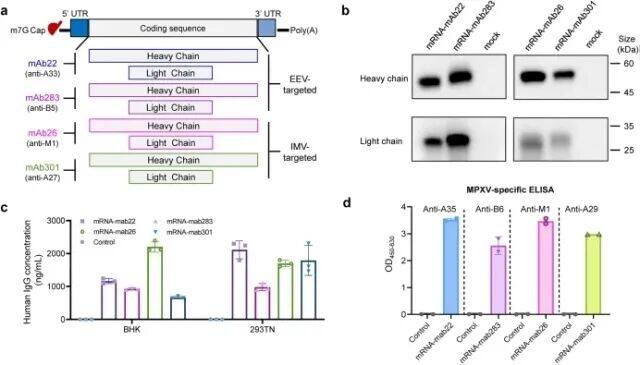
The mRNAs encoding four antibodies were combined and encapsulated into LNP formulations, named mRNA-mab22-LNP, mRNA-mab283-LNP, mRNA-mab26-LNP, and mRNA-mab301-LNP. Dynamic light scattering analysis showed uniform particle sizes ranging from 73.12 to 75.39 nm, with a polydispersity index (PDI) below 0.1. The concentration of human IgG in mouse serum was evaluated using ELISA, with serum human IgG concentrations ranging from 269 to 2598 ng/mL.
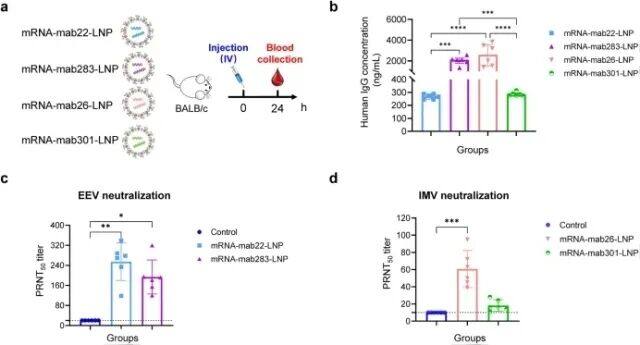
To further determine the efficacy of these mRNA antibodies, plaque reduction neutralization tests (PRNT) were conducted using VACV EEV and IMV in BS-C-1 cells. High levels of antibodies were measured in the serum of mice injected with mRNA-mab22-LNP and mRNA-mab283-LNP.EEVNeutralizing antibodies, with mRNA-mab26-LNP and mRNA-mab301-LNP injections helping to neutralize the IMV form of VACV. The neutralization titer of the EEV candidate was much higher than that of the IMV candidate, leading to the speculation that the EEV candidate is crucial for superior protective efficacy.
Since the lung tissue is the primary infected organ in mice infected with VACV, the infectious viral particles in the lungs of infected mice were further measured using a standard plaque assay in BS-C-1 cells. Treatment with mRNA-mab22-LNP completely controlled VACV replication in the lungs, with no detectable infectious viral particles. Additionally, pathological pulmonary lesions were studied using H&E staining and immunohistochemical (IHC) analysis. The results showed that VACV infection caused mild to significant diffuse degeneration and necrosis of the epithelial lining (black arrows) in control group mice, accompanied by hemorrhage, edema (red arrows), and fibrin exudation into surrounding alveoli (blue arrows), while treatment with mRNA-encoded antibodies (except for mRNA-mab283-LNP) significantly prevented VACV-induced lung injury. Furthermore, IHC analysis using an anti-VACV D8 monoclonal antibody revealed D8L protein-positive cells in the lungs of control group mice, whereas no virus protein-positive cells were detected in the lung tissues of the mRNA antibody-treated groups.
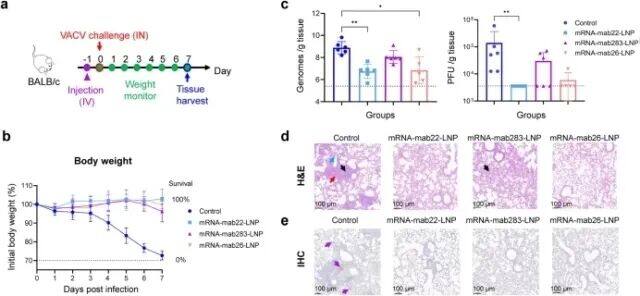
Figure 3. Study on the protective efficacy against VACV infection
To determine the optimal dual-hit mRNA antibody mixture for neutralizing IMV-type and EEV-type viruses, two candidate drugs were prepared, referred to as Mix2a (mRNA-mab22-LNP plus mRNA-mab26-LNP) and Mix2b (mRNA-mab283-LNP and mRNA-mab26-LNP), respectively.
Experiments showed that Mix2a and Mix2b contributed to the functional neutralization of EEV and IMV forms of VACV. The level of functional antibodies produced by Mix2a was higher than that of Mix2b. Both could protect mice from weight loss after infection with a lethal dose of VACV, completely blocking VACV-induced pathological lung lesions. No virus protein-positive cells were detected through IHC analysis.
These results suggest that optimal protection against orthopoxvirus infection requires the cooperation of EEV and IMV targeting neutralizing antibodies, and highlight Mix2a as the most effective dual-hit mRNA antibody combination candidate in current research.
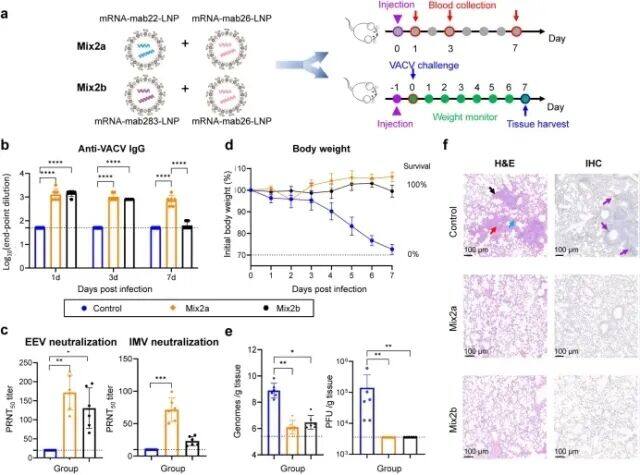
Figure 4. Dual-Target mRNA Antibody Combination Enhances Protective Efficiency
Overall, a single injection of the mRNA antibody mixture Mix2a prevented mice from orthopoxvirus infection. The combination of human antibodies using customized mRNA represents a promising antiviral strategy that can respond rapidly to combat current and future human poxvirus outbreaks.
It should be noted that, in the formulation approach of this study, it is necessary to encapsulate the two mRNAs encoding the light chain and heavy chain into the LNP formulation. The correct pairing of homologous light and heavy chains is crucial for antibody function, making multi-component mRNA antibodies more complex than multi-component mRNA vaccines. Additionally, research has found that the simultaneous administration of different mRNAs expressing antibodies may lead to low production efficiency of functional antibodies. The levels of functional antibodies in the Mix2a and Mix2b groups were slightly lower than those obtained from administering a single antibody, indicating some degree of antibody interference. Therefore, further research is needed to determine the interactions between different mRNA antibodies and the specific mechanisms affecting their functionality.
Source: Chinese Center for Disease Control and Prevention