IL-15 Immunotherapy 'Rising Star' Anktiva (N-803) Files Prospectus Following FDA Approval and Clinical Breakthrough

ImmunityBio
Developer of Immunotherapy Products

IL-15, once considered one of the most promising targets in the field of cancer immunotherapy.
As a stimulatory cytokine, it has shown significant effects in preclinical studies on inhibiting tumor growth and anti-metastatic properties.
Because of this, IL-15 has attracted significant attention in cancer immunotherapy research. As early as 2008, the U.S. National Cancer Institute listed it as one of the most promising candidate drugs.
However, the road to new drug development is not smooth. Due to the relatively short half-life of IL-15, it is difficult to achieve a balance between efficacy and safety. It was not until 2024 that a true breakthrough finally emerged.
On April 22, ImmunityBio announced that the FDA had approved Anktiva (N-803) in combination with BCG for the treatment of patients with BCG-unresponsive non-muscle invasive bladder cancer with carcinoma in situ.
The approval and market launch of N-803 marks it as a pioneer in the IL-15 agonist field, and will also encourage more pharmaceutical companies to accelerate progress in this赛道.
Overall, efficacy, safety, and half-life are the three key factors in the development and optimization of IL-15 agonists. Striking a balance among these three is crucial for the success of the drug.
In other words, the development path of IL-15 agonists is far from over. With more pharmaceutical companies stepping up their efforts, the golden age of IL-15 agonist development is slowly unfolding.
/ 01 /
Immune System "Agonist"
As a pleiotropic cytokine, IL-15 plays a critical role in the development and maintenance of the immune system, promoting the survival and proliferation of NK cells and CD8+ T cells through various mechanisms.
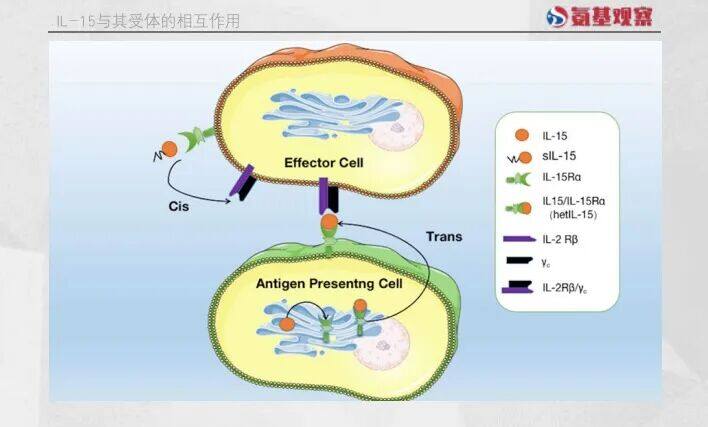
First, IL-15 can stimulate the expression of the anti-apoptotic protein Bcl-2, helping to prevent cell death and thereby increasing the survival rate of NK cells and CD8+ T cells.
Secondly, IL-15 can promote the expression of Ki67, a protein closely related to cell proliferation, driving the rapid division and increase in the number of NK cells and CD8+ T cells.
NK cells and CD8+ T cells are important cytotoxic cells in the immune system, capable of recognizing and killing tumor cells. Therefore, their increased numbers and enhanced activity directly strengthen the immune system's ability to attack tumors.
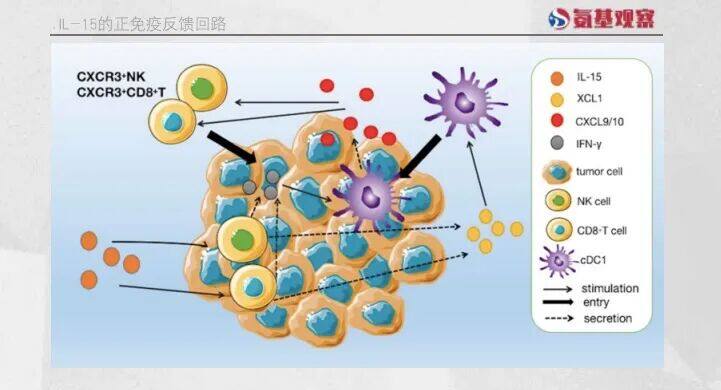
The role of IL-15 is not limited to this. Studies have found that IL-15-activated tumor-infiltrating NK cells and CD8+ T cells upregulate the secretion of a chemokine named XCL1.
XCL1 can recruit conventional type 1 dendritic cells (cDC1) to tumor tissues. cDC1 has a strong ability to cross-present antigens, effectively activating naïve CD8+ T cells in tumor-draining lymph nodes, prompting them to enter the tumor lesion for synergistic tumor cell killing, further enhancing the anti-tumor effect.
In addition, IFN-γ secreted by activated NK cells and CD8+ T cells can stimulate cDC1 to secrete CXCL9 and CXCL10. These factors attract peripheral CXCR3+ NK cells and CD8+ T cells to the tumor tissue, forming a positive immune feedback loop that maintains immune surveillance against tumors.
Meanwhile, IL-15 plays a crucial role in the tumor microenvironment by maintaining the homeostatic survival and proliferation activation of memory T cells, as well as sustaining the activity of cytotoxic T lymphocytes (CTLs). The formation of memory T cells enhances the immune system's ability to rapidly respond to tumor recurrence.
In addition, current research has shown that IL-15 can enhance antibody-dependent cell-mediated cytotoxicity of NK cells and increase the efficacy of immunotherapy.
In summary, IL-15, as a promising immunotherapeutic agent, not only directly enhances the combat capability of immune cells and improves their ability to penetrate the tumor microenvironment, but also can be combined with drug molecules or engineered into multifunctional molecules to produce synergistic effects and enhance therapeutic efficacy.
Therefore, IL-15 agonists have received widespread attention in the medical community as potential cancer immunotherapy agents. Data shows that nearly 200 clinical trials using different IL-15 drugs for cancer treatment have been initiated globally.
/ 02 /
From Ideal to Reality
The process of translating theory into practice is often fraught with challenges and uncertainties.
Initially, the medical community primarily developed the first generation of IL-15 agonists—recombinant human interleukin-15 (rhIL-15)—through recombinant technology.
rhIL-15 is a non-glycosylated IL-15 monomer of approximately 13 kDa produced in E. coli. The results of the first-in-human Phase I clinical trial of rhIL-15 published in 2015 showed that the anti-tumor effect of rhIL-15 was not ideal in patients with metastatic malignant melanoma or metastatic renal cell carcinoma.
First, from the perspective of efficacy, the performance of rhIL-15 was not ideal. Continuous 12-day administration via intravenous bolus (IVB) increased the number of NK cells and CD8+ T cells in peripheral blood to a certain extent, but no objective responses were observed among the 18 patients, with stable disease being the best outcome.
Secondly, rhIL-15 has strong toxic side effects. In this clinical trial, dose-dependent toxicity reactions were observed, including fever and chills, thrombocytopenia, and hypotension.
Although the toxic side effects of rhIL-15 were later mitigated through subcutaneous injection, the issue of efficacy remains difficult to resolve.
The core issue lies in the short half-life of rhIL-15, which leads to its rapid clearance in the body. Frequent and high-dose administration may cause toxicity problems, while reducing the dose to ensure safety makes it difficult to achieve significant effects.
To overcome the shortcomings of rhIL-15, researchers have adopted two main optimization strategies: one is to mutate or modify IL-15 itself, which is a common modification strategy for protein drugs; the other is to develop the IL-15/IL-15Rα complex. Both strategies aim to enhance the activity and stability of the drug molecule.
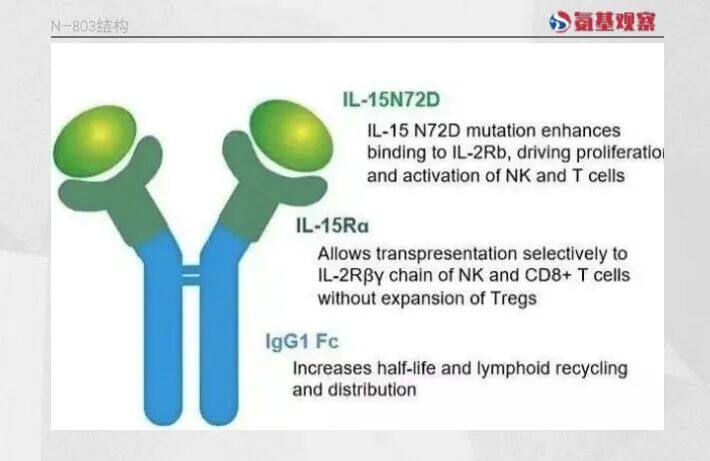
N-803 is the leading candidate drug that has achieved a breakthrough at this stage. As an IL-15 superagonist complex, N-803 is composed of an IL-15 mutant (IL-15N72D), the IL-15Rα sushi domain, and an IgG1 Fc fusion protein. The design of the IL-15Rα sushi domain enables N-803 to activate downstream signaling pathways without relying on the trans-presentation mechanism required by natural IL-15, while the IgG1 Fc fragment significantly extends the drug's half-life. Pharmacokinetic analysis shows that the half-life of N-803 is approximately 7.2-8 hours.
In clinical studies combining N-803 with Bacillus Calmette-Guérin (BCG), N-803 has demonstrated significant potential. In the combination therapy for 160 patients with BCG-unresponsive non-muscle invasive bladder cancer (NMIBC), both patients with or without papillary tumors (CIS cohort) showed a 71% complete response rate, with a median duration of 24 months. In the non-CIS cohort, the disease-free rate was 57% at 1 year and 48% at 2 years.
Overall, the majority of patients (91% in the CIS cohort and 95% in the non-CIS cohort) were able to temporarily avoid cystectomy, and the safety of the combination therapy was favorable with no reported serious treatment-related adverse effects.
Precisely because of these positive clinical outcomes, the FDA approved the indication for N-803 in combination with BCG for the treatment of BCG-unresponsive NMIBC. N-803 has thus become a pioneer in the field of IL-15 agonists.
/ 03 /
Entering the Golden Age
After more than a decade, the IL-15 agonist has finally broken the ice. However, the market launch of N-803 is not the end of exploration in the IL-15 agonist field; instead, it marks the beginning of a golden age of development in this area.
It can be seen that quite a few pharmaceutical companies have modified IL-15 agonists based on the aforementioned concepts, and their methods vary to some extent.
For example, NKTR-255, designed by Nektar, is a novel recombinant human IL-15 (rhIL-15) polyethylene glycol (PEG) conjugate that retains the ability to bind to all receptors and maintains the full biological properties of IL-15. Compared with rhIL-15, NKTR-255 exhibits superior pharmacokinetic characteristics, with a half-life of 15.2 hours.
In this field, there have also been some innovative designs, and several new targeted/multifunctional IL-15 agonists are currently under development.
For example, pro-IL-15 is the first IL-15 agonist molecule to adopt a prodrug design strategy. This drug is based on the IL-15-IL-15RαSu-Fc structure, connecting the extracellular domain of IL-15Rβ via an N-terminal MMP-14-cleavable peptide linker to form pro-IL-15. Pro-IL-15 blocks the binding site of IL-15, rendering it inactive in peripheral circulation.
The purpose of this concept is that, in the tumor microenvironment rich in matrix metalloproteinases (MMPs), the peptide linker is enzymatically cleaved, leading to the shedding of IL-15Rβ and thereby restoring the molecule's activity.
HCW Biologics has developed the bifunctional molecule HCW9218. This is a heterodimeric fusion protein containing soluble TGF-βRII and IL-15/IL-15RαSu, which can neutralize TGF-β (inhibiting tumor progression and alleviating immunosuppression) while directly activating immune cells.
In this IL-15 research and development race, Chinese pharmaceutical companies have also joined the competition, including Hengrui Medicine, Boji Biotech, and Aosaikang, all of which are involved and have established relevant pipelines.
So, which company will ultimately stand out?
Text / Zheng Xiao
PS: Welcome to scan the QR code below to add the WeChat ID of AminoJun for communication.