

WeLi Tech Files IPO Prospectus: Pioneering Indigenous Chips for Non-Invasive Brain-Computer Interface Ecosystem

WAVELETECH
Leading Provider of Bioelectric Technology
In March, the first volunteer of Neuralink, with only a "chip" in their brain, defeated normal human players in a racing game. This news ignited social media, and while everyone was amazed by the progress of invasive brain-computer interfaces, "the father of brain-computer interfaces," Miguel Nicolelis, expressed concerns in a public interview."I think brain-computer interfaces are very useful, but from a commercialization perspective, it’s not necessarily required to implant them into the brain."
Before Neuralink's first human clinical trial was approved by the FDA, it had been officially rejected at least twice and had invested hundreds of millions of dollars over more than four years. However, corresponding to the long upgrade path of invasive brain-computer interfaces is the fact that there are still many real needs for brain-computer interfaces that remain unmet, and these needs "do not necessarily require implantation into the brain," just as people with fully functional nervous systems generally do not consider implanted or invasive devices.
Against this backdrop, in order to promote the development and practical application of non-invasive brain-computer interface industries with higher safety and wider applicability, and help them enter the daily lives of the general public, Suzhou Weili Innovation Technology Co., Ltd. (hereinafter referred to as: WAVELETECH) was officially established in 2019.
Talking about the original intention of starting a business,WAVELETECH CEO Wang Wan"In the interview, he mentioned, 'I pursued my master's degree at the Institute of Microelectronics of Tsinghua University, where my main research focus was on bioelectrical signal acquisition chips and algorithms, such as EEG and ECG. After graduating with my master’s degree in 2015, I worked successively at top scientific research institutions in China and a leading Chinese chip manufacturing company.'"
From research institutions to leading listed companies, it was during this period of working alongside the rise of China's chip industry that Wang Wan not only deepened his understanding and application of chip and algorithm technologies but also became more determined to apply his knowledge after witnessing massive industries such as healthcare and technology being hindered by a tiny chip. He aimed to help Chinese enterprises, which were constrained by chip shortages and international politics, build their own chip supply chains and resolve bottlenecks and challenges in the development of the chip industry.
"At the outbreak of the pandemic in 2020, various industries in China faced a severe challenge of chip supply disruptions, with delivery cycles extending up to a year after placing orders. Besides the supply chain difficulties, many domestic brain-computer interface manufacturers were still in the exploratory stage at that time, and many emerging ideas and demands could not be realized through imported general-purpose chips," said Wang Wan.
Thus, WAVELETECH was officially established in 2019 and successfully secured financing.For many years, the entire team of the company has been committed to serving relevant industry customers by leveraging its extensive experience in the research and development of bioelectric chips and algorithms, such as those for ECG and EEG.
WAVELETECH Co-founder and Algorithm Director, Li MenghuiHolds a Ph.D. in Biomedical Engineering from Peking University, with extensive experience in bioelectrical data processing, neural networks, and deep learning. The company's software and cloud platform leader, as well as the production and supply chain leader, have both held management positions in related fields at large enterprises, possessing strong capabilities in professional transformation and implementation.
With the efforts of the team, WAVELETECH has gradually grown into a professional provider of non-invasive brain-computer interface chips, algorithms, and solutions with “chip” as its core. It is one of the few companies in China capable of researching, developing, and mass-producing medical-grade ECG and EEG chips. Moreover, the company's technical products have passed the verification of national medical device standards and medical device manufacturers, helping several domestic manufacturers solve the "bottleneck" problem of local substitution for medical chips and maintaining the stability of the supply chain.
When talking about the imported chips widely adopted in the current market, Wang Wan made an analogy, "General imported chips are like commercial housing. Corporate customers can only decorate according to a standardized fixed layout, which largely limits the imaginative potential of products. However, the goal of WAVELETECH's self-developed chips is to collaborate with customers to build more suitable 'houses,' achieve better product experiences, and ultimately bring value to end consumers."
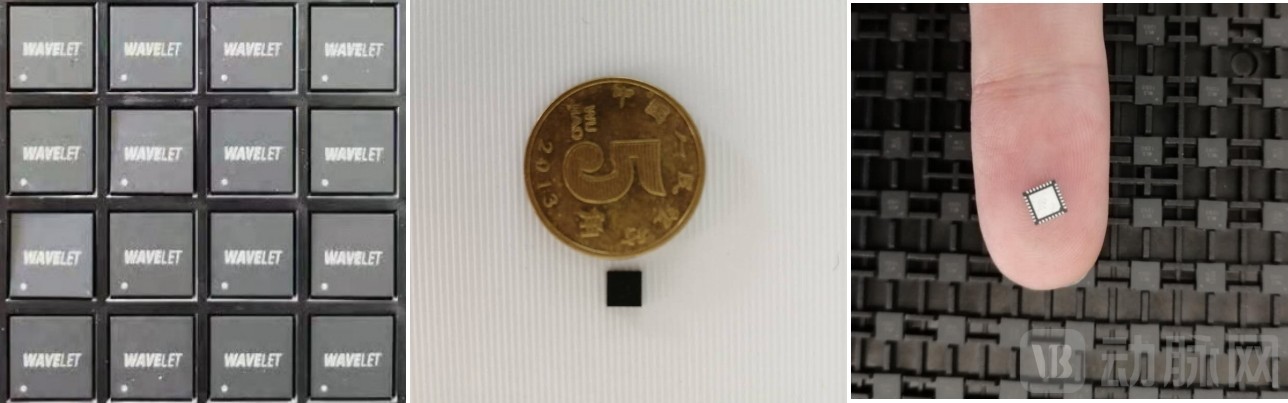
WL Series Bioelectric Chip
WAVELETECH's chips have the advantages of high signal-to-noise ratio and high integration.Among them, the signal-to-noise ratio of the chip has reached a leading level in the industry. Moreover, for DC interference in sensors, electronic devices, or signals, the chip can withstand a maximum DC offset of 300mV, enabling the extraction of stable and high-quality EEG and ECG signals across various application scenarios.
Secondly, the acquisition chip must ensure high throughput and low power consumption during the acquisition process, and reducing module power consumption often means high noise. This poses higher requirements for the performance and design of the chip.
WAVELETECH possesses ultra-low power digital chip design technology. In its latest chip development, the power consumption of bioelectric AI algorithms at the same scale has been reduced from several mA to a thousandth of nA, breaking through the bottleneck of power consumption and performance, and will unlock value in some future applications.
"For downstream manufacturers, data acquisition is often just the starting point. More importantly, it's about how to process the high-quality EEG and ECG information collected and unleash the value of the data through algorithms," said Wang Wan. "This can be quite complex for many manufacturers, often meaning they need to hire multiple technical personnel in relevant fields and invest substantial R&D expenses."
"WAVELETECH aims to provide manufacturers with a complete non-invasive brain-computer interface solution, from chips to data processing and algorithms, enabling more manufacturers in China to implement non-invasive brain-computer interface applications faster and at a lower cost. This will accelerate the commercialization of China's non-invasive brain-computer interface industry, allowing more users to benefit from the industry's prosperity."
Wang Wan continued, "By adopting our technical solution, customers can save a significant amount of development costs and R&D time compared to using imported chips, directly enabling the implementation of brain-computer applications."
WAVELETECH provides a set of "Galvani Bioelectric Algorithm Platform." With various processing, noise reduction, and analysis recognition algorithms in the fields of ECG, EEG, and EMG based on different application scenarios and needs, it can offer downstream manufacturers with different demands plug-and-play algorithm cores and various APIs, effectively reducing product development cycles and costs.
Specifically, for brain-computer interfaces, the Galvani bioelectric algorithm platform provides hand motion recognition algorithms, electrooculogram interference identification algorithms, EEG data denoising preprocessing algorithms, mental fatigue analysis and prediction, and brain activity heatmaps. For ECG devices, the platform offers ECG data denoising preprocessing algorithms, ECG disease classification algorithms, and cardiovascular disease risk prediction algorithms.
In addition, the WAVELETECH team also has a knowledge database of the electrical and processing characteristics of various electrode materials, which can assist downstream manufacturers in selecting the most suitable electrode material for specific application scenarios.
According to the introduction, WAVELETECH's non-invasive brain-computer interface solution mainly serves three major application scenarios: monitoring and prediction, rehabilitation and limb enhancement, entertainment and interaction enhancement.
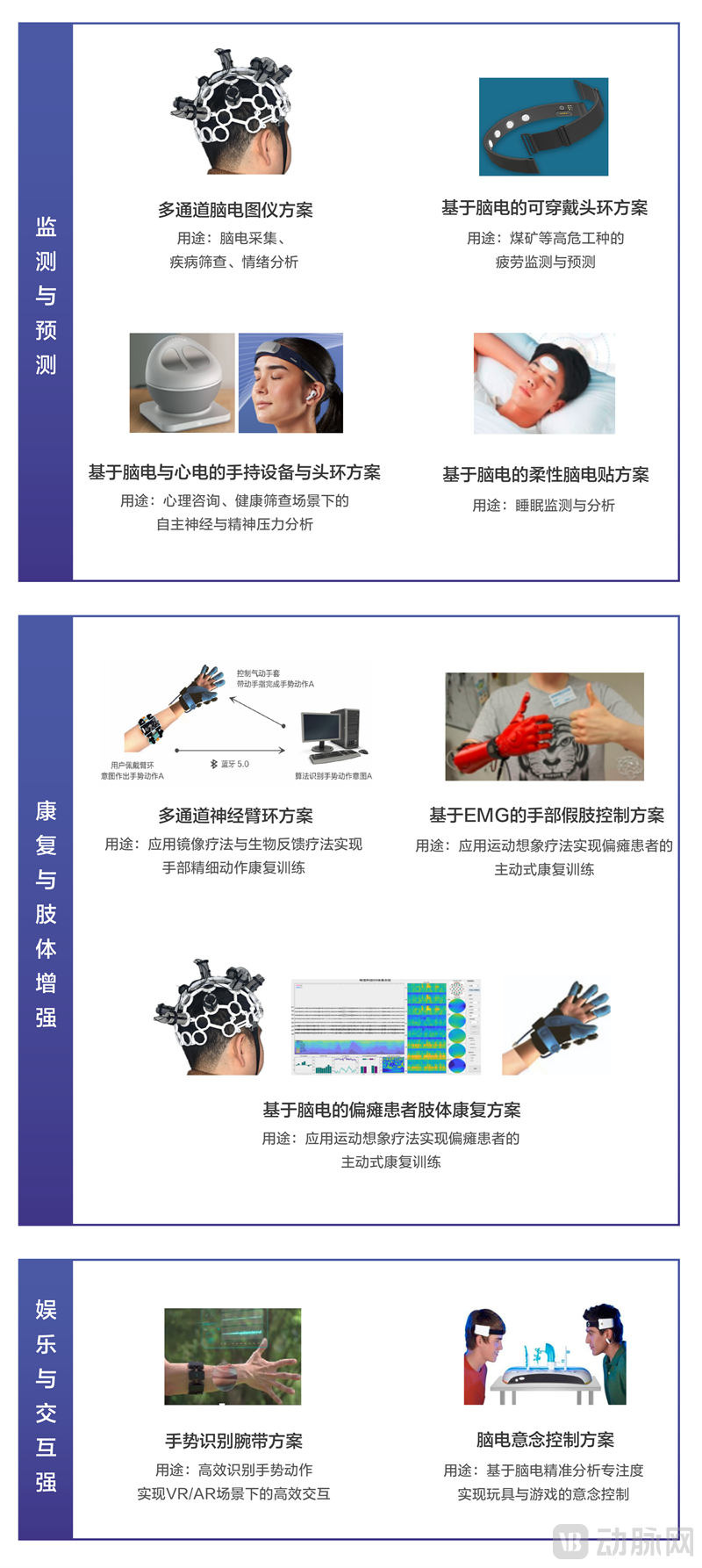
Non-Invasive Brain-Computer Interface Solutions
For example, handheld devices and headband solutions based on EEG and ECG can be used forPsychological Counseling, Health ScreeningAutonomic Nervous System and Mental Stress Analysis in Scenarios; EMG-based Hand Prosthesis Control Solutions Can Utilize Motor Imagery Therapy to Achieve Active Rehabilitation Training for Hemiplegic Patients; Gesture Recognition Wristband Solutions Enable Efficient Gesture Recognition for High-efficiency Interaction in VR/AR Scenarios.
WAVELETECH's ECG solutions are divided into two major application scenarios: medical and consumer. For example, the 12-lead ECG solution and the handheld single-lead ECG solution have already entered hospital systems through partners; there are also ECG modules that can be widely used in consumer electronic devices, adding cardiac monitoring and risk assessment functions to the products.
"EEG and ECG carry a wealth of information related to human consciousness, health, and more. Studying them can help us gain a deeper understanding of the essence and patterns of life activities, providing new ideas and methods for disease diagnosis and treatment. WAVELETECH hopes to serve downstream manufacturers to address usage needs in more clinical and consumer scenarios, benefiting more users," said Wang Wan.
As a leading provider of non-invasive brain-computer interface technology, the value offered by WAVELETECH goes beyond just technology delivery. Wang Wan then discussed the issue of "data silos."
WAVELETECH provides downstream manufacturers with standardized EEG and ECG complete solutions while maintaining a database of considerable scale. In collaboration with partners, the company continuously iterates its algorithms. The Galvani Brain-Computer Cloud Algorithm Database can also share desensitized data with downstream partners. By co-building an industry development ecosystem, the full potential and value of the data can be thoroughly explored and unleashed.
In addition, the company has also extensively collaborated with prestigious universities such as Tsinghua University and several large tertiary hospitals to upgrade and enrich its technical reserves in ECG, EEG data analysis, and disease diagnosis.
At the end of the interview, Wang Wan mentioned, "Since its establishment, WAVELETECH's ECG dataset has accumulated ECG data from hundreds of thousands of people, totaling hundreds of thousands of hours. The data has gradually entered the value-release phase. For instance, the company can now use ECG to identify populations with coronary artery stenosis, which previously required imaging techniques for detection. Currently, this project is collaborating with a high-end Chinese listed bathroom company to develop an intelligent toilet capable of real-time ECG monitoring and disease prediction. In the future, we hope to accelerate the implementation of technology in more application scenarios such as ECG and EEG, collaborate with benchmark customers to refine our products, and build an open ecosystem platform that is replicable and scalable."