

Former BMS CEO Giovanni Caforio Nominated as Next Novartis Board Chair Amid Strong Q1 Growth and Speculation Over Expanded M&A Strategy

Novartis
Drug Development and Manufacturing
Bristol-Myers Squibb
Biopharmaceutical and Nutritional Product R&D and Sales
Any adjustment or change in the management of multinational pharmaceutical companies (MNCs) attracts the attention of the global pharmaceutical industry.
Recently, Novartis nominated Giovanni Caforio, the former head of competitor Bristol-Myers Squibb (BMS), as its next Chairman of the Board. This news was released alongside Novartis' Q1 financial report, sparking market speculation about Novartis' future M&A strategy.
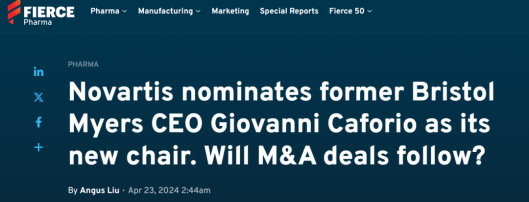
In related reports, Novartis praised Giovanni Caforio for transforming BMS into "a global pharmaceutical company with strong capabilities in both R&D and commercialization."
In fact, during his tenure as CEO of Bristol-Myers Squibb (BMS), Giovanni Caforio became well-known for his bold decision-making in major acquisitions: leading BMS to bet $74 billion on the acquisition of Celgene, $13.1 billion on MyoKardia, and $2 billion on Cardioxyl… At the end of 2023, he actively led BMS in launching a series of large-scale acquisitions.
In the industry's view, it is uncommon for a CEO to join a competing pharmaceutical company as chairman of the board after retirement. If Giovanni Caforio successfully assumes his new role, will Novartis' M&A strategy in the new era change?
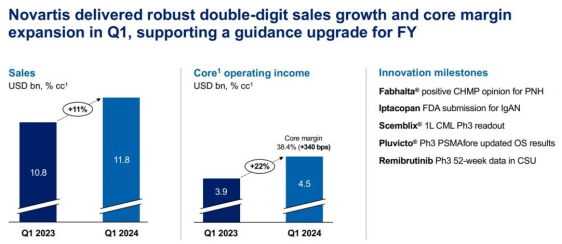
According to Novartis' Q1 2024 financial report, net sales for the quarter reached $11.8 billion, marking an 11% year-over-year increase. Core operating income amounted to $4.5 billion, surpassing Wall Street analysts' expectations of $4.3 billion and reflecting a 22% year-over-year growth. These figures demonstrate Novartis' strong momentum in financial performance.
Moreover, Novartis has raised its full-year outlook for 2024, indicating that the company holds a positive and optimistic attitude towards its future business prospects. This may be based on expectations regarding the company’s product portfolio and market performance in the innovative drug sector.
The main contributors to revenue growth include Entresto (Sacubitril/Valsartan) with a 36% increase in sales, Kesimpta (Ofatumumab) with a 66% increase, Cosentyx (Secukinumab) with a 25% increase, the CDK4/6 inhibitor Kisqali (Ribociclib) with a 54% increase, the radioligand therapy Pluvicto with a 47% increase, and the long-acting siRNA lipid-lowering drug Leqvio (Inclisiran) with an impressive 139% growth.
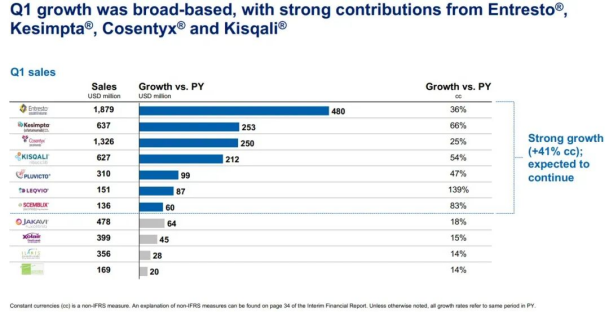
Notably, Pluvicto achieved sales of $310 million in the first quarter, with this significant growth primarily driven by the continuous improvement in its production and supply situation. As a radiopharmaceutical treatment, Pluvicto is currently one of the highest-grossing drugs and accomplished this feat in only its second year on the market. In 2023, Pluvicto's revenue surged by 260% to reach $980 million. This brings Pluvicto just one step away from becoming a "blockbuster" drug with $1 billion in annual sales. This achievement highlights the strong market demand and recognition for Pluvicto in the field of radiopharmaceutical treatments and demonstrates Novartis' leadership in this area.
Moreover, Novartis's better-than-expected performance in the first quarter was also attributed to the continued strong performance of two major blockbusters.
The growth momentum of Entresto (Sacubitril/Valsartan), a heart failure treatment, and Cosentyx (Secukinumab), a psoriasis treatment, has been remarkable, with both experiencing growth rates exceeding 20%. In the first quarter of 2024, Entresto continued to benefit from recommendations in clinical treatment guidelines for heart failure, and demand-driven growth in the U.S. and Europe propelled Entresto’s sales to surpass $1.8 billion, marking a significant year-over-year increase of 34%.
Cosentyx sales growth benefited from the approval and launch of its new formulation in the second half of 2023.
Novartis announced on October 6, 2023, that the intravenous formulation of Cosentyx, an anti-inflammatory drug, has received approval from the U.S. FDA and has been successfully launched. The drug is approved for treating adult patients with psoriatic arthritis (PsA), ankylosing spondylitis (AS), and non-radiographic axial spondyloarthritis (nr-axSpA). Cosentyx is the only IL-17A monoclonal antibody intravenous formulation to gain approval and represents the second intravenous treatment option for PsA, AS, and nr-axSpA beyond tumor necrosis factor-alpha (TNF-α) inhibitors.
In the first full quarter after the launch of Cosentyx intravenous injection, the drug's sales in the United States, emerging growth markets, and Europe exceeded $1.3 billion. Notably, the revenue from China reached $1 billion, marking a 25% year-on-year increase. This growth is mainly attributed to the performance of Cosentyx and Entresto.
Novartis also plans to build facilities in China for the production of radioligand therapies (RLT) Pluvicto (lutetium Lu 177 vipivotide tetraxetan) and Luthathera (lutetium Lu 177 dotatate). Before the cardiovascular drug Leqvio (inclisiran) enters the medical insurance system in 2025, it is expected to continue gaining momentum in the self-pay market.
Industry insiders pointed out that despite strong financial performance, attention should still be paid to market competition and the potential impact of generic drugs. The generic version of Novartis' best-selling drug Entresto is expected to enter the Chinese market next year, which may affect its sales.
While releasing the financial report, Novartis revealed potential new personnel appointments, directly indicating a strategic adjustment in the mergers and acquisitions field.
Giovanni Caforio, the candidate for the next Chairman of the Board, will succeed Joerg Reinhardt, who will step down upon the completion of his term in 2025. Novartis shareholders will vote on Giovanni Caforio's board nomination at the next Annual General Meeting in 2025.
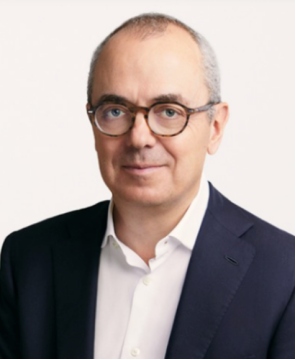
Giovanni Caforio has just retired after working at Bristol-Myers Squibb (BMS) for 20 years, during which he was promoted to CEO of BMS in 2015. Over the span of eight years, BMS evolved from a pharmaceutical company focused on oncology and cardiovascular diseases into a company with a diverse pipeline, expanding into fields such as immunology, neuroscience, and nephrology.All of this is inseparable from Giovanni Caforio's decision-making. Under his leadership, BMS has seen many high-profile acquisition cases.
On January 3, 2019, BMS acquired Celgene for $74 billion, marking the largest M&A deal in pharmaceutical history, bringing in JCAR017 and bb2121, which have blockbuster potential in the fields of oncology, immunology, and inflammation.
On June 2, 2022, Bristol-Myers Squibb acquired Turning Point Therapeutics for $4.1 billion, adding the fourth-generation ALK inhibitor, ropretinib, to its product pipeline.
In 2023, BMS acquired Mirati, a star company in the KRAS field, for $4.8 billion, fully filling the gap in BMS's late-stage KRAS project pipeline, and bringing Sitravatinib, Krazati, and Lumakras into its portfolio.
This series of operations significantly boosted BMS's performance, with revenue soaring from $16.385 billion in 2015 to $46.159 billion in 2022, and net profit reaching $11.4 billion, while its market value surged to $104.851 billion.
In contrast, Novartis’ largest deals over the past two decades include the $39 billion acquisition of Alcon, which was later spun off into a standalone eye care business, and the $9.7 billion acquisition of The Medicines Company, marking one of the biggest drug acquisitions in recent years.
Current CEO Vas Narasimhan has repeatedly stated that Novartis' M&A strategy leans towards complementary deals sized at or below $5 billion, aiming to strengthen its four core therapeutic areas.
Giovanni Caforio's appointment as Chairman of the Board of Novartis has indeed attracted widespread attention and discussion in the industry. Industry insiders believe that Giovanni Caforio’s joining will bring unique leadership and industry experience to Novartis. As the former CEO of Bristol-Myers Squibb, his involvement may inject new vitality and innovative thinking into Novartis, helping the company navigate a highly competitive market environment.
Another perspective suggests that Giovanni Caforio, in his role as Chairman of the Novartis Board, may leverage the industry knowledge and strategic insights he accumulated during his time at BMS to pose a competitive challenge to BMS. Both BMS and Novartis are key players in the fields of oncology and cardiovascular diseases, with both companies committed to developing and launching innovative drugs for cancer treatment. Due to the complexity and diversity of the pharmaceutical industry, BMS and Novartis may also compete in other forms across different segments and product lines.
The competition in the pharmaceuticals industry is intense and complex, and senior personnel changes could have significant impacts on the industry landscape. Nonetheless, this appointment demonstrates Novartis' high regard for Giovanni Caforio's experience and leadership capabilities. With the addition of a mergers and acquisitions strategist, will Novartis become a global "big buyer"? The Pharmaceutical Economy News will continue to monitor the situation.





www.yyjjb.com.cn
Insight into Industry Trends

"Pharmaceutical Economy Newspaper"
Academic Official Account
Focus on the Frontier of Oncology Academia

Terminal Official Account