Sanofi Launches Phase 3 Trial in China for Amlitelimab, a Potential First-in-Class OX40L Inhibitor Administered Once Every 12 Weeks, for Moderate-to-Severe Atopic Dermatitis

Sanofi
Pharmaceutical R&D Developer
▎WuXi AppTec Content Team Report
Today (April 25), the official website of the Chinese Drug Clinical Trial Registration and Information Disclosure Platform has newly announced,SanofiPhilippines(Sanofi)An international multi-center (including China) Phase 3 clinical study of amlitelimab injection has been initiated to evaluate the product's efficacy in treatment.Moderate to Severe Atopic Dermatitis in Patients Aged 18 Years and AboveThe efficacy and safety of patients.According to the public information from Sanofi,Amlitelimab is a potential "first-in-class" OX40 signaling pathway blocker,Has PotentialOnly requires dosing once every 12 weeks., which can significantly reduce the treatment burden on patients.

 Screenshot source:China Drug Clinical Trial Registration and Information Disclosure Official Website
Atopic dermatitis is a chronic, recurrent, and inflammatory skin disease. Patients often have other atopic diseases such as allergic dermatitis and asthma, accompanied by severe itching, which seriously affects the quality of life.Moderate to severe atopic dermatitis usually requires systemic treatment, with main therapeutic drugs including non-specific anti-inflammatory drugs such as corticosteroids, but these drugs carry the risk of rebound after short-term treatment.
OX40 is a co-stimulatory receptor primarily present on activated T cells, which interacts withOX40-Ligand (OX40L,A Key Immune Regulator)The interaction provides crucial signals for T-cell activation, proliferation, and survival; thus, this signaling pathwayPlays an important role in the pathogenesis of a series of inflammatory and immune diseases.。The immunomodulatory effect of OX40L enhances immune activity by regulating the proliferation and survival of effector T cells, while also suppressing the activity and proliferation of regulatory T cells.
Amlitelimab is a fully humanized, non-depleting monoclonal antibody administered by subcutaneous injection.It can interact withOX40LCombination,Aiming to restore immune homeostasis between pro-inflammatory and regulatory T cells. In addition,The ProductWhile suppressing T cell-dependent inflammation, it does not lead to the depletion of immune cells, potentially avoiding the side effects of immunosuppression.
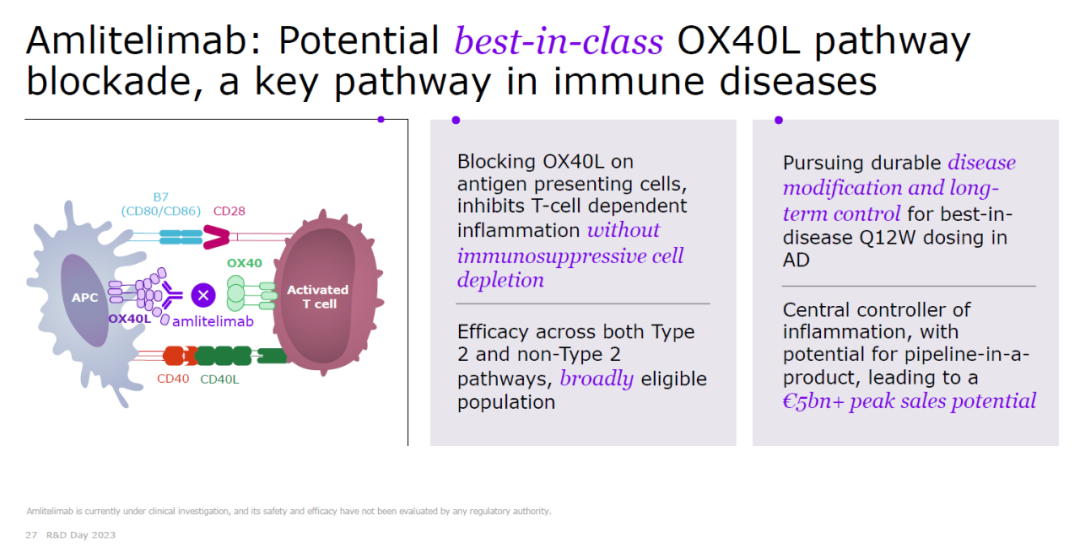
▲Introduction to Amlitelimab (Image Source: Reference [2]))
Sanofi's launch in China this time isA randomized, double-blind, placebo-controlled, parallel-group, 3-arm, multi-national and multi-center Phase 3 study to evaluate subjects aged 18 years and above with moderate to severe atopic dermatitisSubcutaneousEfficacy and Safety of Amlitelimab Monotherapy.In the study, the dosage and administration of amlitelimab injection were as follows:After completing the assessment and enrollment at V2/Week 0/Day 1, a double dose of amlitelimab is administered, followed by a single dose of amlitelimab starting from V4 (Week 4).Every 4 weeks (Q4W)OrOnce every 12 weeks(Q12W)Administration.

Previously,Amlitelimab targetsAdult patients with moderate to severe atopic dermatitisOnePhase 2b Trial (STREAM-AD)Has already reached the primary endpoint. Patients treated with amlitelimabThe average score of the Eczema Area and Severity Index (EASI) at week 16 improved by up to 61.5% from baseline, with continued improvement over 24 weeks.。
In March this year, Sanofi announced the positive results of the second part of the STREAM-AD study, which aimed to exploreContinue or StopAmlitelimab TreatmentDuring the additional 28 weeksClinical responses in patients. The results showed that, in patients who continued to receive amlitelimab 250mg Q4W + 500mg loading dose (LD),69.2% of patients (58.8% in the treatment discontinuation group) maintained IGA 0/1 and/or EASI-75 responses.。
Moreover, in patients who discontinued and continued amlitelimab, atopic dermatitis-related biomarkers remained reduced at week 52. Observed at week 24.Serum Thymus Activation Regulated Chemokine (TARC), eosinophils, and IL-22 remained unchanged during the discontinuation period and in patients who continued treatment up to week 52. These data suggest that,Even after discontinuation of amlitelimab, it can still modulate inflammatory T cells by blocking OX40L, achieving durable disease control.According to the press release from Sanofi, the pharmacokinetic data from this study also supported the researchers in adopting the Phase 3 clinical trial.Quarterly AdministrationThe plan.
[1] China Drug Clinical Trial Registration and Information Disclosure Platform. Retrieved Apr 25, 2024, from http://www.chinadrugtrials.org.cn/clinicaltrials.searchlistdetail.dhtml
[2] Sanofi R&D day. Retrieved Dec 7, 2023, from https://www.sanofi.com/assets/dotcom/content-app/events/investor-presentation/2023/r-and-d-day-2023/Presentation.pdf
[3]Press Release: New Phase 2b results for amlitelimab support potential for best-in-class maintenance of response in atopic dermatitis. Retrieved Mar 11, 2023, from https://www.sanofi.com/en/media-room/press-releases/2024/2024-03-11-06-00-00-2843456
This article is from the content team of WuXi AppTec. Individuals are welcome to share it on their social media feeds, but unauthorized reproduction by media or institutions in any form to other platforms is prohibited. For authorization to reproduce, please leave a message on the "MedView" WeChat Official Account to contact us. For other collaboration inquiries, please contact wuxi_media@wuxiapptec.com.
Disclaimer: The content team of WuXi AppTec focuses on introducing the research progress in global biopharmaceuticals and health. This article is for information exchange only, and the views expressed in the article do not represent the position of WuXi AppTec, nor does it mean that WuXi AppTec supports or opposes the views in the article. This article is not a recommendation for treatment plans. If you need guidance on treatment options, please visit a regular hospital.