Merck Reports Q1 2024 Revenue of $15.8 Billion, Driven by Keytruda's $6.9 Billion Sales

MSD
Pharmaceutical R&D and Manufacturer
On April 25, MSD disclosed its Q1 2024 financial report, with revenue reaching $15.8 billion. Leveraging the strengths of its oncology and vaccine products, Q1 2024 sales increased by 9% year-over-year, surpassing Wall Street expectations.
At the same time, MSD raised its full-year 2024 revenue guidance to $63.1 billion - $64.3 billion, representing a 5-7% increase from the previously forecasted $62.7 billion - $64.2 billion.
K Drug and HPV Vaccine Hold Up Half the Sky
According to the financial report, MSD's pharmaceutical sales in the first quarter reached $14 billion, with its leading star product PD-1 inhibitor Keytruda (K drug) remaining the largest revenue source. In 2024, Keytruda continued its growth trend, generating $6.9 billion in revenue, a year-on-year increase of 20%. This accounts for nearly half of the total pharmaceutical revenue and exceeded analyst expectations of $6.71 billion.
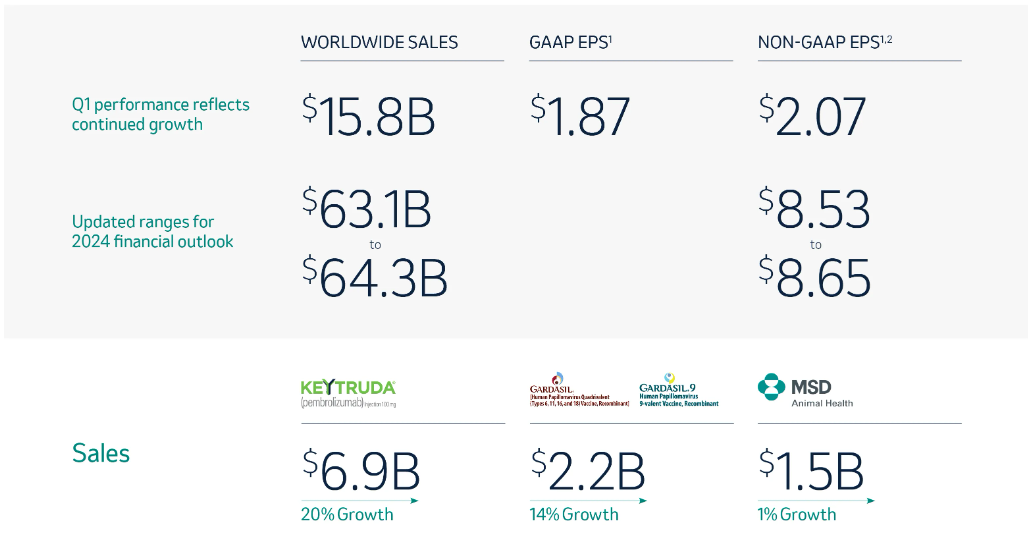
Image Source: MSD Official Website
In recent years, Keytruda has consistently played a pivotal role in supporting MSD's performance. MSD has also been relentlessly working to further establish Keytruda as a blockbuster drug.
Keytruda Has Maintained Strong Momentum Over the Past Decade. In 2018, Just Four Years After Its Launch, Keytruda’s Sales Reached $7.2 Billion, Ranking 5th Among the World’s Best-Selling Drugs.
During the COVID-19 pandemic, Keytruda maintained strong growth momentum, gradually narrowing the gap with the "former blockbuster drug" Humira. In 2023, it successfully claimed the top spot as the "best-selling drug" with an impressive $25 billion in sales. Recommended reading: "Top 10 Best-Selling Drugs Worldwide in 2023."
In the first quarter of 2024, Keytruda continued to receive good news. In January, it was approved by the FDA for a new indication, which is in combination with chemoradiotherapy (CRT) for the treatment of patients with stage III-IVA cervical cancer. According to the announcement on MSD's official website, based on Keytruda's established role in advanced cervical cancer, regardless of PD-L1 expression levels, Keytruda + chemoradiotherapy is currently the first anti-PD-1-based therapy approved in the United States for the treatment of FIGO 2014 stage III-IVA cervical cancer patients.
This approval marks the 39th indication for Keytruda in the United States, and it is also the third FDA approval for Keytruda in the cervical cancer field.
Keytruda, besides flourishing across the United States, is also continuously expanding its reach in China.
On February 4, MSD announced that Keytruda has been approved by the National Medical Products Administration (NMPA) of China for first-line treatment in combination with gemcitabine and cisplatin for patients with locally advanced or metastatic biliary tract cancer (BTC). According to statistics, this is already the 13th indication for Keytruda approved in China.
Keytruda is not only the PD-1 monoclonal antibody with the most approved indications covering cancer types, but also the immune checkpoint inhibitor with the most comprehensive layout for lung cancer indications.
By 2026, Keytruda's annual sales are expected to exceed $30 billion. However, with the earliest arrival of biosimilars in 2028, Keytruda will face a patent cliff.
Another blockbuster product from MSD, the HPV nine-valent vaccine Gardasil/Gardasil9, also performed remarkably well, achieving sales of $2.25 billion, representing a 14% increase compared to the same period in 2023.
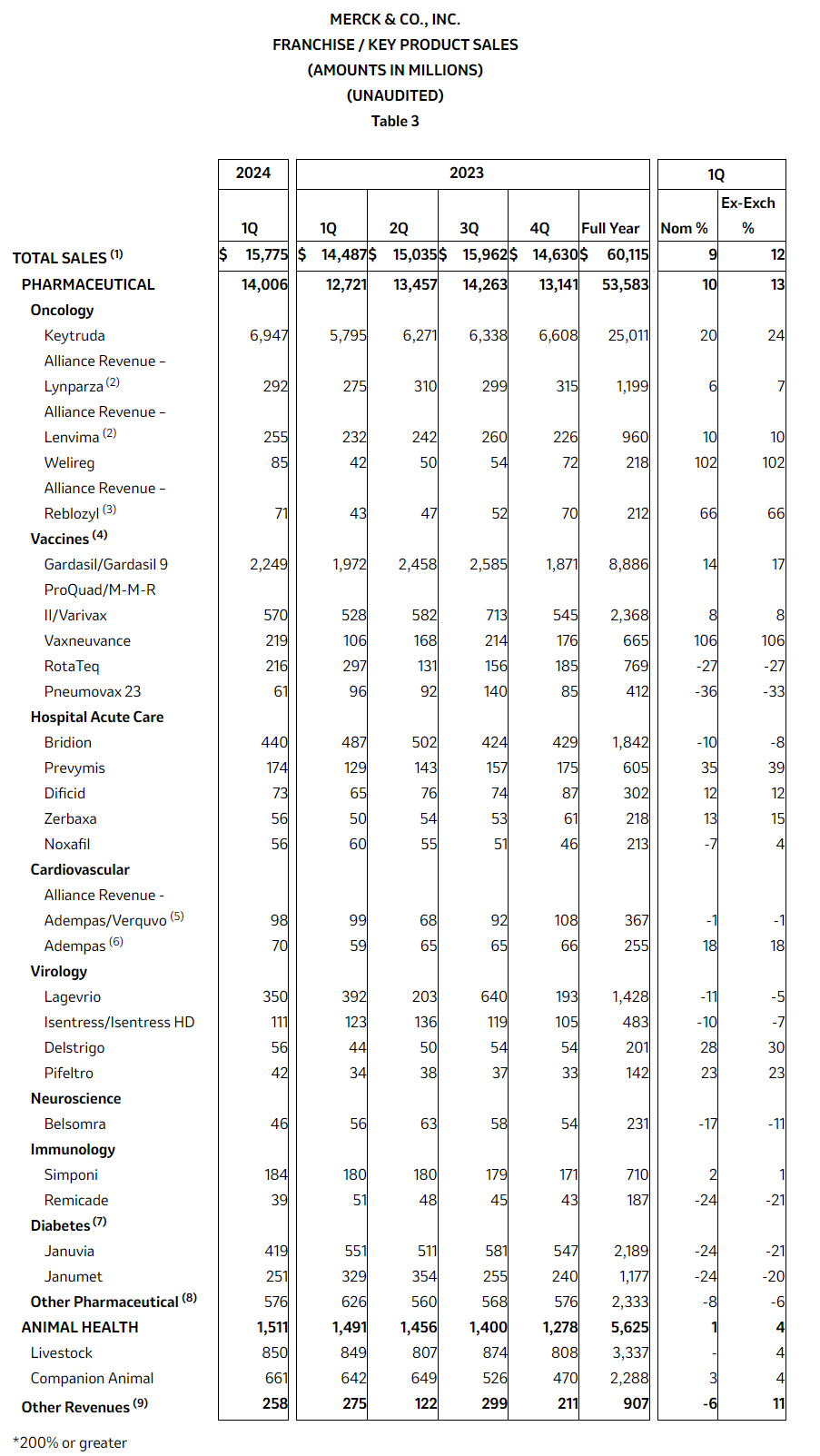
Image Source: MSD Official Website
The growth in Gardasil sales is mainly attributed to strong market demand in China, where Gardasil holds a monopoly position in the nine-valent HPV vaccine market. However, this year, China's HPV vaccine market is expected to welcome a new competitive landscape.
Currently, more than 10 companies in China have included HPV vaccine products in their R&D pipelines, including Walvax Biotechnology, Sino Biological, Bowei Biotech, Recbio, and China National Biologic Development.
Among them, there are companies positioning themselves in higher-priced products and broader population coverage. For instance, the research pipeline of CanSino Biologics covers a trivalent HPV vaccine, a nine-valent HPV vaccine for female indications, a nine-valent HPV vaccine for male indications, and a fifteen-valent HPV vaccine, with the first three already entering Phase III clinical trials. On March 29, the company announced that its recombinant fifteen-valent human papillomavirus vaccine (E. coli), co-developed with Chengda Bio, officially launched Phase I clinical trials.
The competition in the nine-valent HPV vaccine sector is still intensifying. On April 10, the unblinding results of the Phase III clinical trial of the nine-valent HPV vaccine developed by Wantai Biologics showed that the main outcomes met expectations, and on April 11, its stock price surged to the daily limit.
Apart from the HPV vaccine, another product, the 15-valent pneumococcal conjugate vaccine Vaxneuvance, is also gaining momentum, achieving significant growth in the first quarter. This vaccine generated $219 million in revenue, representing a 106% year-over-year increase.
Vaxneuvance was approved by the FDA on July 16, 2021, for active immunization in individuals aged 18 years and older to prevent invasive pneumococcal disease (IPD) caused by the aforementioned 15 serotypes of Streptococcus pneumoniae.
On June 22, 2022, the U.S. FDA approved the expansion of the indication for MSD's 15-valent pneumococcal conjugate vaccine Vaxneuvance to include the prevention of invasive diseases caused by pneumococcal infection in children aged 6 weeks to 17 years. In the first quarter, the significant increase in sales of the Vaxneuvance vaccine was mainly driven by the rise in vaccination rates for pediatric indications.
Vaxneuvance is the first new pneumococcal conjugate vaccine approved by the FDA in nearly 10 years to prevent invasive pneumococcal disease (IPD) in children. Previously, the U.S. FDA had granted Vaxneuvance Breakthrough Therapy Designation (BTD).
However, not all the news was good for MSD in the first quarter.
A Mixed Q1 of Joy and Worry
Sales of the diabetes drug Januvia (sitagliptin phosphate) fell 24% to $670 million. MSD noted that the reasons were decreased demand and generic competition.
Januvia's sales exceeded $1 billion in its third year on the market, and continued to grow, reaching $5.3 billion in 2021. With more than a decade of significant clinical efficacy, it has withstood the test of the global market and also led to the launch of a large number of DPP-4 inhibitors.
However, as the patent protection period gradually approaches, and with the continuous emergence of blockbuster hypoglycemic drugs, MSD faces unprecedented challenges. Part of the reason comes from the impact of nitrosamine impurities in sitagliptin itself: Nitroso-STG-19 (NTTP). The sales revenue of Januvia in 2023 was only $2.813 billion.
It is worth mentioning that 2024 poses at least three major challenges for pharmaceutical and medical device companies listed in the U.S. One of these is the Inflation Reduction Act (IRA), which for the first time breaks the monopolistic pricing power of pharmaceutical companies. In early February, Medicare conducted negotiations with manufacturers of the top 10 best-selling drugs for bulk procurement under the federal health insurance program. Januvia is one of these "ten."
Another pneumococcal vaccine, Pneumovax23, also saw a decline in the first quarter, with only $61 million, representing a 36% decrease compared to the same period in 2023.
In addition, MSD recently had a new drug approved, Winrevair, which received FDA approval for the treatment of adult pulmonary arterial hypertension (PAH). Administered via fixed subcutaneous injection every three weeks, the drug can enhance patients' exercise tolerance, alter disease progression, and reduce the risk of clinical worsening events associated with pulmonary arterial hypertension.
Currently, Winrevair is priced at $14,000 (approximately RMB 100,000) in the United States, with an annual cost of approximately $243,000 (approximately RMB 1.75 million). The high price may make it difficult for Winrevair sales to gain momentum.
Wall Street analysts expect Winrevair's peak sales to be between $2 billion and $4 billion.
Winrevair is an asset that MSD acquired through an $11 billion acquisition agreement with Acceleron in 2021. According to predictions by Wall Street analysts, it may take MSD a few more years to "break even."
Summary
Keytruda's dominance as the top drug is becoming increasingly solid, with continued successes in earlier treatment lines and strong demand in late-stage therapies. Although the HPV vaccine Gardasil continues to maintain its growth momentum, in China, its second-largest market by demand, multiple companies have begun to establish their presence, and pipeline products are accelerating to encircle it. Faced with fierce competition, MSD needs to reinforce its defensive strategies.
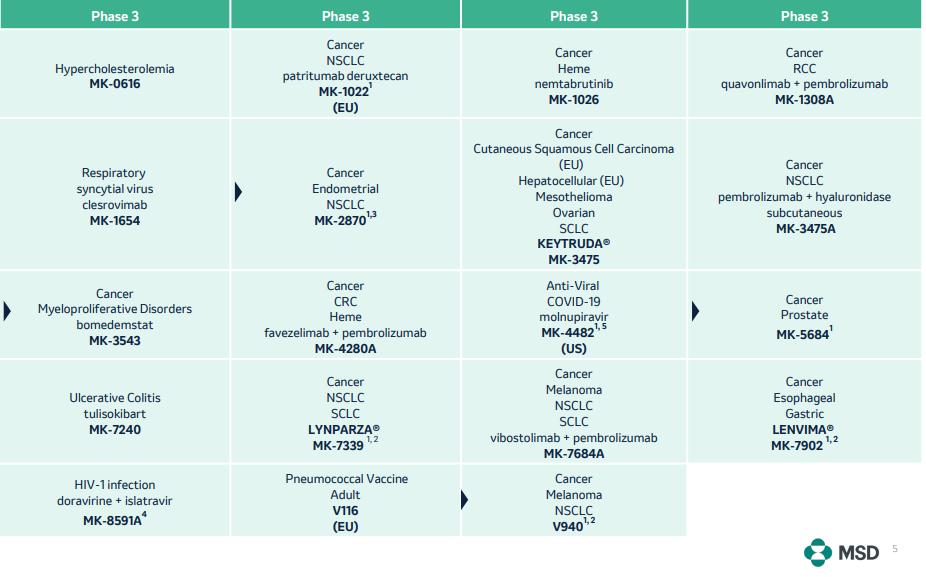
Figure: MSD Phase 3 Pipeline Under Development
Image Source: MSD Official Website
Source: MSD Official

Editorial Responsibility: Pea Shooter
Disclaimer: The views expressed in this article are solely those of the author and do not represent the position of PharmNet. We welcome exchanges and additional input in the comment section; for reprints, please be sure to credit the author and source. If the content, copyright, or other issues of the work are involved, please leave a message on this platform, and we will address it promptly.