
Text by Wang Cong
Editor | Wang Duoyu
Typesetting | Shuicheng Wen
Crystalline Retinopathy(BCD)It is a hereditary retinal degenerative disease characterized by the presence of yellowish-white crystalline deposits in the retina, accompanied by retinal pigment epithelium.(RPE), progressive atrophy of photoreceptors and choroidal capillaries.BCD patients typically exhibit clinical symptoms in their 20s or 30s, including progressive night blindness, decreased visual acuity, restricted visual fields, and impaired color vision. Most BCD patients experience severe visual and field loss between the ages of 50 and 60, leading to blindness.Worldwide, the prevalence of BCD is 1/57,600. However, the disease is more common in East Asia. In China, the prevalence of retinitis pigmentosa is 1/3,784, of which BCD accounts for 15%. This means that the prevalence of BCD in China is estimated to be approximately 1/25,000. Currently, there is no treatment available for BCD.April 24, 2024CHIGENOVOIn collaboration with Beijing Tongren Hospital, Capital Medical UniversityWei WenbinPeking University Third HospitalYang Liping, Peking University School of Basic Medical SciencesWang Likunetc., inSignal Transduction and Targeted TherapyThe journal published an article titled:Gene replacement therapy in Bietti crystalline corneoretinal dystrophy: an open-label, single-arm, exploratory trial Research Paper。The research report on the treatment of hereditaryRetinal Degenerative DiseasesCrystalline Retinopathy(BCD)TheAAV Gene Replacement TherapyZVS101e(rAAV2/8-hCYP4V2)Good safety and excellent efficacy in clinical trials.The therapy was developed byCHIGENOVODeveloped by CHIGENOVO Co., Ltd., this is the world's first gene therapy clinical trial targeting BCD.Crystalline Retinopathy(BCD)is produced byCYP4V2A specific type of autosomal recessive retinitis pigmentosa caused by gene mutations.The CYP4V2 protein is produced in various body tissues, butRetinal Pigment Epithelium(RPE)It is particularly abundant in China. CYP4V2 is an omega-3 polyunsaturated medium-chain fatty acid hydroxylase, which hydrolyzes docosahexaenoic acid and eicosapentaenoic acid within the eye.CYP4V2Gene mutations can disrupt lipid metabolism and RPE-mediated lipid recycling, impairing photoreceptor membrane disc regeneration, causing photoreceptor damage, and ultimately leading to retinal degeneration.In 2017, the U.S. FDA approved the AAV gene therapy Luxturna for the treatment ofRPE65Congenital amaurosis caused by gene mutations, this is not only a milestone in the field of genetic disease treatment, but also provides hope for other hereditary retinal dystrophies caused by gene mutations, including BCD.(IRD)Points the way for gene therapy.Adeno-Associated Virus(AAV)Mediated gene therapy has shown promising results in multiple in vivo or in vitro BCD models, thereby providing a basis for AAV-basedCYP4V2Laid the foundation for clinical trials of gene replacement therapy.The paper reports an investigator-initiated clinical trial of BCD gene replacement therapy, which is the world's first gene therapy clinical trial for BCD.Open-label, single-arm, exploratory trial aimed toEvaluation of rAAV2/8-hCYP4V2(ZVS101e)Safety and preliminary clinical efficacy.The therapy was developed byCHIGENOVODevelopment, the R&D concept of this therapy was proposed byYang LipingThe researcher first proposed the concept in 2021, when the investigator-initiated clinical trial was first conducted. In the same year, it received orphan drug designation from the U.S. FDA, followed by IND approval in both China and the U.S. in 2022. In February 2023, the first subject was enrolled in the Phase I/II clinical trial, which has now been completed, paving the way for the upcoming Phase III clinical trial.The trial included 12 BCD patients who were followed up for 180-365 days after treatment. Participants received a single unilateral subretinal injection of 7.5×10.10rAAV2/8-hCYP4V2 VG Dose.Overall, the trial reported 73 treatment-related adverse events, most of which(98.6%)Mild or moderate, considered related to the surgery itself or corticosteroids. No serious adverse reactions or local/systemic immunotoxicity associated with the treatment were observed. Compared with baseline, on day 180 post-treatment, 77.8% of the treated eyes had improved best-corrected visual acuity.(BCVA)Improved, the mean BCVA of the treated eyes increased by 9.0 letters from baseline.On the365 days, 80% of treated eyes with improved BCVA,The mean improvement in eye BCVA from baseline was 11.0 letters.Of which 40% improved by ≥15 letters, with significant clinical implications.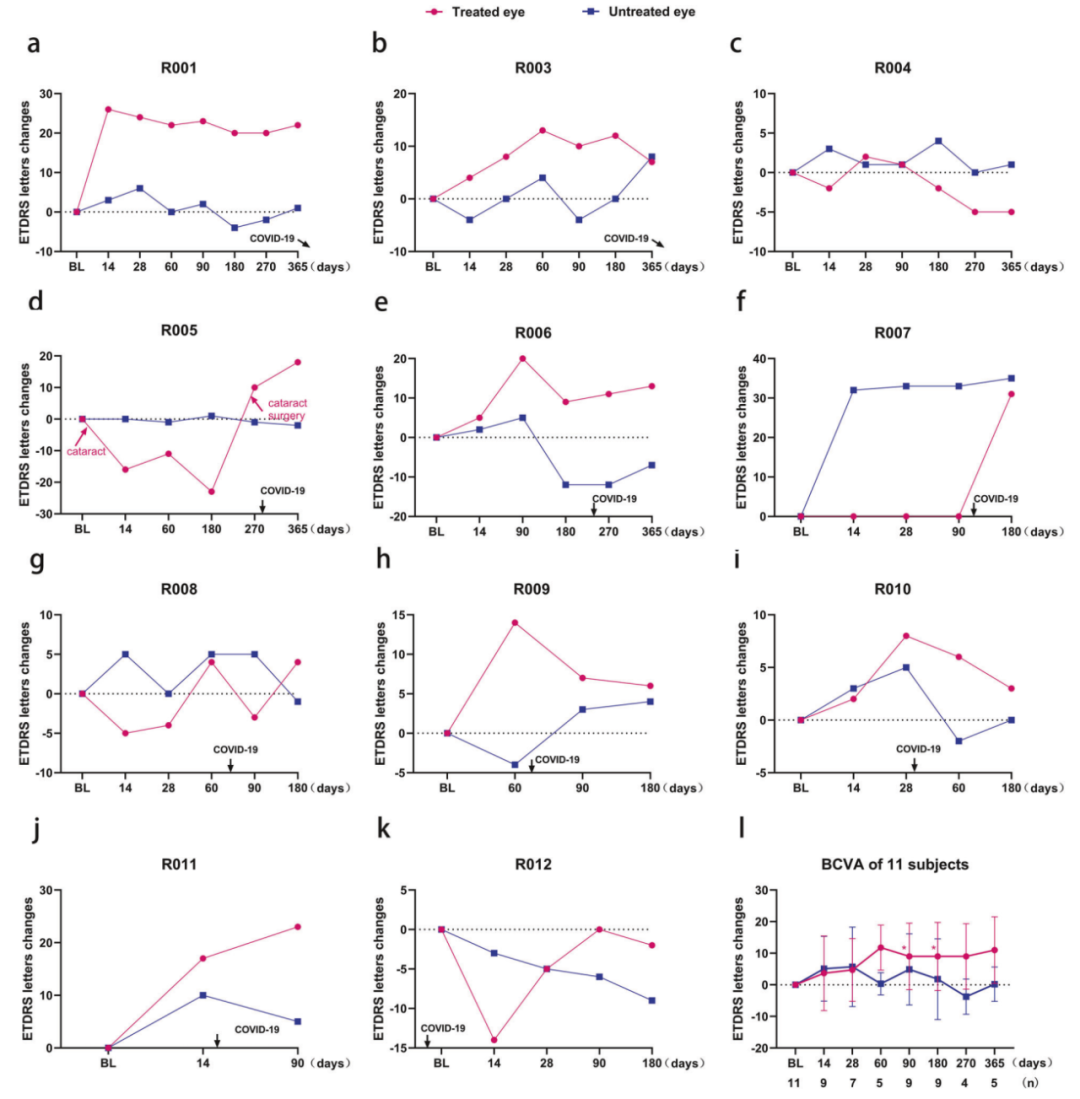 Importantly, through multifocal electroretinography(mfERG), Microperimetry Examination and Visual Function Questionnaire(VFQ-25), the observed improvement in patients further supports the beneficial effects of the treatment. The research team concluded that the good safety profile and vision improvement found in this trial encourage the continued development of rAAV2/8-h.CYP4V2(ZVS101e)Therapy.
https://www.nature.com/articles/s41392-024-01806-3
SettingsStar Mark`, not missing any exciting tweets`Welcome to forward to Moments and WeChat groupsTo promote the dissemination and exchange of cutting-edge research, we have established severalProfessional Exchange Group, Press and hold the QR code below to add the editor's WeChat and join the group. Due to the large number of applicants, please note the following when adding WeChat:School/Professional/Name, if it isPI/Professor, please also indicate.
PointIn Progress`, Convey Your Taste`