

Regeneron and Mammoth Biosciences Partner to Advance In Vivo Gene Editing Therapies Using Antibody-Targeted AAV and Ultra-Compact Cas Enzymes

Mammoth Biosciences
Disease Detection Service Provider

Regeneron
Biopharmaceutical Manufacturer


April 28, 2024
eMedClub News
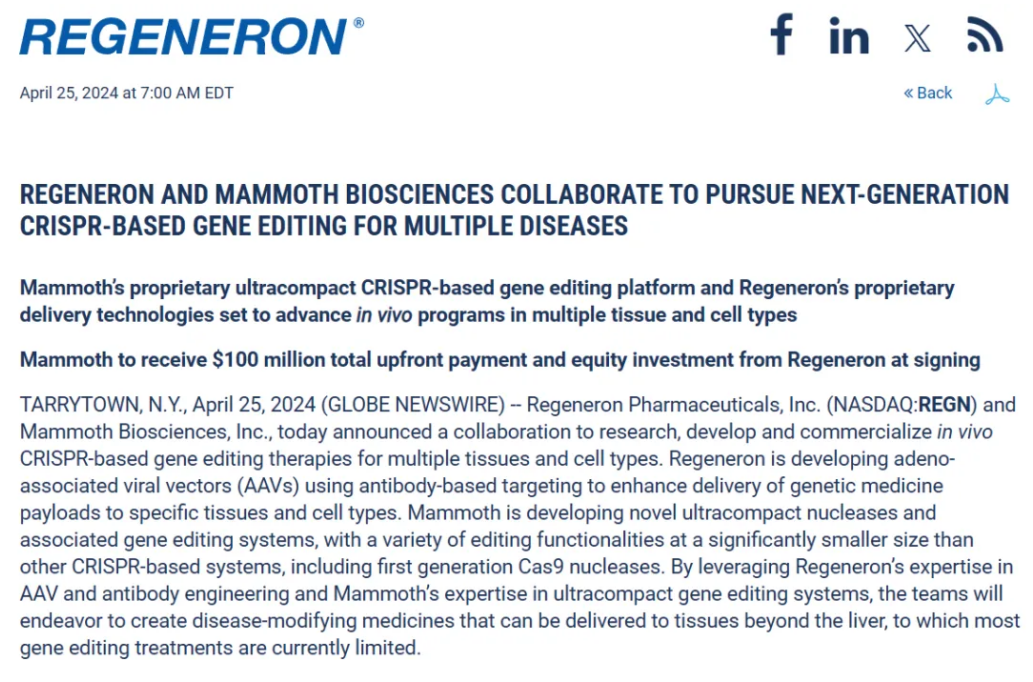
Recently,Regeneron(Regeneron) andMammoth BiosciencesAnnounce that the two parties have reached an agreement onJointly research, develop, and commercialize based on the next generationCRISPRIn vivo gene editing technology, aimed at targeting multiple tissue and cell types。

RegeneronUnder DevelopmentAntibody-targeted adeno-associated virus (AAV) vectors to enhance the delivery of gene drug payloads to specific tissues and cell types, effectively delivering gene editing systems to tissues throughout the body, impacting various diseases, and significantly increasing the number of patients who can benefit from gene editing therapies.Mammoth Biosciences is developing novel ultra-compact nucleases and related gene editing systems.。Compared with other CRISPR-based systems (including the first-generation Cas9 nuclease), this system has multiple editing functions. By leveraging Regeneron's expertise in AAV and antibody engineering, as well as Mammoth's expertise in ultra-compact gene editing, the two teams will work together toCreate disease-modifying drugs that can be delivered to tissues beyond the liver to better match payloads, delivery systems, and disease types.However, most gene-editing therapies have made limited progress in this area.

Hot Topic
A New Era of Gene Therapy for Hereditary Diseases
Innovative Trends and Commercial Translation in Gene Therapy
Clinical Progress of China's First Phase 3 AAV Gene Therapy for Hemophilia B
Innovative Design and Development Strategies for Gene Therapy
Next-Generation AAV Gene Therapy Drug Development Strategies
Gene Editing Treatment Strategies for Different DMD Targets
Chronic Disease Gene Therapy: Epigenetic Precision Regulation
Development Strategies for Gene Therapeutics Targeting Telomere Mechanisms in Aging Diseases
mRNA/LNP-Mediated In Vivo Gene Editing Delivery Strategies
Innovative Trends and Commercial Translation in Gene Therapy
Non-Viral Vector Gene Therapy UsHers in Gene Therapy 2.0
In Vivo Gene Therapy for Neurofibroma Mediated by Fifth-Generation Lentiviral Vectors
Opportunities and Challenges of In Vivo Gene Editing Delivery Therapy
Scan the code
Limited Time Offer
Free Tickets


Hotline for Cooperation

18701871600 (Manager Wang)
15572286596 (Manager Yuan)
15221150919 (Manager He)
According to the terms of the agreement, Mammoth will receive $100 million at signing, including $95 million in equity investment and upfront payment, and is eligible to receive $370 million in development, regulatory, and commercial milestone payments for each target therapy, as well as royalties ranging from single-digit percentages to 15% of future net sales of all collaboration products. Additionally, Mammoth has the option to co-fund and share profits from most of the collaboration programs. In exchange, over a period of five and a half years, excluding certain excluded candidate therapies,RegeneronWill gain broad access to Mammoth’s editing technology and have the option to extend this access for an additional two years by paying a research extension fee. The two parties will jointly select and study candidate therapies for collaboration, thenRegeneronWill lead development and commercialization.
▲Image Source: GLOBE NEWSWIRE
Regeneron: Antibody-Targeted AAV Vectors
eMedClub
The field of gene therapy has continued to make progress in recent years. However, how to efficiently deliver gene vectors to organs and tissues other than the liver, thereby expanding the scope of gene therapy applications, has been a bottleneck challenge in the field of gene therapy and also the key to breakthroughs.
With its years of accumulated expertise and experience in the antibody field, Regeneron is conducting early-stage research with the intention toAttach antibodies to standard viral vectors to promote the specific entry of the vector into targeted cells.,is expected to become the most direct and effective way to overcome delivery challenges. HoweverAchieving repeatable and robust scalable production is the technical challenge for practical application in humans.The industry must be able to convince regulatory authorities of its capability to maintain consistent conjugation efficiency of antibodies and viral vectors in mass production for each batch of drugs, ensuring that each batch possesses equivalent therapeutic efficacy. This is also one of the main challenges faced by Regeneron in developing such therapies.
However, Regeneron is highly confident in the development of this therapy. Dr. Christos Kyratsous, co-head of Regeneron's gene therapy team, stated that they are advancing two methods of attaching antibodies to the virus and are seeing consistent results in both approaches. Additionally, Regeneron's leadership noted their extensive experience in large-scale antibody production and their growing team focused on adeno-associated virus (AAV) vectors, moving toward clinical-scale viral production.
Currently RegeneronFocus on Developing Therapies Targeting Muscle Cells and the Brain, these therapies currently show positive preclinical data. Among them, the most advanced project is aAntibodies targeting the protein CACNG1 in muscle cells are attached to viral vectors.According to data presented at the 2023 American Society of Gene & Cell Therapy (ASGCT) conference, studies in mice and non-human primates showed that the therapy significantly enhanced the ability of the vector to reach muscle cells compared to unmodified viruses, while its ability to enter the liver and heart was substantially reduced.
Mammoth: Ultra-compact Nuclease
eMedClub
MammothYesCRISPRThe pioneer, by2020Nobel Prize in Chemistry WinnerJennifer DoudnaCo-founded by PhDs,Aiming toMore specifically utilizing the new editing mode(Including base editing, retrotransposon editing, and epigenetic editing), performing in vivo gene editing in hard-to-reach tissues。
CRISPR gene-editing technology relies on the Cas9 protein to edit DNA, removing faulty genes to fundamentally treat diseases. Besides Cas9, CRISPR gene-editing technology also includes other tools capable of editing DNA. Over the past few years, Mammoth Biosciences has developed four main editing tools: Cas12, Cas13, Cas14, and Casɸ. Cas enzymes are the core components of the CRISPR editing system. The commonly used delivery vehicle for gene editors is the adeno-associated virus (AAV), but the cargo capacity of AAVs is very limited, soThe ultra-small size of Cas makes it more suitable for delivery, facilitating in vivo gene editing and treatment.
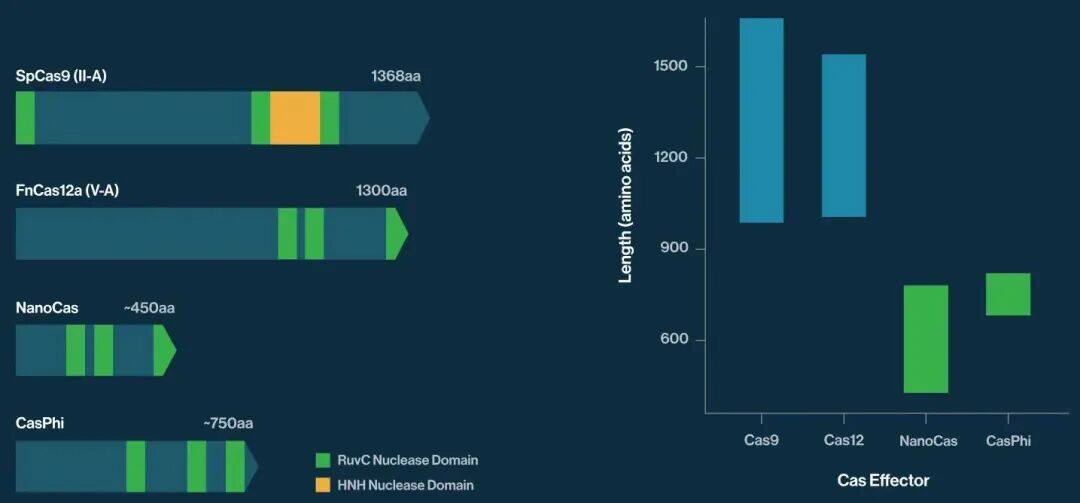
Currently, the Cas14 and Casɸ that Mammoth is focusing on developing are the smallest known gene-editing proteins; both of these Cas proteins were discovered in the lab by Jennifer Doudna, a co-founder of Mammoth Biosciences.The two enzymes not only have an ultra-small size but also increased temperature stability, faster reaction kinetics, high fidelity, and expanded targeting capabilities.。
Cas14 can encode Cas proteins as small as 40-70 kDa, which is about half the size of other Cas proteins. Unlike Cas9, Cas14 does not require a PAM sequence. Meanwhile, in addition to cis cleavage, Cas14 is also capable ofIndiscriminately trans-cleaves single-stranded DNA, similar to Cas13 and Cas12.
Casɸ contains a Cas protein of approximately 70 kDa and a CRISPR array. In addition to its small size, researchers have discovered that this protein is capable of generating its own guide RNA (gRNA) and can simultaneously cleave target DNA at the same site. This means it does not need to outsource gRNA production to other enzymes. Due to the small size of the Casɸ protein and minimal PAM sequence requirements, it offers significant advantages for vector delivery into cells and broader targetable genomic sequences.
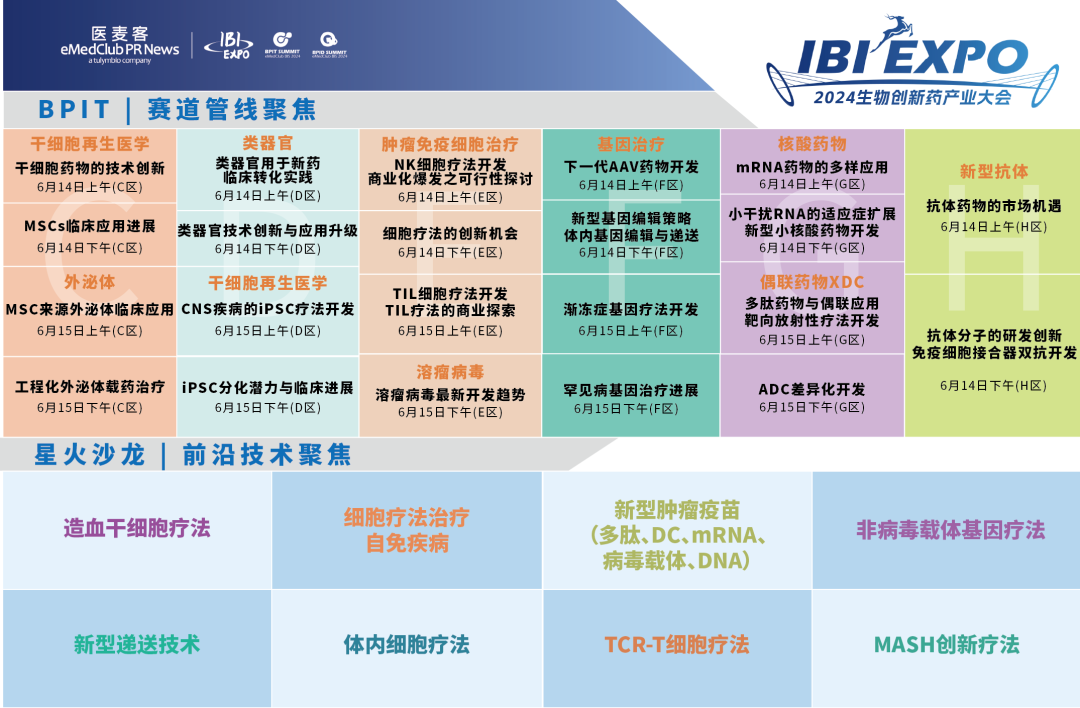
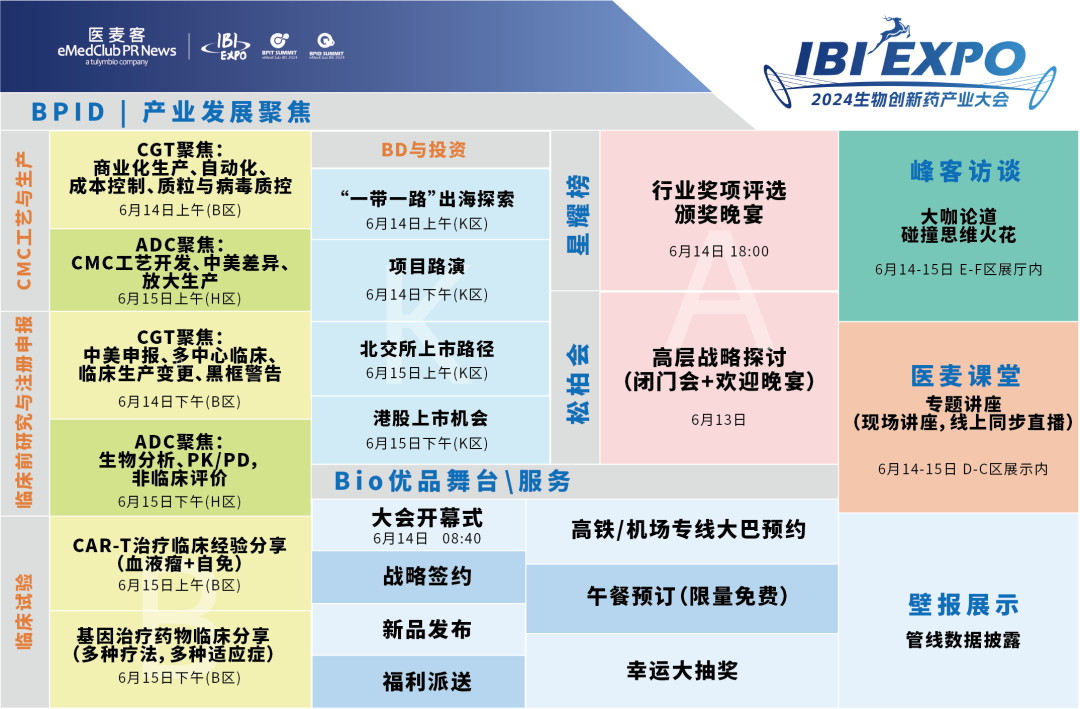
To seize the opportunities currently facing the industry and promote the common development of the industry.Mammoth Biosciences will host the 2024 IBI EXPO Biotech Innovation Conference in Nanjing, China on June 14-15, 2024., and convened "International Gene Editing and Gene Therapy Symposium". This conference will invite pioneers and leaders in this field, focus on the latest research trends and advancements, and deeply discuss and forecast the future development trends of gene therapy.
//
2024 IBI EXPO Schedule Overview
Scan the code
Limited Time Offer
Free Tickets




DianDian "Share”、“Like" and "In View",Give me a little recharge~"