Dr. Liu Wendao's Team Showcases Scoring Drug-Coated Balloon for Improved AVF Patency

DK Medtech
Vascular Interventional Balloon Product Developer

Stenosis of autologous or artificial arteriovenous fistula (AVF/AVG) is the most common complication in hemodialysis patients. Percutaneous transluminal angioplasty (PTA) has become the primary method for maintaining dialysis access. However, the blunt and irregular tearing of the intima and part of the media by traditional balloons during PTA can cause excessive damage to the endothelial vessels, leading to intense proliferation of vascular smooth muscle cells and macrophages, which rapidly results in restenosis.
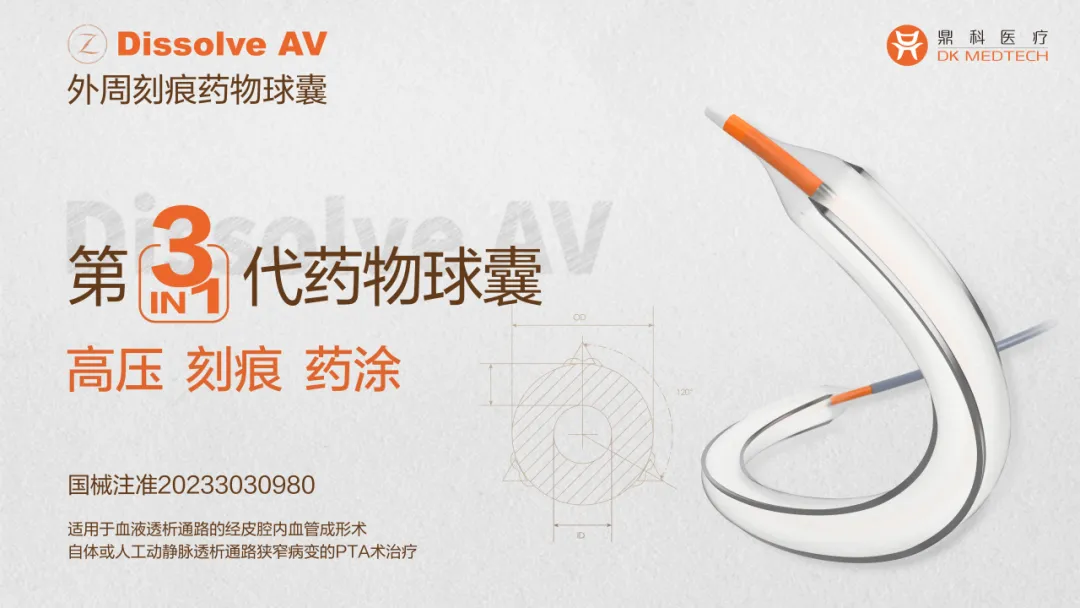
In recent years, there have been continuous explorations and clinical studies internationally regarding the use of drug-coated balloons for PTA treatment in dialysis access. DK Medtech has developed the Dissolve™ AV Scoring Drug Balloon, which integrates three features—"scoring," "high pressure," and "drug coating"—and is the world's first third-generation drug balloon:
Directional Scoring: Uniform and regular tearing of the intima to reduce damage from blunt rupture.
High Burst Pressure: For high-resistance lesions, improving technical success rate.
Paclitaxel Coating: Effectively Inhibits Excessive Proliferation of Smooth Muscle Cells.
DK Medtech Special Release[Professor Liu Wendao's Team: Scored Drug-Coated Balloon Facilitates More Patency in AVF] Case Presentation, demonstrating the precise operation of each case and the clinical application of advanced equipment and instruments. From the formulation of treatment strategies for different cases, standardized procedures during surgery, technical applications, complication prevention, to perioperative management, etc., the aim is to promote the standardization of diagnosis and treatment for vascular stenosis and occlusive diseases, strengthen technical exchanges and experience sharing among doctors, with the hope of providing new ideas and methods for future diagnosis and treatment, benefiting more clinical patients.

Scored Drug-Coated Balloons Help AVF Stay More Open
Guangdong Provincial Hospital of Chinese Medicine, Liu Wendao

Patient Information
Basic Information:Ten years of hemodialysis, with a left forearm autologous arteriovenous fistula established and used for 10 years.
Chief Complaint:Maintenance hemodialysis for over 10 years, thrill of left upper limb arteriovenous fistula disappeared for 1 day (admitted on 2024-4-11).
History of Present Illness:The patient was found to have nearly no function in the right kidney and mild decrease in blood flow perfusion and function of the left kidney with a serum creatinine level of 184 umol/L in a bilateral renal ECT examination conducted at the First Affiliated Hospital of Sun Yat-sen University in June 2009. The diagnosis was "Chronic Kidney Disease Stage 3". The patient received treatment for lowering blood pressure and protecting renal function, and the condition remained stable. In mid-March 2014, the patient was admitted to the Nephrology Department of our University Town hospital due to fatigue and weakness. A check revealed a creatinine level of 712 umol/L, suggesting that the condition had worsened, indicating the need for dialysis. On March 29, 2014, the patient underwent an arteriovenous fistula surgery on the left upper limb, and the condition stabilized after the surgery before being discharged. Later, the patient regularly received hemodialysis treatment at a local hospital, three times a week. After the surgery, there were multiple instances of decreased dialysis flow, and the patient underwent endovascular angioplasty of the left upper limb veins in our department. Yesterday, during dialysis, the patient noticed the disappearance of the thrill in the fistula, which suggested stenosis of the upper limb vein.
Past Medical History:History of right kidney stones for many years, underwent open surgery for stone removal in 1992, and later had another open surgery for repair due to right kidney hydrops; hypertension was found 20 years ago with the highest blood pressure reaching 150/80mmHg, but has been normal in the recent year without taking antihypertensive drugs; diagnosed with "lumbar degenerative disease, gallbladder stones, and hepatitis B surface antigen carrier" during hospitalization in the nephrology department of our University Town Hospital in March 2014; denies history of other infectious diseases such as tuberculosis, and denies history of major trauma and blood transfusion.
Physical Examination:The arteriovenous fistula formed by the cephalic vein and radial artery in the upper left arm shows aneurysmal dilation at the puncture site, with palpable hard nodules and absence of thrill.
Admission Diagnosis:Cephalic Vein Stenosis.
Previous interventional treatment
Time | Main Treatment Process |
March 2013 | Long-term Catheter in Right Internal Jugular Vein |
March 2013 | Left Forearm Radial Artery Cephalic Vein Autologous Fistula |
January 2017 | Left Anterior Forearm Cephalic Vein Stenosis, Balloon Dilation under DSA Guidance |
November 2017 | Left Anterior Forearm Cephalic Vein Stenosis, Balloon Dilation under DSA Guidance |
March 2020 | Left Anterior Forearm Cephalic Vein Stenosis, Balloon Dilation under DSA Guidance |
December 2022 | Left Anterior Forearm Cephalic Vein Stenosis, Balloon Dilation under DSA Guidance |
June 2023 | Left Anterior Forearm Cephalic Vein Stenosis, Balloon Dilation under DSA Guidance |
April 11, 2024 | Left Anterior Forearm Cephalic Vein Stenosis, Balloon Dilation under DSA Guidance |
Preoperative Analysis
Preoperative Analysis:Preoperative physical examination and color Doppler ultrasound evaluation suggested calcification and severe stenosis of the cephalic vein. Based on theoretical knowledge, the severe calcification is considered to be the cause.
Surgical Objective:
Main Objectives:Dilate the stenotic segment of the vein to restore normal venous diameter and meet the needs of dialysis;
Secondary Objectives:Extend the service life of autologous arteriovenous fistulas, with fewer complications and fewer interventions.
Surgical Strategy/Plan:Balloon dilation under DSA guidance.
Equipment Preparation:DK Medtech Scored Drug-Coated Balloon 6*80mm.
Surgical Procedure

Severe stenosis near the fistula of the cephalic vein, with a stenosis rate of approximately 90%.
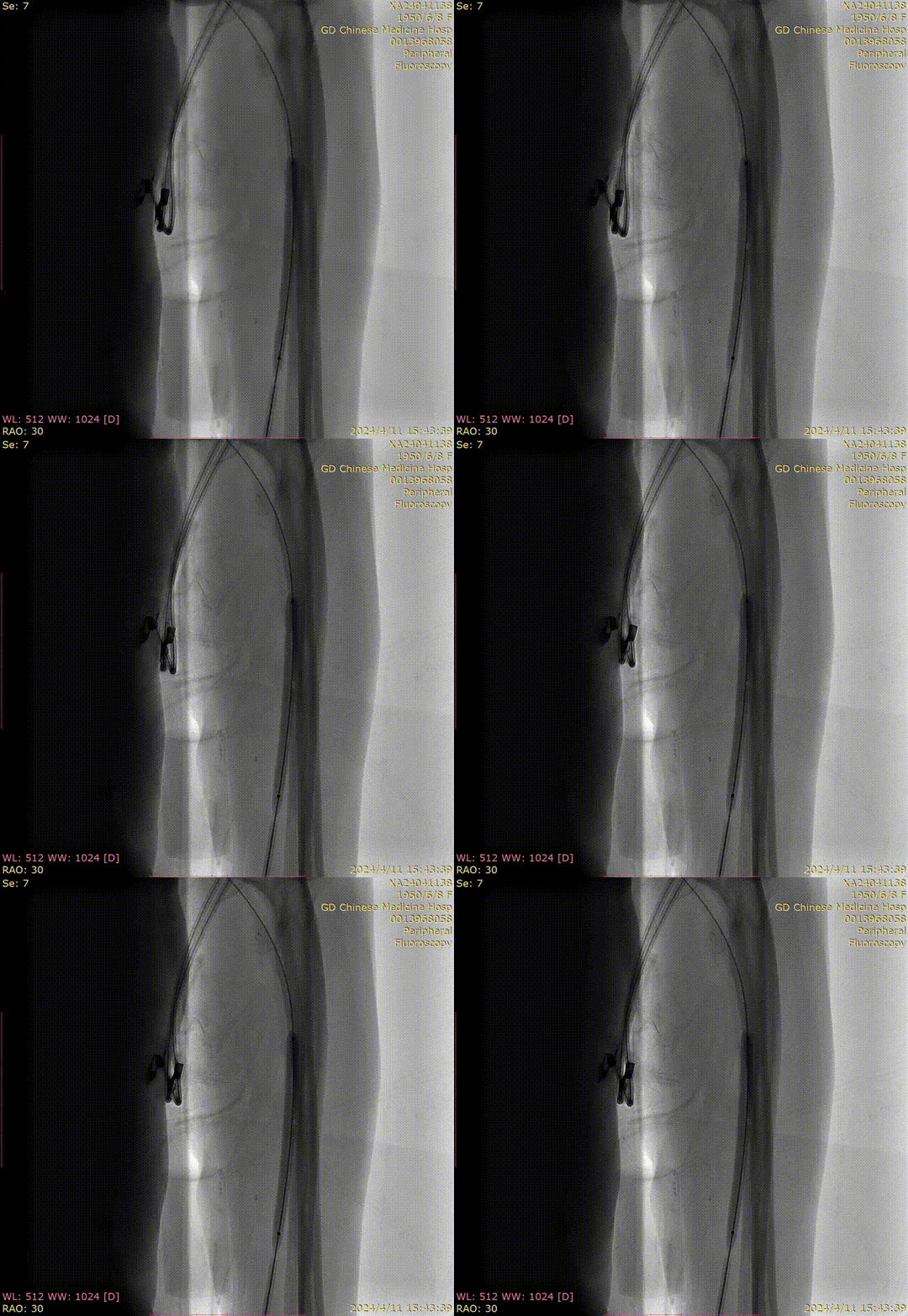
DK Medtech's scored drug-coated balloon (6*80mm) dilates the stenotic segment of the cephalic vein.
Increase by 2 atmospheres every 3 seconds, continue pressurizing to 20 atmospheres after reaching 8 atmospheres, and maintain expansion for 3 minutes.

After balloon withdrawal, angiography showed resolution of the stenosis in the cephalic vein without significant residual narrowing, and good contrast flow.
Follow-up
Discharge Status:
After balloon dilation, the thrill of the autologous arteriovenous fistula vessel can be felt;
On the same day, dialysis treatment was performed using this autologous arteriovenous fistula, with normal blood flow and venous pressure.
Case Summary
Case Characteristics:Severe stenosis of the cephalic vein in autologous arteriovenous fistula.
Preoperative Assessment Key Points:The patient has been using an autologous arteriovenous fistula for over 10 years, with multiple occurrences of cephalic vein stenosis post-surgery, likely associated with severe intimal hyperplasia and calcification of the cephalic vein. The nature of the cephalic vein stenosis may be directly related to the efficacy of drug-coated balloon usage. Pre-balloon dilation angiographic evaluation showed that the calcified segment was mainly limited to the puncture site of the autologous arteriovenous fistula.
Surgical Strategy/Technical Key Points:
The patient underwent high-pressure scoring balloon dilation with a 6mm diameter balloon, which can help maximize the opening of the stenotic lesion and reduce elastic recoil.
At the same time, high-pressure scoring paclitaxel drug-coated balloons help extend the patency rate of autologous fistulas and reduce the number of re-interventions.
Characteristics/Usage Tips of the Device:
Using a scored drug-coated balloon can eliminate the need for pre-treatment of the vascular lesion segment.
The balloon should be maintained at pressure dilation for 2-3 minutes after inflation.
References:DK Medtech's Drug-Coated Balloon Catheter Launches RCT in China.
Effectiveness Evaluation:After the treatment with the scored drug-coated balloon dilation, the autologous arteriovenous fistula functioned well. The scored drug-coated balloon can indeed extend the life of the autologous arteriovenous fistula.

Expert Introduction


Dr. Wen Dao Liu, Chief Physician
The Surgeon of This Case
M.D., Chief Physician, Master's Supervisor,Director of the Vascular Intervention Department at Guangdong Provincial Hospital of Traditional Chinese Medicine,The Seventh Batch of "Guangdong Special Support Plan" Talents,
Member of the Provincial Expert Database for the "High-Quality Development Project of Hundreds of Counties, Thousands of Towns, and Tens of Thousands of Villages" by the Guangdong Provincial Health Commission;Vice President of the Integrative Medicine Intervention Branch of the China Association of Traditional Chinese Medicine Information;Standing Committee Member and Secretary of the Whole-body Interventional Therapy Committee, Guangdong Association of Integrated Traditional Chinese and Western Medicine;Vice Chairman of the Professional Committee on Tumor Interventional Therapy, Guangdong Association of Integrated Traditional Chinese and Western Medicine;Member of the Varicose Veins Professional Committee of the Expert Committee of the Chinese Division of the International Vascular Union;Committee Member of the Peripheral Vascular Disease Branch of the China Association of Chinese Medicine;Member of the Endovenous Treatment Professional Committee of the Peripheral Vascular Committee of the Chinese Society of Microcirculation;Member of the Expert Committee of the National Strategic Alliance for Industrial Technology Innovation in Minimally Invasive Tumor Treatment;Standing Committee Member of the Interventional Branch of the Guangdong Medical Association;Standing Committee Member of the Interventional Branch of the Guangdong Province Medical Association;Standing Committee Member of the Vascular Disease Diagnosis and Treatment Professional Committee of the Guangdong Provincial Hospital Association;Standing Committee Member of the Interventional Professional Committee of the Guangdong Provincial Hospital Association;Standing Committee Member of the Interventional Radiology Branch of the Guangzhou Medical Association;Chaoyang Talent of Guangdong Provincial Hospital of Chinese Medicine, Young Post Expert of Guangdong Provincial Hospital of Chinese Medicine.

Department Introduction

The Interventional Department of Guangdong Provincial Hospital of Traditional Chinese Medicine is the earliest established interventional specialty in China to have a combined Western and traditional Chinese medicine interventional ward. The integrated Western and traditional Chinese medicine interventional treatment is a distinctive feature of our hospital’s interventional specialty, and it is a doctoral and master's degree authorization point approved by the National Ministry of Education. Our department is a standing member unit of the Interventional Branch of the Chinese Medical Doctor Association, a vice-chairman unit of the Chinese Integrated Western and Traditional Chinese Medicine Interventional Diagnosis and Treatment Alliance, a chairman unit of the Whole-body Interventional Specialty Committee of the Guangdong Provincial Integrated Western and Traditional Chinese Medicine Association, and a standing member unit of the Vascular Disease Diagnosis and Treatment Management Committee of the Guangdong Hospital Association, among others. In March 2023, we successfully became part of the national-level Peripheral Vascular Intervention Construction Center.
This department has independent interventional wards, interventional operating rooms, interventional outpatient clinics, and interventional training bases. It is one of the large comprehensive interventional diagnosis and treatment centers that integrates medical treatment, scientific research, and teaching. Currently, the department has 30 open beds and 15 physicians, including 2 senior-level, 3 associate senior-level, 6 intermediate-level, and 4 junior-level physicians, among whom there is 1 doctoral supervisor and 1 master's supervisor. Under the leadership of Director Chang Gang and Director Liu Wen Dao, the department has developed into an interventional specialty characterized by peripheral vascular diseases such as "lower extremity arterial sclerosis occlusion, aortic aneurysm, aortic dissection, lower extremity varicose veins, and deep vein thrombosis." At the same time, it also possesses advanced interventional techniques and rich experience in integrated traditional Chinese and Western medicine diagnosis and treatment in multiple benign and malignant tumors (such as liver cancer, hepatic hemangioma, lung cancer, thyroid cancer, uterine fibroids, etc.) for biopsy, embolization, and ablation treatments, as well as in areas like esophageal and gastric variceal bleeding caused by portal hypertension (Transjugular Intrahepatic Portosystemic Shunt, TIPS), thoracic/abdominal paracentesis and drainage, and stenosis or occlusion of hemodialysis access.
Copyright Statement: This platform aims to help medical and health professionals better understand the latest developments in relevant disease areas. The information content published on this platform does not imply agreement with its descriptions or viewpoints, but is merely for providing more information. If there are any copyright issues, we kindly request the rights holders to contact us, and we will address them as soon as possible. This information is solely for medical and health professionals to stay informed, and such information cannot replace professional medical guidance in any way, nor should it be regarded as medical advice. If such information is used for purposes other than staying informed, this platform and the author shall not bear any related responsibilities.Contact email for collaboration:vascular@edoctor.work。