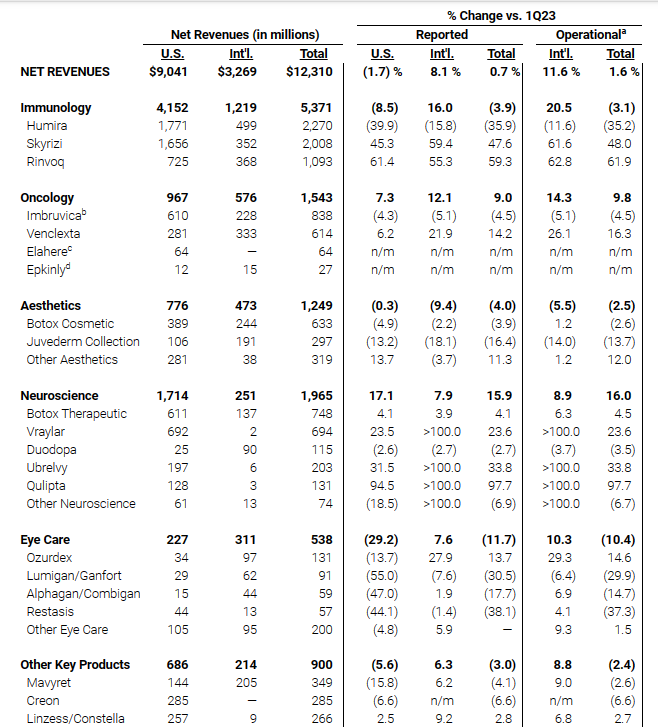
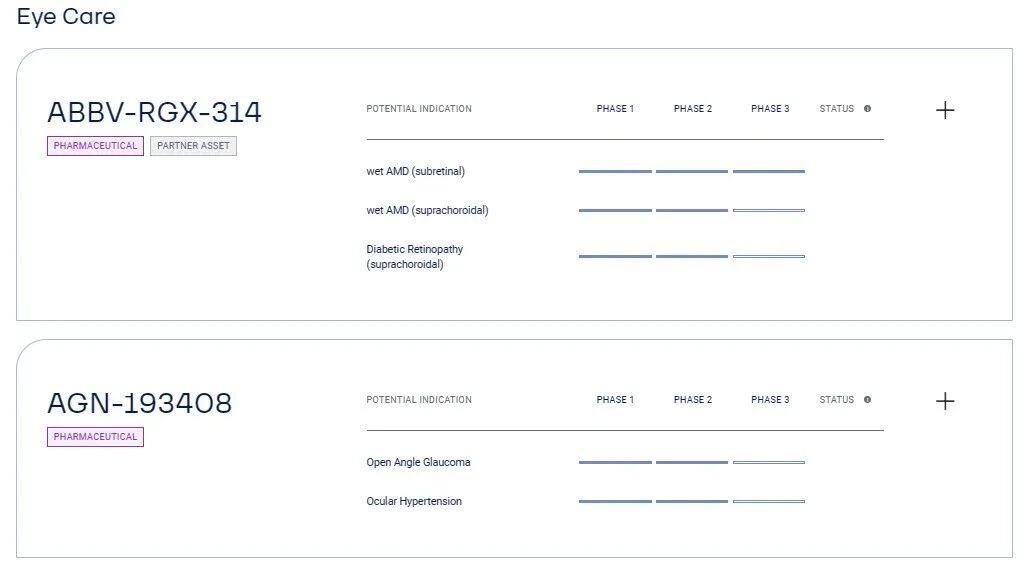
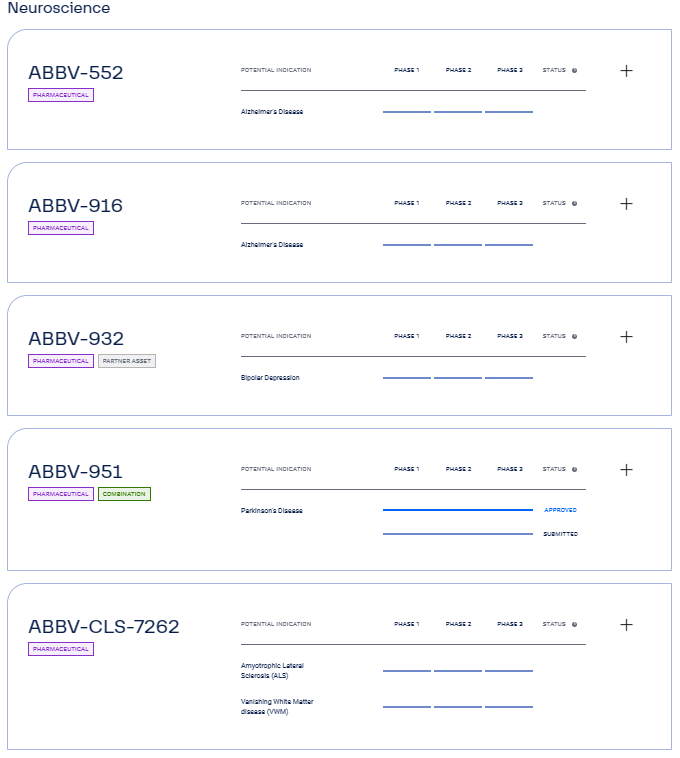
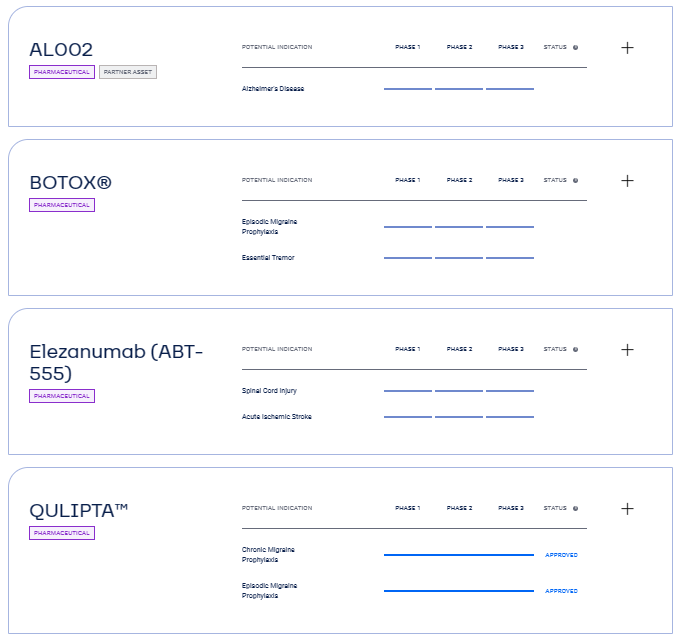
On April 26, AbbVie Inc. released its financial report for the first quarter of 2024, with total revenue reaching $12.3 billion, roughly flat compared to the same period in 2023 but surpassing Wall Street expectations. The revenue from AbbVie's products in the first quarter was mainly driven by contributions from its immunology and oncology portfolios. AbbVie disclosed in its financial report that it has raised the full-year 2024 earnings guidance from $10.97-$11.17 per share to $11.13-$11.33 per share. Humira Has Successors: Rinvoq and Skyrizi In terms of the immunology pipeline, Skyrizi, Rinvoq, and Humira are running neck and neck. Among them, Rinvoq and Skyrizi have shown strong performance with considerable growth rates, while Humira continues to decline due to the erosion from biosimilars. Image Source: AbbVie Official Website IL-23 Inhibitor Skyrizi (Risankizumab) Generated $20.08 Billion in Global Revenue in the First Quarter, a Significant Year-over-Year Increase of 47.6%, Surpassing the Expected $19.4 Billion.Global sales of AbbVie's JAK1 inhibitor Rinvoq (upadacitinib) reached $1.093 billion, a 59% surge year-over-year, slightly above the expected $1.06 billion. As the leader in the immunology field, AbbVie began to proactively seek change even before Humira faced performance challenges. Starting from 2010, AbbVie independently developed Rinvoq and incorporated Skyrizi in 2016, actively planning for the next-generation products of Humira. After the launch of these two "supernova" products in 2019, following five years of nurturing, they have now gradually matured. Rinvoq has consecutively achieved over 50% revenue growth for nine fiscal quarters. However, the global total sales of AbbVie's immunology pipeline in the first quarter were $5.3 billion, a decrease of 3.9% year-over-year. AbbVie stated that the decline in sales was due to biosimilar competition for its former flagship product, Humira.Humira's global sales in the first quarter were $2.27 billion, a 35% decrease year-over-year, but largely in line with the expected $2.28 billion. According to the latest quarterly report from Samsung Bioepis, as of February 2024, Humira still firmly controls 96% of the adalimumab market. Compared to the report released by Samsung six months ago, biosimilars have only captured an additional one percentage point of market share. However, starting from April 1, 2024,Due to CVS Caremark, one of the three giants of pharmacy benefit management (PBM) companies, removing Humira from its national commercial formulary template. Instead, biosimilars of Humira will be retained in the formulary. New prescriptions for biosimilars increased by 36%, leading to a sudden intensification of competition in April. Tumor Pipeline: Venclexta is the Major Contributor Oncology products are another key focus area that AbbVie has been striving to deeply invest in recent years, with a product pipeline covering hematological malignancies and solid tumors such as lung cancer. In the first quarter of 2024, the global sales of the oncology business reached $1.543 billion, increasing by 9% year-over-year, with Venclexta (Viklont) being the major contributor. BCL-2 Inhibitor VenclextaHas long been regarded as the future performance cornerstone of AbbVie in the细分领域 of hematological oncology. Venclexta has not disappointed AbbVie's expectations, maintaining a robust double-digit growth rate this quarter.Global revenue in Q1 2024 reached $614 million, a year-over-year increase of 14%. Based on this base and growth rate, Venclexta's total revenue for 2024 is set to surpass the $2 billion mark once again. AnotherAnti-tumor Drug Imbruvica (Ibrutinib)Revenue in the first quarter reached $838 million, a year-on-year decrease of 4.5%, but exceeded expectations of $744 million. Imbruvica was one of the first drugs included in the 2023 national medical insurance drug price negotiations. Regarded as a powerful "weapon" for AbbVie to impact the ADC marketElahere (Mirvetuximab Soravtansine)In the first quarter of 2024, Elahere's performance was also disappointing, with sales reaching only $64 million. ElahereIt is a "first-in-class" antibody-drug conjugate (ADC) that links a humanized monoclonal antibody binding to FRα with the cytotoxic DM4 molecule via a disulfide bond. In November 2022, Elahere received FDA accelerated approval for the treatment of adult patients with FRα-positive, platinum-resistant epithelial ovarian, fallopian tube, or primary peritoneal cancer. On March 22, 2024, AbbVie announced that the U.S. FDA has fully approved Elahere for the treatment of adult patients with folate receptor alpha (FRα)-positive, platinum-resistant epithelial ovarian, fallopian tube, or primary peritoneal cancer who have previously received up to three systemic therapies. As for Elahere itself, this means it has retained the honor of being the "first FRa ADC" and can continue to expand as a leader; for AbbVie, the MNC deeply troubled by the patent cliff, it can now escape from external criticism about an "accelerated withdrawal" and further prove its foresight and capability. Elahere's sales surged rapidly following its accelerated approval for market release. The sales in the first quarter of 2023 were $29.5 million, $77.4 million in the second quarter, and net sales reached $105.2 million in the third quarter—totaling $212 million in the first nine months, demonstrating significant growth potential. AbbVie has not yet provided an explanation for the recent decline in Elahere sales. However, two other clinical trials of Elahere for ovarian cancer (the MIRASOL study and the GLORIOSA study) have now entered Phase III clinical trials. ImmunoGen also has eight ongoing clinical trials, which are expected to expand AbbVie's competitiveness in the solid tumor field and bring new potential growth points to AbbVie. The Fields of Ophthalmology and Neuroscience Rise and Fall in Turn Ophthalmology is another major area for AbbVie. In this quarter, ophthalmology products contributed $538 million in sales to AbbVie, marking an 11.7% decrease year-over-year. Except for Ozurdex, sales of the remaining three ophthalmic care products declined to varying degrees. Ozurdex (Ozurdex), an anti-inflammatory product for the eye, continued its impressive growth rate, achieving a result of $1.31.Up 13.7% year-on-year. Achieving double-digit year-on-year growth for three consecutive quarters, with international markets contributing over 70% of its sales in the quarter. Ophthalmic care products Lumigan/Ganfort, Alphagan/Combigan, and Restasis all showed double-digit declines. Figure: AbbVie Ophthalmology R&D PipelineImage Source: AbbVie Official Website AbbVie also has a significant advantage in the neurology product sector, with most products acquired through the merger with Allergan. This business segment contributed a total revenue of $1.965 billion in the first quarter, representing a year-over-year increase of 15.9%.Four products performed remarkably well this quarter, with Vraylar, Ubrelvy, and Qulipta all achieving double-digit growth. Aesthetic star product Botox Therapeutic (Botox) achieved $748 million, a year-on-year increase of 4.1%. Botox Therapeutic is an acetylcholine release inhibitor and neuromuscular blocking agent injected into muscle tissue. It is approved in the United States for multiple indications, including chronic migraine, overactive bladder in adults with inadequate response to anticholinergic medications, and urinary incontinence due to neurogenic detrusor overactivity caused by neurological conditions in adults with inadequate response to anticholinergic medications. In addition, Botox therapy is approved for the treatment of spasticity in patients aged two years and older, cervical dystonia in adults, and other conditions. Figure: AbbVie Neuroscience R&D PipelineImage Source: AbbVie Official WebsiteScan the WeChat QR code to add the editor of Antibody Circle.Those who meet the requirements can join the Antibody Circle WeChat group!Please indicate: Name + Research Direction! All articles reproduced in this official account are intended to convey more information, with the source and author clearly stated. Media or individuals who do not wish to be reprinted may contact us (cbplib@163.com), and we will immediately delete the content. All articles represent the views of the author and do not represent the position of this site.