

Qilu Pharmaceutical's Denosumab Injection (Ludaxin) Approved for Market Launch, Pioneering a New Era in Oncology Bone-Modifying Therapy

Qilu Pharmaceutical
Specialty Formulations and Active Pharmaceutical Ingredients (API) Developer
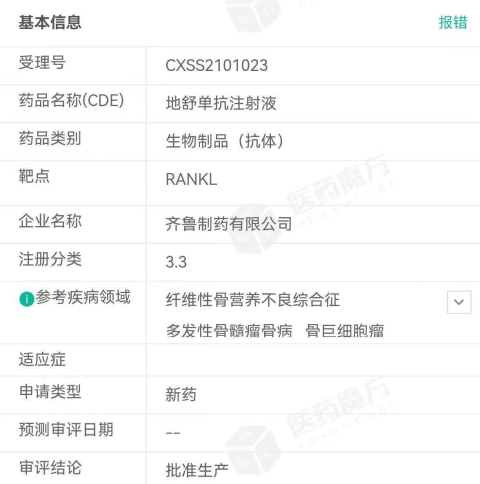
About Denosumab Injection Ludacin
Rudaxin is a biosimilar of denosumab 120mg developed by Qilu Pharmaceutical, which can bind to RANKL with high affinity and inhibit osteoclast activation. Qilu Pharmaceutical strictly followed the biosimilar research guidelines, after ten years of research and development, through a series of comparative studies in pharmaceuticals, non-clinical, and clinical trials, progressively and scientifically confirming the overall similarity of this product to the original reference drug, supporting the safety, efficacy, and quality control of this product. Qilu Pharmaceutical published the Phase I and Phase III clinical study results of Rudaxin in "Frontiers in Pharmacology" and "BioDrugs" in 2020 and 2023 respectively. The studies demonstrated that Rudaxin is similar to the original denosumab in pharmacokinetics, pharmacodynamics, clinical efficacy, and safety. Its Phase III clinical efficacy comparison study conducted in patients with bone metastases from solid tumors was also first presented at the ASCO 2022 meeting.
02
Rudaixin Improves Disease-Free Survival Rate for Chinese Patients with Giant Cell Tumor of Bone, Bringing Multiple Benefits
Giant Cell Tumor of Bone (GCTB) is a common primary bone tumor with locally aggressive growth in clinical practice in China. Its incidence accounts for approximately 23.96% of all primary benign bone tumors and 11.61% of primary bone tumors, which is higher than the 3%-8% reported in foreign literature.[1]。
The main pathogenesis of GCTB lies in the high expression of RANKL in stromal cells, which activates osteoclasts, thereby leading to tumor growth and bone resorption.[2]Although the vast majority of giant cell tumors of bone are benign, if left untreated, they can frequently cause damage to the bone, leading to bone pain, swelling, loss of mobility, and pathological fractures.[15]。
Rudaxin can inhibit osteoclast activation and reduce the recurrence of GCTB by high-affinity binding to RANKL.[16]The latest analysis results show that, the prognosis of patients with giant cell tumor of bone treated with Denosumab has significantly improved. For patients whose tumors can be surgically removed, after treatment with Rudaixin, they only need to undergo surgery with less functional impact, or even be exempted from surgery; for patients whose tumors cannot be surgically removed, treatment with Rudaixin can achieve long-term disease control and significantly improve disease-free survival rate.[3]。
03
Denosumab Offers Survival Hope and Improves Quality of Life for Chinese Patients with Bone Metastases from Solid Tumors and MM
Bone is the most common metastatic site in advanced malignant tumors. With the continuous improvement of cancer treatment, the overall survival of patients has significantly increased, and the incidence of bone metastases has also risen. Bone metastases are frequently observed in advanced lung cancer, breast cancer, and prostate cancer, with occurrence rates of 30-40%, 65-75%, and 65-75% in these late-stage patients, respectively.[4]. The incidence of osteolytic lesions in multiple myeloma patients is even higher, reaching 90%.[5]。
The main pathogenic mechanism of bone metastasis is the binding of Receptor Activator of Nuclear Factor-κB (RANK) and Receptor Activator of Nuclear Factor-κB Ligand (RANKL), which transmits signals to activate osteoclasts, subsequently activating dormant tumor cell micro-metastases, leading to proliferation.[6]Once bone metastasis occurs, it can lead to a series of skeletal-related events (SREs) such as pathological fractures, spinal cord compression, bone pain, and bone radiation therapy, significantly shortening the overall survival of advanced patients, affecting their quality of life, increasing economic burden, and representing a significant unmet need.[7][8][9][10][11]。
Denosumab can inhibit osteoclast activation by preventing RANKL from binding to RANK, thereby reducing the occurrence of SREs. In multiple studies on solid tumors such as lung cancer, breast cancer, and prostate cancer, it has been confirmed that denosumab significantly delays the occurrence of SREs in advanced patients compared to zoledronic acid, alleviates bone pain, prolongs survival, and improves quality of life.[12][13][14][15][16][17]Qilu Pharmaceutical is also advancing the launch of Rudaxin for tumor bone metastasis and MM indications.
04
Rudaixin Benefits a Wide Range of Chinese Patients, Supporting Healthy China 2030
Rudaixin Brings New Treatment Options for Patients with Giant Cell Tumor of Bone, Making Another Breakthrough in China’s Tumor Bone-Modifying Drug Field. The recent marketing approval granted by the National Medical Products Administration (NMPA) marks the official entry of Rudaixin, a groundbreaking product, into clinical use. This provides new hope for a wide range of cancer patients, significantly improving drug accessibility and treatment adherence among Chinese patients. It will help more cancer patients overcome treatment challenges and contribute to the realization of the grand blueprint of Healthy China 2030.
05
Qilu Vision
Zhang Minghui, Vice President of Qilu Pharmaceutical Group and Dean of the Drug Research Institute, stated: "Whether it is giant cell tumor of bone or bone metastasis from tumors, both can lead to adverse events such as pathological fractures and bone pain, posing a serious threat to patient survival. The approval of Ludaxin® will bring hope to a wide range of patients in China, improving accessibility, extending survival, and enhancing quality of life." Qilu Pharmaceutical will continue to uphold the philosophy of "Excellence in Medicine, Serving the Nation and the World," taking societal needs as its responsibility, relying on advanced science and technology, and advancing with the times. It is committed to developing innovative products that address diseases posing serious threats to human health, fulfilling unmet needs of patients in China. Finally, we extend our gratitude to the patients, medical professionals, and relevant government departments who have made significant contributions to the approval of Ludaxin®.