On April 22, 2024, ImmunityBio, Inc. announced that the FDA had approved Anktiva (N-803) in combination with Bacillus Calmette-Guérin (BCG) for the treatment of BCG-unresponsive non-muscle invasive bladder cancer (NMIBC) with carcinoma in situ (CIS), with or without papillary tumors.
However, apart from its anti-tumor activity, many studies have shown that IL-15 itself also hasPromote tumor activity。IL-15 and Its Receptor
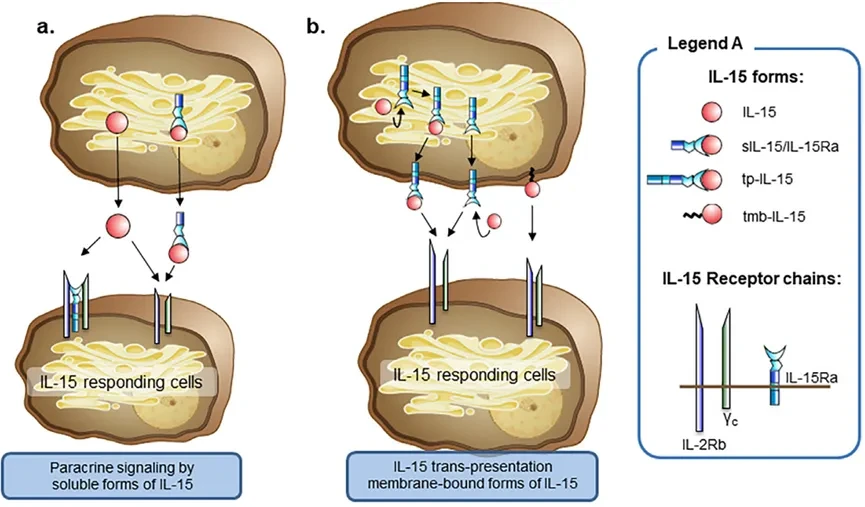
IL-15 is a pleiotropic cytokine, initially considered a T-cell growth factor, linking innate and adaptive immune responses in vivo. IL-15 belongs to the four α-helix bundle cytokine family and is co-produced by various types of cells, such as monocytes, macrophages, dendritic cells, stromal cells, epithelial cells, etc.IL-15 Exists in Four Functional Forms- Soluble monomer form (soluble IL-15, sIL-15)
- Soluble Complex sIL-15/IL-15Rα
- Transpresentation (transpresented IL-15, tp-IL15)
- Transmembrane form (transmembrane IL-15, tmbIL-15)
IL-15 Receptor
IL-15 binds to the IL-2Rβ/γc heterodimer (shared with IL-2, formed by IL-2Rβ and γc chains).IL-2Rβ/γcDimer receptor toMedium Affinity BindingIL-15 (Kd=0.27 to 2.5 nM). Signals are transduced intracellularly by activating the Jak/Stat pathway (Jak 1 and 3, Stat3 and 5).IL-15RαThe chain is specific to IL-15 andHigh AffinityBinding to cytokines (Kd=10-80pM). IL-15Rα forms a high-affinity trimeric receptor with IL-2Rβ and γc chains, allowing cells to respond toLow concentration of IL-15Respond. IL-15Rα itself can also undergo signal transduction.Journal for ImmunoTherapy of Cancer 2020- sIL-15CombinationMediumAffinity dimer IL-2Rβ/γc receptor orHigh AffinityTrimeric IL-15Rα/IL-2Rβ/γc receptor.
- sIL-15/IL-15RαComplexOnly binds to IL-2Rβ/γc receptors
- tpIL-15With MembraneIL-15RαChain Binding
- tmb-IL-15Anchored on the cell membrane through an IL-15Rα-independent mechanism, both of these bind to the IL-2Rβ/γc receptor (trans-presentation). tp-IL-15 is either assembled intracellularly before appearing on the cell membrane surface, or sIL-15 may bind to the cytokine-free membrane-bound IL15Rα.
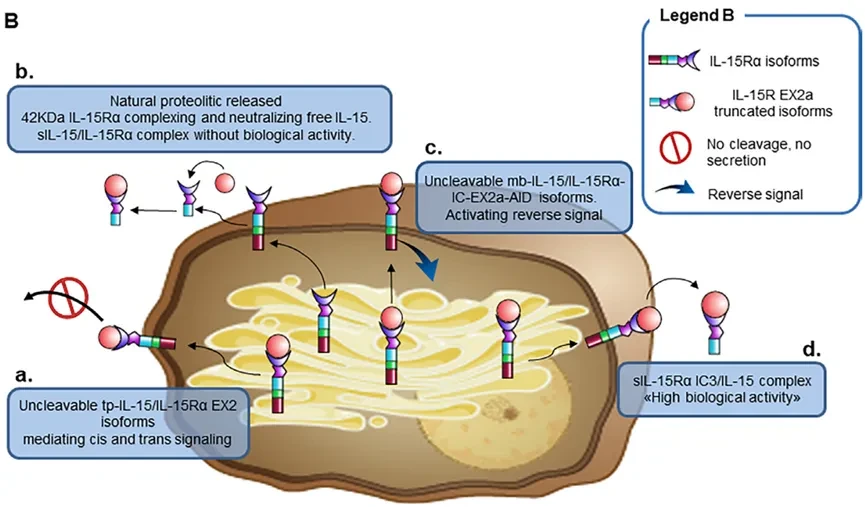
Journal for ImmunoTherapy of Cancer 2020The non-cleavable tp-IL-IL-15/IL15Rα complex, carrying the IL-15Rα EX2 subtype, mediates both cis and trans signaling.
sIL-IL-15/IL-15Rα complex carries NPR-IL-15Rα without biological activity (NPR, natural proteolytic release).
The non-cleavable IL-15/IL-15Rα complex carries the IL-15Rα-IC-EX2a-AID subtype, mediating reverse signaling.
The sIL-15/IL-15Rα complex carries the IL-15Rα-IC3 subtype and exhibits high biological activity.
IL-15 Promotes Tumor Progression
IL-15 mayPromoteCertainExpressing IL-15 ReceptorGrowth of Malignant Cells, such as human T-cell leukemia cells, cutaneous T-cell lymphoma (CTCL) cells, large granular lymphocyte (LGL) leukemia cells, and multiple myeloma.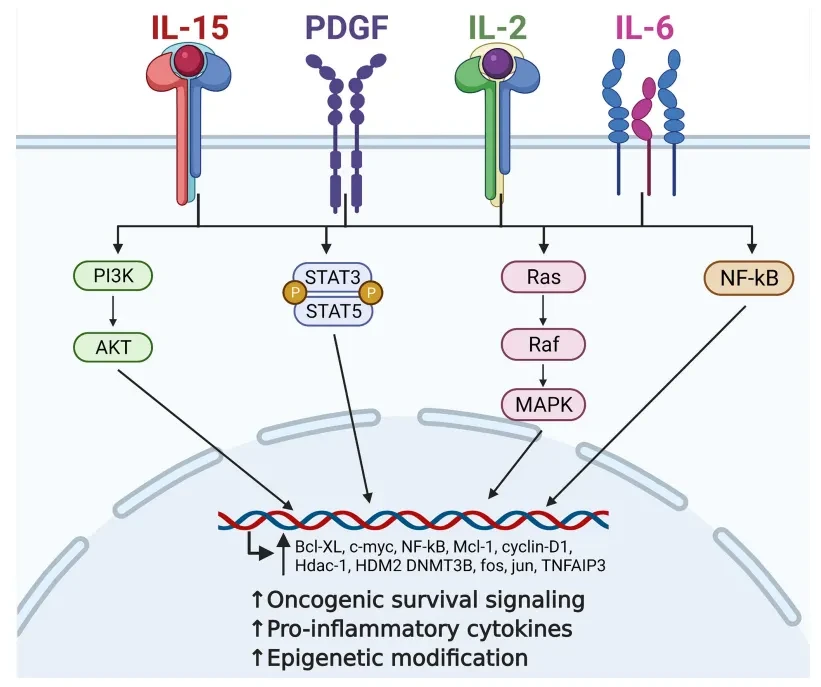
sIL-15RαPresent at low levels in the serum of healthy individuals, but highly expressed under disease conditions. For example, T-cell large granular lymphocyte leukemia (LGL) is characterized by elevated levels of sIL-15Rα in the serum, consisting of both the naturally shed form and alternatively spliced form of sIL-15Rα, potentially originating from different cells.In addition, IL-15Rα is upregulated in peripheral blood mononuclear cells of patients. The upregulation of IL-15Rα can protect IL-15 from proteolysis.Lowering the IL-15 Response Threshold in Cells, while the complex of sIL-15Rα with monomeric circulating IL-15 (sIL-15) may form a soluble complex. Both events could be involved in disease progression. Additionally, LGL cells express tp-IL-15, which can act through both cis and trans signaling.Promote the expansion of leukemia cells。IL-15Can serve as lymphoma patientsMalignant T CellsTheGrowthAndSurvival Factor. Skin lesions and PB T cells in patients with cutaneous T-cell lymphoma show overexpression of both IL-15 mRNA and protein. In these patients,Malignant CD4+ T CellsSurvival inDependent on IL-15 provided by the microenvironment in the early stage, but in the process of disease progression, malignant cells throughAutocrine IL-15The production may autonomously support their growth and survival.In human T-cell leukemia virus-induced leukemia, the viral Tax protein induces the production of IL-15 and IL-15Rα, and this IL-15 autocrine loop contributes to the progression of leukemia. In multiple myeloma, malignant plasma cells exhibit functional IL-15 receptors, increased expression of the IL-15Rα chain, and autocrine production of IL-15, all of which favor the survival and proliferation of malignant cells independently of their microenvironment.Head and Neck Squamous Cell CarcinomaElevated levels of sIL-15Rα in patient serum and higher intratumoral IL-15 concentrations are highly associated with poor clinical prognosis. Clinical research has reportedIntratumoral IL-15 ConcentrationAndLung CancerCorrelation between patients' poor clinical outcomes.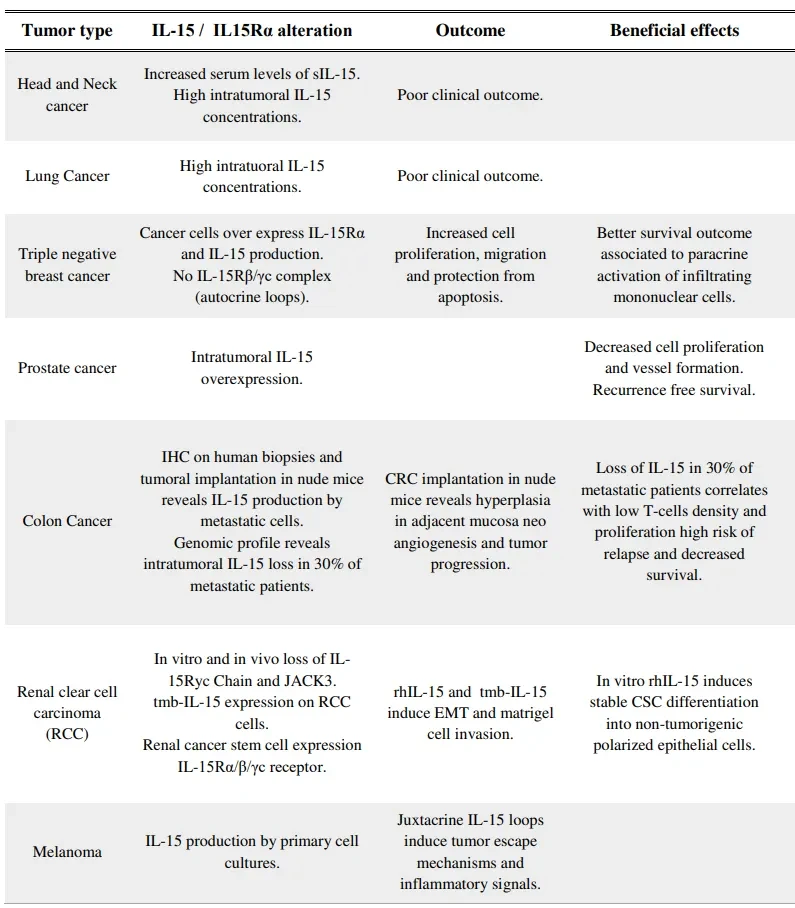
Journal for ImmunoTherapy of Cancer 2020
IL-15 Produced by Primary Melanoma Cell Cultures Participates in Tumor Escape Mechanisms and Pro-Inflammatory Signal Activation. Similarly, injecting low concentrations of human recombinant IL-15 (rhIL-15) into nude mice results in more aggressive tumors when human melanoma cells are subcutaneously implanted. High levels of sIL-15/IL-15Rα detected in the serum of patients with metastatic melanoma suggest that intratumoral and/or circulating sIL-15/IL-15Rα complexes may contribute to the development of a tumor microenvironment favorable for tumor progression and immune escape.Intrarenal IL-15 is produced by tubular and cortical cells and plays a crucial role in maintaining epithelial cell homeostasis. In contrast,Renal Clear Cell Carcinoma (RCCs)Does not secrete IL-15, butExpress tmb-IL-15In RCCs, both recombinant IL-15 (rhIL-15) and tmb-IL-15 can transduce an imbalanced signal, promoting epithelial-mesenchymal transition, thereby acting as tumorigenic factors. In contrast,Renal Cancer Stem CellsExpresses the IL-15Rα/IL-2Rβ/γc heterotrimeric receptor. When stimulated by rhIL-15, it promotes the generation of polarized, non-tumorigenic, and IL-15 secreting epithelial cells, which, like "normal cells," are capable of autocrine IL-15 secretion. Thus, IL-15 may exhibit both pro-tumor and anti-tumor effects, depending on the renal cell carcinoma cell subpopulation involved.Immunostaining was performed on 70 biopsy samples of colon cancer, and human colon cancer cells were implanted into nude mice. The results showed that IL-15 is produced by metastatic colon cancer cells, which can induce mucosal hyperplasia near the colon cancer, thereby promoting angiogenesis and tumor progression. In addition, IL-15 promotes the proliferation, motility, and invasiveness of human colon cancer cells in vitro and increases their resistance to apoptosis. In contrast, in human patients, the absence of IL-15 expression in approximately 30% of metastatic patients is associated with lower T-cell density, reduced T-cell proliferation, a higher risk of recurrence, and decreased survival rates.ANKTIVA Approved:https://ir.immunitybio.com/news-releases/news-release-details/immunitybio-announces-fda-approval-anktivar-first-class-il-15?field_nir_news_date_value[min]=Azzi S, Gallerne C, Romei C, et al. Human renal normal, tumoral, and cancer stem cells express membrane-bound interleukin-15 isoforms displaying different functions. Neoplasia 2015;17:509–17.Yuan H, Meng X, Guo W, et al. Transmembrane-Bound IL-15- Promoted epithelial-mesenchymal transition in renal cancer cells requires the Src-dependent Akt/GSK-3β/β-catenin pathway. Neoplasia 2015;17:410–20.Fiore PF, Di Matteo S, Tumino N, et al. Interleukin-15 and cancer: some solved and many unsolved questions. Journal for ImmunoTherapy of Cancer 2020;8:e001428. doi:10.1136/jitc-2020-001428Isabelle C, Boles A, Chakravarti N, Porcu P, Brammer J and Mishra A (2022) Cytokines in the Pathogenesis of Large Granular Lymphocytic Leukemia. Front. Oncol. 12:849917. doi: 10.3389/fonc.2022.849917