

Breaking the 5-Year 5% Survival Barrier: Merck and Chinese Biotechs Forge Ahead in the SCLC Blue Ocean Market

GSK
Pharmaceutical R&D Manufacturer

MSD
Pharmaceutical R&D and Manufacturer
How can pharmaceutical companies find those hidden blue ocean markets?
Some cancer types lack subsequent treatment options after developing resistance to first- and second-line therapies, presenting significant market opportunities. Even in the highly competitive lung cancer field, where companies like AstraZeneca, MSD, BMS, Johnson & Johnson, Junshi Biosciences, and BeiGene have primarily focused on non-small cell lung cancer (NSCLC), the small cell lung cancer (SCLC) area has seen much less attention.
Although SCLC patients account for only 15%, two-thirds of them are already in the extensive stage, which cannot be cured at the time of diagnosis. Even for limited-stage patients diagnosed earlier, more than 75% will experience recurrence after radical treatment, and the 5-year survival rate is only about 5%, making it the most challenging subtype of lung cancer.
Despite the favorable initial response of SCLC to chemotherapy, recurrence or disease progression quickly follows. The development of drug resistance, particularly multidrug resistance, is a significant factor affecting SCLC treatment. Currently, options for second-line and later-line treatments for SCLC are extremely limited, with only a few approved drugs available. This means that if the disease progresses after first-line treatment, patients will face the dilemma of lacking effective subsequent treatment options.
On the other hand, with the intensification of competition, the development of new indications for NSCLC is becoming increasingly difficult. Some pharmaceutical companies have started to shift their innovation goals towards the SCLC field. Especially with breakthroughs in emerging target research, this niche area of SCLC is expected to welcome blockbuster products.
With the entry of MNCs, ADC is becoming a rising star in the SCLC field.
At the end of last year, MSD and Daiichi Sankyo reached a global development and commercialization agreement for three ADC pipelines in clinical development stages, with a potential total value of $22 billion ($4.5 billion upfront payment + $1 billion R&D milestone + $16.5 billion commercial milestone).
Compared to the other two deals, which require potential upfront payments of $1.5 billion each after a certain period, the B7H3 ADC (DS7300) project involves an immediate full upfront payment of $1.5 billion upon contract signing.
At almost the same time, GSK also entered the SCLC field by acquiring Hansoh Pharma's B7H3 ADC93 pipeline for $1.71 billion. Hansoh Pharma licensed the global rights (excluding Greater China) of B7H3 ADC HS-20093 to GSK in exchange for a $185 million upfront payment, $1.525 billion in milestone payments, and a certain percentage of sales royalties.
MSD and GSK are both interested in the B7H3 target due to its promising early clinical data, positioning it as a strong contender not only for small cell lung cancer but also offering hope to break new ground in colorectal cancer, head and neck cancer, prostate cancer, and squamous cell carcinoma of the lung.
Taking MSD's interest in DS-7300 as an example, it is the world's first B7H3-targeted ADC to enter Phase 3 clinical trials, with an estimated global enrollment of 1,307 patients. As of mid-April 2024, DS-7300 has initiated five clinical studies, including a Phase 3 clinical trial for second-line small cell lung cancer planned to begin in March 2024. Meanwhile, MSD/Daiichi Sankyo also plans to combine it with the PD-L1 inhibitor atezolizumab for a Phase 1/2 clinical trial in early-line extensive-stage small cell lung cancer.
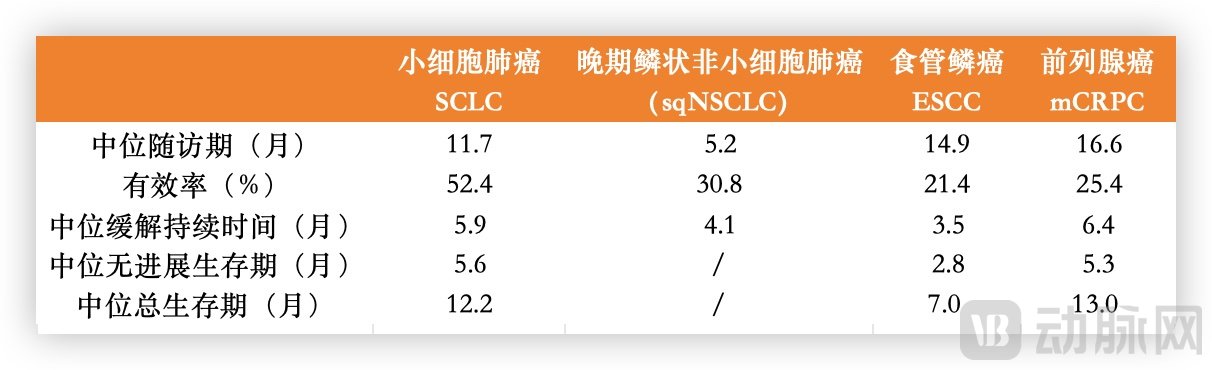
Partial clinical results of DS-7300, data sourced from publicly available information
DS-7300 Demonstrates Promising Antitumor Activity Across Multiple Solid Tumors. In the SCLC Subgroup, the Confirmed ORR Reached 53%, with a Median Time to Response of 1.2 Months; All Patients Showed Varying Degrees of Target Lesion Reduction. At the 2023 World Conference on Lung Cancer, Daiichi Sankyo Reported Results from an 11.7-Month Median Follow-Up in the SCLC Cohort: DS-7300 Showed Significant Efficacy in Later-Line Small Cell Lung Cancer Populations, with an ORR of 52.4%, mDoR of 5.9 Months, and mPFS of 5.6 Months.
At the same time, DS-7300 was well-tolerated, with manageable adverse events and a safety profile consistent with previous findings. In addition, DS-7300 has shown preliminary efficacy in studies on esophageal squamous cell carcinoma, castration-resistant prostate cancer, and NSCLC. Particularly in squamous cell carcinoma of the lung, an NSCLC subtype with a poorer prognosis, early clinical results have also been encouraging, which might be one of the reasons MSD values it.
HS-20093 is another deep collaboration between GSK and Hansoh Pharma following HS-20089. According to the clinical data of HS-20093 disclosed by Hansoh Pharma at the American Society of Clinical Oncology (ASCO), among 50 subjects who underwent at least one tumor assessment post-baseline, the objective response rate (ORR) and disease control rate (DCR) were 30% and 86%, respectively, with a median progression-free survival (mPFS) of 5.4 months.
In SCLC subjects, the ORR and DCR were 63.6% and 81.8%, respectively, with an mPFS of 4.7 months and a 3-month PFS rate of 72.7%. HS-20093 demonstrated excellent anti-tumor efficacy in subjects with various advanced solid tumors who had failed or were intolerant to existing standard treatments, particularly showing superior efficacy in small cell lung cancer.
To this end, Hansoh Pharma has launched multiple clinical studies targeting SCLC, squamous cell carcinoma of the head and neck, prostate cancer, as well as recurrent or refractory bone and soft tissue sarcomas, hoping to quickly advance and capture the market.
Prior to this, heavyweights like Opdivo (O药) and Keytruda (K药) aimed to expand their indications to SCLC. However, subsequent failures of Opdivo in two pivotal Phase 3 clinical trials, CheckMate-331 and CheckMate-451, along with Keytruda’s Phase 3 KEYNOTE-604 trial not meeting the OS endpoint, led both companies to withdraw their SCLC indications. As a result, only a few drugs remain available for SCLC.
Even though SCLC accounts for only 15% of lung cancer cases, the sheer size of the patient population remains substantial due to the large base. As emerging targets such as B7H3 and DLL3 are validated, there may be new hope for addressing the unmet clinical needs of patients.
The emergence of significant BD transactions indicates that B7H3 ADC is one step closer to commercialization, and domestic pharmaceutical companies are certainly not willing to lag behind.
Innovent Biologics Reports Full-Year 2023 Revenue of 6.206 Billion Yuan, with Product Revenue at 5.728 Billion Yuan, a Year-on-Year Increase of 38.4%. Innovent Biologics Also Announced That It Will Continue to Advance Clinical Research for Multiple ADC Therapies in 2024. Recently, Two B7H3 ADC Drugs Under Innovent Have Achieved New Progress.
In March this year, Innovent's B7H3 ADC drug IBI129 received implied permission for clinical trial application in China, with the indication for advanced malignant solid tumors. Meanwhile, IBI129 has already initiated clinical trials overseas. According to publicly available information, this drug is one of the differentiated molecules that Innovent Biologics plans to explore for its global innovation potential through a Phase 1 multi-center study conducted simultaneously in China and Australia.
In April, Innovent Biologics registered the B7-H3/EGFR bispecific ADC drug IBI3001 on the ClinicalTrials website for a Phase 1/2 clinical trial (NCT06349408) in various solid tumors, with a planned total enrollment of 180 participants.
IBI3001 is the world's first B7-H3/EGFR bispecific antibody-drug conjugate (ADC) to enter clinical stage, and the study was selected as a breakthrough research highlight at the 2024 American Association for Cancer Research (AACR) Annual Meeting. At the 2024 AACR, Innovent Biologics announced that IBI3001 features multiple enhanced mechanisms, particularly in the areas of enhanced EGFR signaling blockade, EGFR- and B7-H3-mediated payload internalization, cytotoxicity, and ADC bystander effects. IBI3001 demonstrated potent tumor-killing effects across various in vivo and in vitro models of solid tumors, with excellent pharmacokinetics and safety profiles.
Innovent Biologics is adept at quickly adjusting its strategy based on the latest trends in global drug development, as seen with previous biosimilars, PD-1, or GLP-1. In the ADC field, Innovent also shows a strong potential to catch up and surpass, whether it’s the first to enter Phase 3 clinical trials with CLND18.2 ADC, the rapid follow-up with B7H3 ADC, or the development of the B7-H3/EGFR bispecific antibody-drug conjugate. Innovent has begun to engage in industry competition through differentiated innovation.
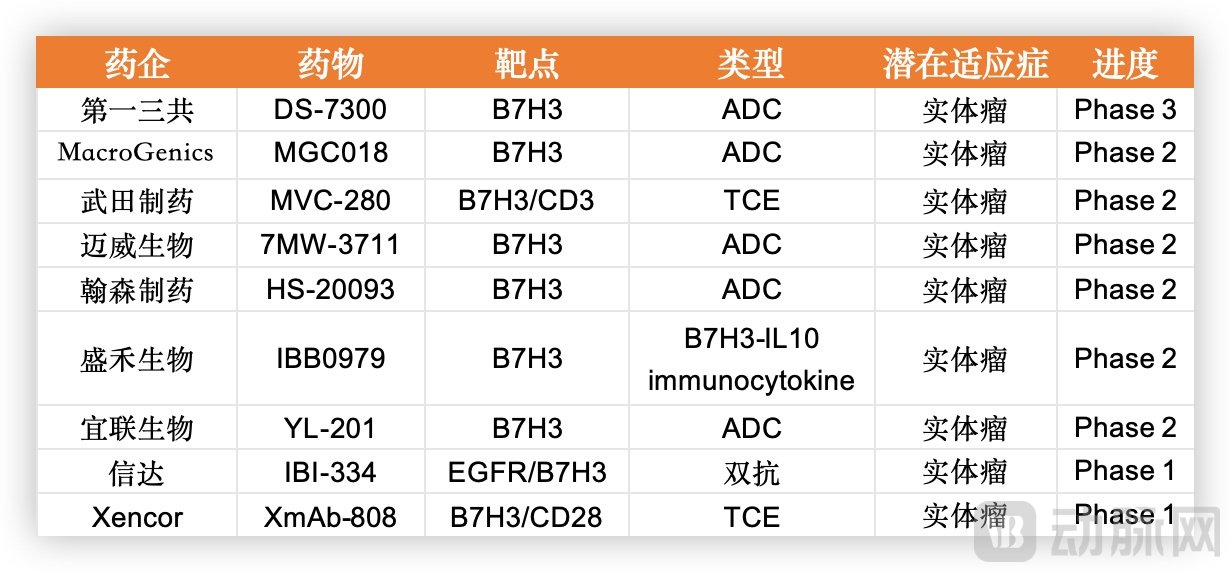
Data on B7H3 drugs with faster progress, compiled based on publicly available information
In February 2024, Mabwell announced that the FDA had approved the clinical trial application for 7MW3711, a B7-H3-targeted ADC drug developed based on its novel antibody-drug conjugate technology platform IDDC, allowing the initiation of clinical trials in patients with advanced malignant solid tumors.
As early as July last year, 7MW3711 was approved by the NMPA for clinical trials in patients with advanced malignant solid tumors. 7MW3711 is a next-generation antibody-drug conjugate molecule developed by Mabwell with full intellectual property rights. After being injected into the human body, it can bind to antigens on the surface of tumor cells and enter the tumor cells, where specific enzymatic cleavage releases small molecules in a targeted manner, thereby achieving precise tumor killing.
In fact, in the past two years, Mabwell has advanced multiple ADC drugs into clinical stages. Thanks to its self-developed IDDC technology platform, the new generation of ADC drugs developed by Mabwell exhibit better structural uniformity, quality stability, efficacy, and tolerability.
In addition to Hansoh, Innovent, and Maiwei, Innolake also announced in March that the clinical application of its B7H3 ADC drug ILB-3101 for patients with advanced solid tumors has been officially accepted by the NMPA. Yilian Biotech's B7H3-targeted ADC drug YL-201, developed through its self-innovated TMALIN technology platform, is already in Phase 2 clinical trials.
From the current competitive landscape of B7H3 ADC, Chinese pharmaceutical companies have invested significant efforts in this popular target. Some pipelines have already achieved promising clinical data, demonstrating strong competitiveness. However, they still need to accelerate their progress to catch the first wave of commercialization dividends.
Beyond ADC, TCE bispecific antibodies also show strong competitiveness in the SCLC field.
In recent years, the indications for TCE bispecific antibodies have mainly been hematological tumors, but they have also shown remarkable potential in solid tumors. Although the tumor microenvironment of solid tumors is difficult to infiltrate, making it a challenge for CAR-T to overcome solid tumors, TCE bispecific antibodies can activate T cells by binding to T cells within the tumor tissue, thereby achieving the treatment of solid tumors.
By the end of 2023, Amgen announced that the FDA had accepted the BLA application for its DLL3 TCE bispecific antibody new drug Tarlatamab (AMG757) and granted it priority review for the treatment of adult patients with advanced small cell lung cancer whose disease has progressed after platinum-based chemotherapy. BeiGene holds the commercial rights to this drug in China.
From the key clinical DeLLphi-301 data of AMG757, with intravenous infusion once every two weeks and over 10 months of follow-up, the ORR in the 10mg and 100mg groups reached 40% and 32%, respectively, and the mDOR was at least 6 months. The mPFS for the two groups were 4.9 months and 3.9 months, respectively. Compared to MSD’s DS-7300 (non-head-to-head), the efficacy was comparable, and there were no issues with interstitial pneumonia in terms of safety.
DLL-3 and B7H3, two new drugs with relatively rapid progress, belong to different mechanisms of action and drug formats, thus presenting a possibility of combination use if safety permits.
SCLC is highly sensitive to chemotherapy, but it is also a type of cancer prone to metastasis and drug resistance. Therefore, despite the high ORR values of ADC drugs, which are essentially chemotherapy-based, early clinical data from B7H3 ADC and DLL-3 ADC in the SCLC field show no significant advantage in survival data such as mDOR and mPFS. On the contrary, DLL-3 TCE, which belongs to immunotherapy, has demonstrated better survival benefits and holds more practical value for patients with advanced stages.
Currently, camptothecin-class drugs are commonly used for second-line treatment of SCLC, and the payloads of the new generation of ADCs are also mostly camptothecin-class. This means that whether used in first-line or second-line treatment, the overall OS benefit for patients is limited. Unless there is a breakthrough in SCLC chemotherapy, the limitations of ADC drugs will continue to exist. In contrast, the theoretical application of TCE in later lines may offer greater benefits to patients.
Considering that DLL-3 TCE and B7H3 ADC have already been validated, it is highly likely that B7H3 TCE will achieve a breakthrough and become a promising pipeline. Currently, there are not many pharmaceutical companies globally developing the B7H3 TCE pipeline. Overseas, Takeda has the fastest progress, currently in Phase 2 clinical trials, while in China, Adagene and Guangzhou iStarBio are leading the way.
ADC wins by quantity, while immunotherapy prioritizes quality; the two are complementary and hold potential as a breakthrough in the SCLC field.
As a major cancer type, the competition in the lung cancer market has never ceased.
At the end of April, various pharmaceutical companies successively announced their Q1 results. AstraZeneca's Q1 revenue reached $12.6 billion, a year-on-year increase of 19%; sales in the Chinese market amounted to $1.748 billion, a year-on-year increase of 13%; the oncology sector led the way with sales reaching $5.1 billion, a year-on-year increase of 26%.
By the end of 2023, AZ's products will be able to cover more than half of lung cancer patients, making it a global leader in the field of lung cancer treatment. As the only company currently with a presence in immunotherapy, targeted therapy, and ADC for lung cancer, several of AZ's lung cancer drugs have achieved high revenue, with Imjudo and Enhertu seeing year-over-year growth exceeding 70%. However, in the SCLC space, there has been no noticeable activity from AZ regarding the two recently popular targets, B7H3 and DLL-3. Whether AZ will take action in the future remains to be seen.
Meanwhile, MSD, another giant in the lung cancer market, has a more extensive layout.
In Q1 2024, MSD's revenue reached $15.8 billion, a year-on-year increase of 9%. Among this, Keytruda's sales amounted to $6.947 billion, marking a 24% year-on-year growth. Despite a high base, Keytruda still achieved significant growth. Keytruda’s continuous growth is related to its strong position in the non-small cell lung cancer (NSCLC) field.
In 2023, the FDA approved Keytruda (K药) in combination with platinum-based chemotherapy as a neoadjuvant treatment before surgery and as a single-agent adjuvant treatment after surgery for patients with resectable non-small cell lung cancer (NSCLC). Additionally, Merck & Co., Inc. initiated a Phase 3 clinical trial of the KRAS G12C inhibitor MK-1084 in combination with Keytruda for metastatic NSCLC. The approval of the new therapy further solidifies Keytruda's position in the field of lung cancer.
With Keytruda as the foundation, MSD has begun a comprehensive expansion into lung cancer, particularly focusing on the SCLC field by targeting two important emerging targets, B7H3 and DLL-3. This includes preparing to launch the Phase 3 clinical study of MK-2400 for SCLC and acquiring Harpoon to obtain the core DLL-3 TCE pipeline for SCLC and neuroendocrine tumors. MSD also places significant emphasis on expanding indications for lung cancer, including collaborations with Daiichi Sankyo to develop ADCs and partnerships with Kelun-Biotech for SKB-264.
Not only AstraZeneca and MSD, but also Roche, Pfizer, Novartis, and Johnson & Johnson are competing in the lung cancer treatment market by targeting different driver gene mutations. However, progress in the SCLC field has been relatively slow. In the past, only PD-L1 inhibitors from AstraZeneca, Roche, Hengrui Medicine, and Fosun Henlius were available, with limited overall benefit—ORR and mPFS were comparable to chemotherapy, and mOS was only 2-3 months longer than chemotherapy.
According to World Health Organization data, the total number of new lung cancer patients in China in 2022 was approximately 815,000. Calculating based on the 15% proportion of small cell lung cancer (SCLC), there were over 120,000 new patients in China that year. Therefore, SCLC is currently a blue ocean field with many patients but few drugs. Emerging targets DLL-3 and B7H3, with positive clinical data, are expected to unlock a vast blue ocean market for small cell lung cancer.
The development direction of precision treatment will not change; uncovering the hidden blue ocean market in niche fields is the key to future competition.