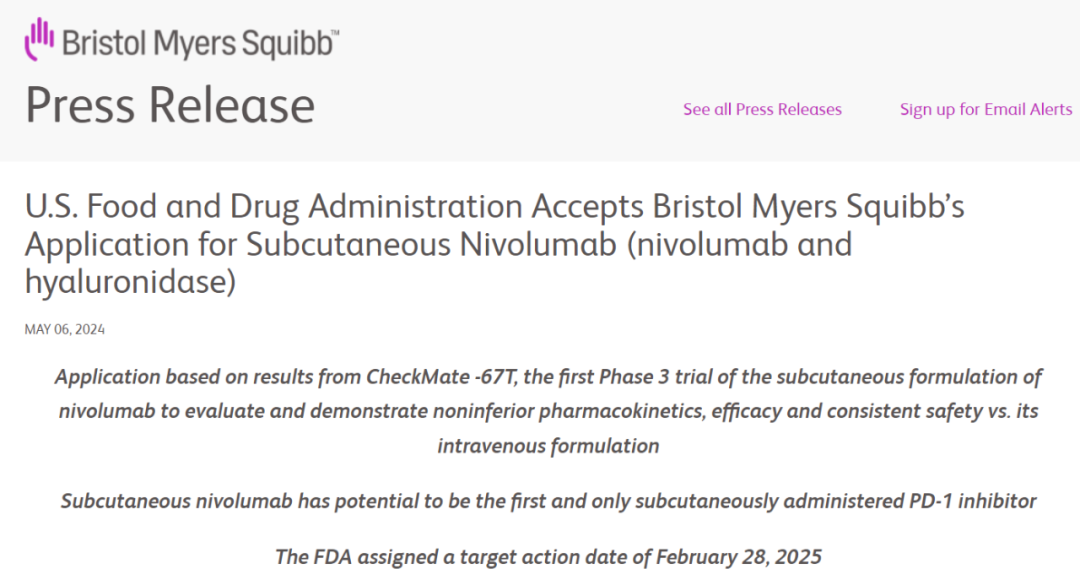
May 6,BMSAnnounce that the FDA has acceptedNivolumab (Opdivo,nivolumab) Subcutaneous injection preparationsBiologics License Application (BLA), can be used forAll solid tumor indications previously approved for Opdivo, including monotherapy and combination therapyIpilimumabMaintenance monotherapy after treatment, with chemotherapy orCabozantinibUsed in combination. The PDUFA date is February 28, 2025, and it is expected to become the first subcutaneously injected PD-1 inhibitor to be approved for marketing.
NivolumabUstekinumab Subcutaneous Injection Formulation byNivolumabUstekinumab andHalozyme's proprietary recombinant human hyaluronidase PH20 (rHuPH20).
This marketing application is primarily based on aRandomized, Open-labelIPhase II CheckMate-67T Study(N=495)Data, the studyAim to evaluate subcutaneous injection versus intravenous infusion of nivolumabLiyudanabIn patients previously treated with systemic therapyAdvanced or Metastatic Clear Cell Renal Cell Carcinoma (ccRCC)Efficacy in patients.
The results showed,AndCompared with intravenous infusion of nivolumab, subcutaneous injection of nivolumab demonstrated non-inferiority in terms of the average serum concentration over 28 days (Cavgd28) and the steady-state serum trough concentration (Cminss), achieving the co-primary endpoints.The geometric mean ratios were 2.098 (90% Cl: 2.001-2.200)、1.774 (90% CI: 1.633-1.927)。
The key secondary endpoint, objective response rate (ORR), also demonstrated non-inferiority.The ORR of patients in the subcutaneous injection nivolumab group was 24.2%, while the ORR of patients in the intravenous infusion group was 18.2% (RR=1.33; 95% CI: 0.94-1.87), demonstrating non-inferiority; the PFS of patients in the subcutaneous injection nivolumab group was 7.23 months, while the latter value was...For 5.65 months.
In terms of safety,Subcutaneous injection of Nivolumab is consistent with intravenous infusion. The incidence of local injection site reactions with subcutaneous Nivolumab is 8.1%, all of which are low-grade and transient. Additionally,For subcutaneous injection and intravenous injection formulations, the proportions of patients experiencing grade 3-4 adverse events (AE) were 35.2% and 40.8%, respectively.The incidence rates of treatment-related AE were 9.7% and 14.7%, the incidence rates of serious AE were 21.1% and 22.9%, and the incidence rates of treatment-related serious AE were both 6.5%.Copyright © 2024 PHARMCUBE. All Rights Reserved.
Welcome to forward, share, and reasonably cite. When citing, please clearly indicate the source of the article in a prominent position.For reprint, please leave a message to the WeChat Official Account backend or send a message, and indicate the name and ID of the official account.
Disclaimer: The information in this WeChat article is for general reference only and should not be directly used as decision-making content. PharmaCube assumes no responsibility for any loss incurred by any party due to the use of the content herein.