▎WuXiEdited by Kant Content Team
Today, Eli Lilly and Company announced,The Peripheral and Central Nervous System Drugs Advisory Committee (PCNS) of the U.S. FDA will meet on June 10, 2024, to discuss the marketing application for donanemab, an Alzheimer's disease (AD) antibody therapy developed by Eli Lilly and Company, for the treatment of early symptomatic Alzheimer’s disease.In addition to directly impacting the final approval of donanemab, many experts believe that the outcome of this advisory committee meeting will also have a profound influence on the development of therapies across the entire AD field. Today, the content team at WuXi AppTec, based on publicly available information, highlights potential focal points that may be addressed and discussed during the upcoming advisory committee meeting.

The Basis for Donanemab's Market Application
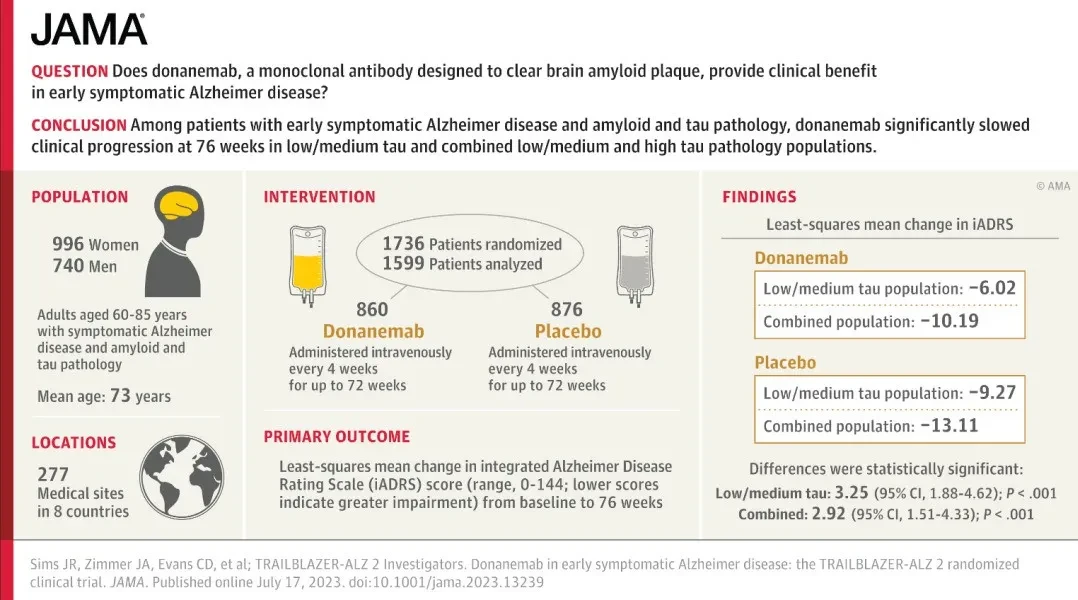
Alzheimer's disease is the most common neurodegenerative disorder in the elderly, with amyloid plaque deposition being a hallmark feature in the brains of patients. Targeting amyloid is one of the key directions in the development of new drugs for Alzheimer's disease.Donanemab specifically binds to a subtype of amyloid protein known as N3pG. By targeting this subtype, donanemab is able to selectively bind to amyloid plaques in the brain, thereby promoting the clearance of these plaques.▲TRAILBLAZER-ALZ 2 Trial Design and Results Summary (Image Source: Reference [4])
The marketing application of Donanemab is primarily based on the results of the Phase 3 study TRAILBLAZER-ALZ 2. This trial is a double-blind, placebo-controlled study.Aiming to evaluate the safety and efficacy of donanemab in patients aged 60-85 with early symptomatic Alzheimer's disease (AD) confirmed by neuropathological features, who have mild cognitive impairment or mild dementia due to AD.Participants were divided into low-to-moderate tau groups or high tau groups (a later pathological stage of disease progression) based on their tau levels as shown by positron emission tomography (PET) imaging. All participants were then evaluated over 18 months using scales that measure cognition and function, including the Integrated Alzheimer's Disease Rating Scale (iADRS) and the Clinical Dementia Rating – Sum of Boxes (CDR-SB, with higher scores indicating lower clinical function in patients). The trial recruited a total of 1,736 participants from 8 countries.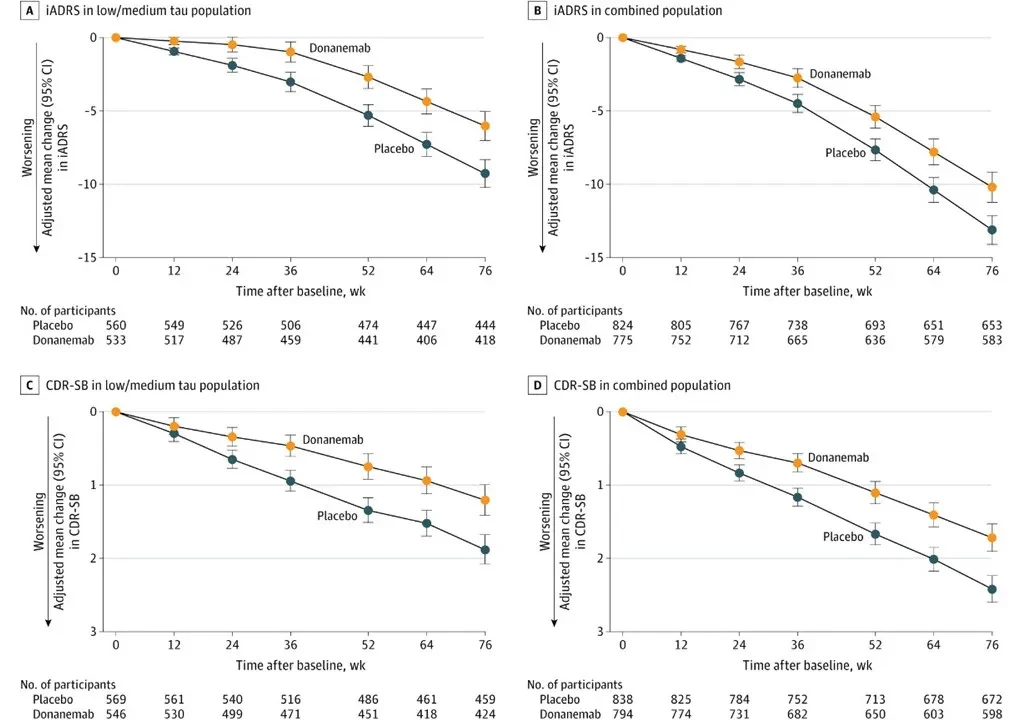 ▲Trial patients from baseline to 76 weeksiADRS andCDR-SB Change(Image source: Reference [4])Previously published results showed,Patients in the low-to-moderate tau group (n=1182)After receiving donanemab treatment, patients showed significant improvements of 35% and 36% in iADRS and CDR-SB indicators, respectively.In all amyloid-positive early symptomatic AD patients (n=1736), treatment with donanemab significantly improved iADRS and CDR-SB scores by 22% and 29%, respectively.Among patients with mild cognitive impairment (n=214), treatment with donanemab led to a 60% improvement in the iADRS metric and a 46% improvement in the CDR-SB metric.
Possible Issues of Concern at the Advisory Committee Meeting
The positive results shown by Donanemab in the trials have led to a widespread belief in the industry that the therapy will eventually be approved for marketing by the FDA.However, due to the unique design of the donanemab clinical trial, the FDA has been more cautious in its review. The drug label that will ultimately be approved is considered the focal point of the upcoming advisory committee meeting.Besides directly impacting the review of donanemab, Dr. Samuel Gandy, deputy director of the Alzheimer's Disease Research Center at Mount Sinai in New York City, believes that,The outcome of this meeting will also have a significant impact on the entire category of anti-amyloid AD therapies.This meeting will likely focus on the following topics for discussion:According to Eli Lilly, the FDA has expressed particular concern over the safety of donanemab. This is due to a higher incidence of amyloid-related imaging abnormalities (ARIA) observed in patients treated with donanemab compared to clinical trials of drugs with similar mechanisms. ARIA is an adverse reaction associated with amyloid plaque-clearing antibody therapies, typically presenting as temporary swelling (ARIA-E) or microhemorrhages (ARIA-H) in one or more regions of the brain, detectable via magnetic resonance imaging (MRI). ARIA is caused by the drug stimulating the immune system to clear amyloid deposits around cerebral blood vessels. Although ARIA does not always present with clinical symptoms, it can be fatal. Eli Lilly reported three ARIA-related deaths in its trials, a figure comparable to currently approved therapies.A major issue at the advisory committee meeting could be,Whether the differences in the incidence of ARIA in donanemab clinical trials are due to the drug itself or variations in the clinical trial designs.For example,This may be due toEli Lilly's trials tend to enroll patients with higher amyloid levels and slightly worse cognitive impairment test scores."These differences may simply be due to varying levels of amyloid in people's bodies," said Dr. Andrew Budson, a consultant for Eli Lilly and the director of cognitive and behavioral neurology at the Veterans Affairs Boston Healthcare System, in an interview with industry media Endpoints News. "Because if you have more amyloid in your brain, your immune response might be stronger."The Impact of Discontinuing Medication on AD PatientsAccording to the existing standard treatment for AD, once patients begin treatment, they usually use the drug for life to control clinical symptoms. However, in Eli Lilly's trial, once PET scans show that the drug has largely cleared amyloid plaques from the patient's brain, the patient can stop taking donanemab. Dr. Howard Fillit, co-founder and Chief Science Officer of the Alzheimer’s Drug Discovery Foundation, believes that compared to long-term use, this not only brings potential economic benefits but also offers significant clinical benefits for patients who no longer need to continue treatment. This is one of donanemab’s greatest potential advantages.Since the clinical trial only lasted for 18 months,This also raises questions for some experts: if those patients who discontinued medication continued treatment, would they achieve long-term clinical benefits?“I think one of the big things the advisory committee is going to discuss is whether it's appropriate to stop taking the drug just because a PET scan didn't find amyloid.Dr. Budson said.Moreover, in the real world, patients are less likely to undergo brain scans as frequently as they do in clinical trials, so it is unclear how doctors would know when to stop ordering brain scans.The Importance of Tau BiomarkersIn the design of the donanemab clinical trial, in addition to studying amyloid plaques in the brain, Eli Lilly and Company alsoBrainTau Protein Included in Analysis. For decades, the amyloid hypothesis has been a key explanation for the pathogenesis of Alzheimer's disease (AD). The accumulation of beta-amyloid (Aβ) in the brain, which eventually forms clumps known as plaques, is considered the primary cause of the disease. Amyloid plaques trigger the aggregation of tau proteins in the brain and their spread within neurons. Typically, when patients reach this stage, symptoms such as memory loss begin to appear.Eli Lilly discovered,Donanemab is more effective for patients under 75 with low to moderate tau levels, slowing cognitive decline by nearly 50%.Patients with higher tau levels and more severe conditions benefited less from the drug, with their condition only slowing down by about 20%.Experts praised Eli Lilly's tau analysis, which confirmed the long-standing hypothesis that people with lower tau levels are in better health. However, if the U.S. FDA requires doctors to test tau levels before prescribing medication, it could impose additional burdens and limitations on both patients and doctors, partly because tau imaging is not yet widely available. Although Eli Lilly tests patients' tau levels during enrollment,But the company believes that this is not necessary in the real world, as the trial results in the TRAILBLAZER program related to donanemab showed that patients can benefit from donanemab treatment regardless of their tau levels. Eli Lilly's innovative initiatives in the development of donanemab may bring significant changes to the entire AD treatment field.This meeting of the advisory committee is also expected to have varying degrees of impact on the development of other AD therapies under research, including another AD antibody therapy by Eli Lilly, remternetug, and AbbVie's amyloid-targeting antibody ABBV-916.It is expected that the discussions among these experts at the conference will ultimately bring a positive impact to the entire AD field, enabling AD patients to receive more effective and safer treatments.
▲To learn more about the application of cutting-edge technologies in the biopharmaceutical industry, please long-press and scan the QR code above to access "WuXi Live Studio" and watch live discussions and exciting replays on related topics.
[1] Lilly Statement on FDA Advisory Committee Meeting on
Donanemab for Early Symptomatic Alzheimer’s Disease. Retrieved May 7, 2024 from https://investor.lilly.com/news-releases/news-release-details/lilly-statement-fda-advisory-committee-meeting-donanemab-early[2] Lilly gets a date with FDA to discuss Alzheimer's med
donanemab. Retrieved May 7, 2024 from https://www.fiercebiotech.com/biotech/lilly-gets-date-fda-discuss-alzheimers-med-donanemab[3] Five questions on the future of Lilly’s Alzheimer’s
drug, from Dunn’s legacy to ARIA. Retrieved May 7, 2024 from https://endpts.com/five-questions-on-the-future-of-lillys-alzheimers-drug-from-dunns-legacy-to-aria/[4] Sims JR, Zimmer JA, Evans CD, Lu M, Ardayfio P, Sparks
J, Wessels AM, Shcherbinin S, Wang H, Monkul Nery ES, Collins EC, Solomon P,
Salloway S, Apostolova LG, Hansson O, Ritchie C, Brooks DA, Mintun M,
Skovronsky DM; TRAILBLAZER-ALZ 2 Investigators. Donanemab in Early Symptomatic
Alzheimer Disease: The TRAILBLAZER-ALZ 2 Randomized Clinical Trial. JAMA. 2023
Aug 8;330(6):512-527. doi: 10.1001/jama.2023.13239. PMID: 37459141; PMCID:
PMC10352931.Disclaimer:WuXi AppTec Content Team Focuses on Introducing Global Biomedical and Health Research Progress.This article is for informational exchange only. The views expressed in the article do not represent the position of WuXi AppTec, nor does WuXi AppTec support or oppose the views mentioned in the article.This article is not a treatment recommendation.For guidance on treatment options, please visit a正规 hospital.Copyright Statement:This article is from the content team of WuXi AppTec. Individuals are welcome to share it on their social media circles, but unauthorized reproduction by media or institutions in any form on other platforms is strictly prohibited.For reprint authorization, please reply "reprint" on the "WuXi AppTec" WeChat Official Account to obtain reprint guidelines.

Share,PointLike,In View, Focusing on Global Biomedical Health Innovation