Source: Eye Future (Partially referenced from Shuling Medical Engineering Research Institute);Editor: Bai XiaofeiReprint requirements: Can be reprinted 24 hours after the first publication, with the source cited.In the global medical device industry, the top five sectors are in vitro diagnostics (13%), cardiovascular (12%), medical imaging (10%), orthopedics (9%),Ophthalmology (7%), while the proportion of ophthalmology in China is only 1%, with a 4-5 times improvement potential in treatment rate compared to the United States.。At this stage,The base number of patients with ophthalmic diseases in China is relatively large.The number of people suffering from refractive errors, dry eye syndrome, conjunctivitis, and cataracts has reached 700 million, 360 million, 260 million, and 180 million, respectively. The number of people with glaucoma, retinal diseases, and uveitis has also reached tens of millions.A large patient base brings a demand blue ocean.。The ophthalmology market is mainly divided into three categories: medical services, ophthalmic drugs, and ophthalmic devices, among which ophthalmic medical services account for more than 70%, making it the largest market.Next are ophthalmic devices, accounting for 16%., ophthalmic drugs are around 11%.High-value consumables in ophthalmology are mainly applied inIntraocular Lens for Cataract, Refractive Intraocular Lens, Orthokeratology LensThe three major fields have maintained rapid growth of 10%, 35%, and 20%, respectively, with both "essential demand + consumption" attributes.。
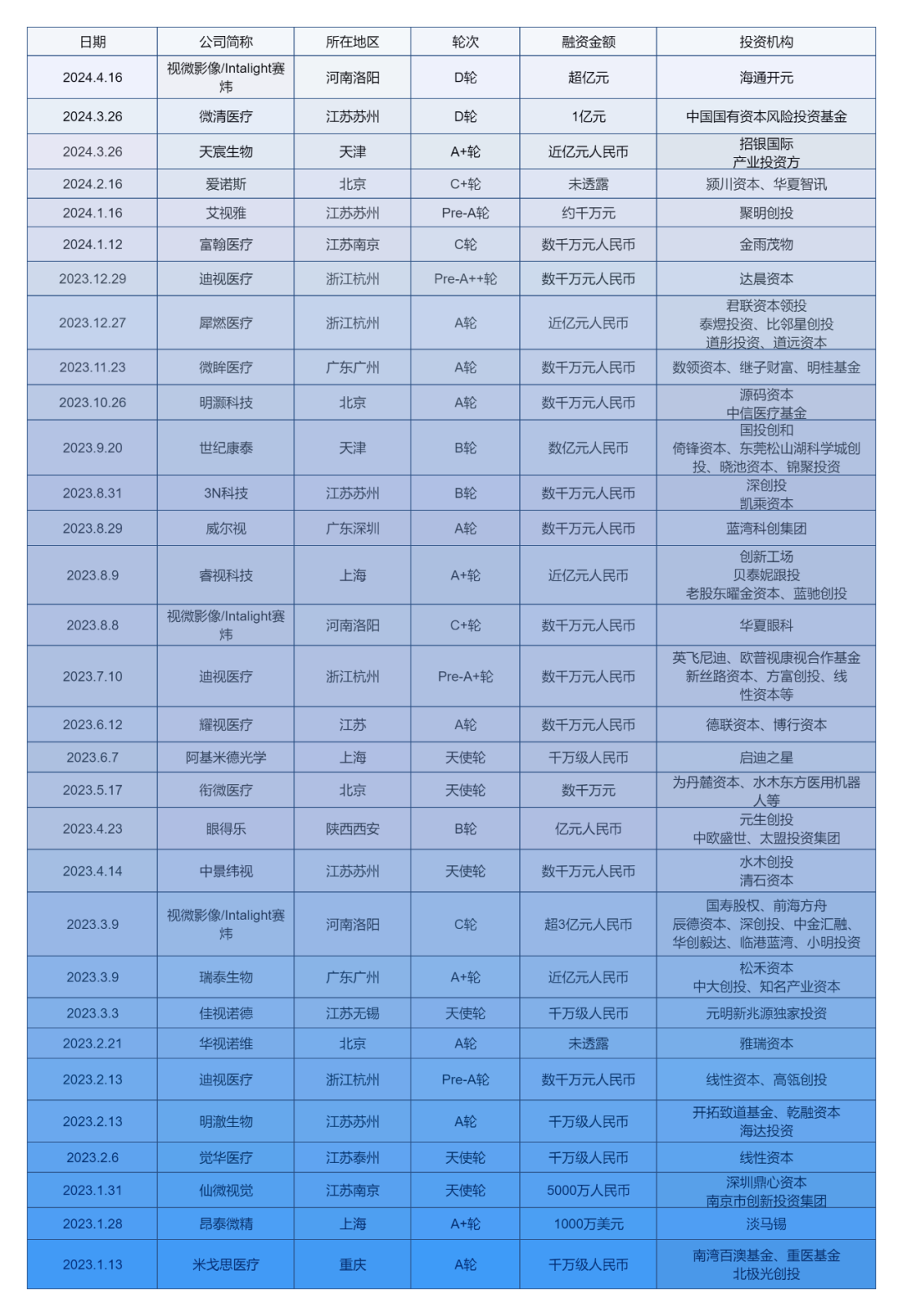
According to statistics,Since 2023, there have been 31 financing events in the primary market for ophthalmic medical devices.,Including Dessight Biomedical, Fuhan Medical, Intalight, Brisight Nord, Tianchen Biotech, Oculotronics, Microclear Medical, Rhino Health, FineVision, and other innovative companies securing financing. Behind them are prominent enterprises and investment institutions such as Huaxia Eye Hospital, Haitong Kaiyuan, Juming Venture Capital, Shenzhen Capital Group, Shuimu Ventures, Yuansheng Ventures, and CMB International.Among themThere were 9 financing events at the billion-yuan level, and the rest were at the tens-of-millions level, making it a relatively popular financing track.。
From 2023 to present, 31 investment and financing cases in ophthalmic devices:
Reasons for the Heat in the Ophthalmic Device TrackYan Yi, Managing Director of Shuimu Ventures, stated the following three points:
FirstOphthalmology is known as the "Golden Field of Ophthalmology." In the past, imported brands were primarily used for ophthalmic instruments.The import share of high-end ophthalmic devices is as high as 90%., soThere is a large space for domestically produced alternatives.。
Second:The production of ophthalmic instruments involves advanced precision manufacturing disciplines.High Industry BarriersOphthalmic medical devices or high-value medical consumables require a high degree of precision in optical processing, electromechanical manufacturing, and material synthesis. As a result, the global market share is currently concentrated in the hands of a few large international medical device manufacturers, with relatively low competition. Many types of ophthalmic devices have not yet reached a highly competitive "red ocean" state.
Third:Ophthalmic Optometry FieldWith strong consumer attributes, against the backdrop of centralized procurement, the risk of policy uncertainty is stronger.
# Analysis of Ophthalmology Investment and Financing Projects
(1) OK Lens Type: Orthokeratology lenses (OK lenses) already have more than 10 products approved and marketed in China, according to predictions from research institutions,By 2025, the OK lens market size can reach 43.1 billion yuan.. Secured financingCentury Kanton and WellvisionAll involve OK lens products, additionally3N TechnologyFocus on more细分的OK care products. In the process of using orthokeratology lenses, care products are indispensable, with an average annual per capita comprehensive expenditure exceeding 14,000 yuan. It is evident that...OK Lens Care Products Also Have a Promising Market Outlook。(2) Intraocular Lens Category: Intraocular lenses are another major high-value consumable in ophthalmology, aside from OK lenses. As the only effective treatment for cataracts, intraocular lenses come in different product specifications such as rigid, soft, single-focus, and multi-focus, with prices ranging from a few hundred to 20,000–30,000 yuan, among which...High-end soft multifocal products are still dominated by imported products.. InThe Increasing Volume of Cataract Surgeries and the Rise of Domestic SubstitutesUnder the logic of growth, artificial crystals remain an important track for enterprises and capital to compete for.(3) Testing Instruments:The main products that have obtained financing are ophthalmic OCT and high-definition fundus cameras.Vision Micro ImagingA total of 3 rounds of financing have been obtained.In the field of ophthalmic OCT, the market share of Chinese-produced products has exceeded 50%., toTopconAndVision Micro ImagingRepresentative domestic brands are gradually surpassing the performance of foreign brands.This field will enter a phase of comprehensive domestic substitution in the future, which is also an excellent moment for capital deployment.。According to the Sullivan High-End Ophthalmic Equipment Report,The high-definition ultra-wide-angle fundus camera is the product with the largest incremental market space and the fastest growth rate among all ophthalmic medical devices., with a compound annual growth rate of over 15%. However,The localization rate in this field is only 25%.Among them, Microclear Medical holds a certain market share. The "Zhuzhao" ultra-wide-angle fundus camera from Tupai Medical has just been launched. It adopts a four-color full-color imaging mode and has the capability to compete in the high-end market.(4) Optometric Products: Products of this type of projectFocusing on myopia prevention and control, involving optometry, myopia lenses, etc.Generally, myopia lenses are not considered medical devices, but they are an undeniable presence in the consumer healthcare field. With comprehensive layouts in high-end ophthalmic diagnostic and treatment equipment,Zeiss Achieves Revenue of 2.089 Billion Euros in 2023, an increase of 9.8% year-on-year.However, the main focus is on the eyewear market.European Optical GiantEssilorLuxottica's Full-Year 2023 Revenue Grew by 3.7% Year-on-Year to €25.395 Billion。(5) Glaucoma Treatment DevicesGlaucoma is the second leading cause of blindness globally, second only to cataracts, and it is also the world's leading cause of irreversible blindness. Common surgical treatments for glaucoma include laser surgery, aqueous humor drainage, and fluid diversion.In China, there are still few innovations in devices for glaucoma treatment.Huashinuowei, Mingche Bio, Migress MedicalCompanies worth paying attention to。(6) Other therapeutic devices: Some therapeutic device projects are not so concentrated in quantity, but that does not mean they can be ignored. For example,Focused on Dry Eye TreatmentTianchen BiotechTargeting a massive market scale of 360 million patients.Rhino HealthThe first phacoemulsification and vitrectomy integrated machine for cataracts is expected to achieve a "zero" breakthrough in the domestic production of this field in China.FineVisionThe full femtosecond laser corneal refractive surgery device is also exploring domestically produced full femtosecond laser technology.(7) Ophthalmic Surgical Robot: The small structure of the eyeball and its delicate vascular network demand extremely high precision and operational stability during surgery. Currently, it is also a critical stage before the domestic ophthalmic surgical robot enters the market.Oculotronics, Dessight Biomedical, FineVision, Anta MicrosystemsThe four leading contenders have all secured financing within the past year.# The Logic Behind Ophthalmology FinancingFrom the macro environment and industry analysis, respectively fromFrom the perspectives of clinical needs, technology, policy, and investment risksSummarized as the following four points:- Changes in disease spectrum, rising clinical demand, market expansionWith the intensification of the aging population trend,The incidence of ophthalmic diseases such as cataracts, glaucoma, and retinopathy continues to rise., China's challenges from demographic changes are becoming more severe; the widespread adoption of digital products,The Prevention and Control of Myopia in Adolescents is UrgentThe disease burden of high myopia is also increasing; changes in the clinical disease spectrum,Myopia is occurring at a younger age, and the age for corrective needs is increasing., the younger trend of presbyopia and the diversification of eye use demands have led to an increase in secondary refractive correction needs, thereby continuously driving the demand for innovative ophthalmic medical technologies and products, and the market is continuously expanding.
- Innovation Breakthrough, Technological Advancement, Industrial UpgradeWith the advancement of technology and the continuous emergence of innovations, the field of ophthalmology has also experienced wave after wave of technological revolutions. Laser treatment, high-end intraocular lenses, gene therapy, ophthalmic robots, AI, advanced drug delivery technologies, and more.The application of advanced technology provides entirely new solutions for the treatment of ophthalmic diseases.,Promoted the upgrading of the industrial structure, attracting a large influx of capital.
- From the perspective of health economics, the requirements of new quality productivity, and the promotion of various policiesThe improvement in economic levels and the process of modernization have increased the demand for human visual quality., has gone beyond the mere scope of physical health,Become an important part of people's quality of life and production efficiencyThis increased demand has, to a certain extent, also driven policy support at the national level for the development of ophthalmology from the perspective of health economics. Positive policies are reflected in the support for technology transfer, the establishment of science and innovation funds, the improvement of relevant product registration regulations, the establishment of green channels for innovative medical devices, and expedited approval policies.
- Specialty-Specific Attributes, Project Risks Relatively Controllable, Gaining Capital FavorThe ophthalmology medical market is relatively mature., especially the product development cycle of device consumables is relatively shorter compared to drug development., the investment return cycle is relatively controllable., which makes investors more willing to invest in ophthalmic enterprises.
# The Rising Track of Ophthalmic Devices
As one of the departments with the most extensive range of equipment,Main Equipment in Ophthalmology(Mainly including diagnostic equipment and therapeutic equipment)More than 30 types, while the main equipment types in general departments are around 5-10. Despite the large number of equipment,China currently has an extremely high import monopoly rate in the ophthalmic medical device industry.。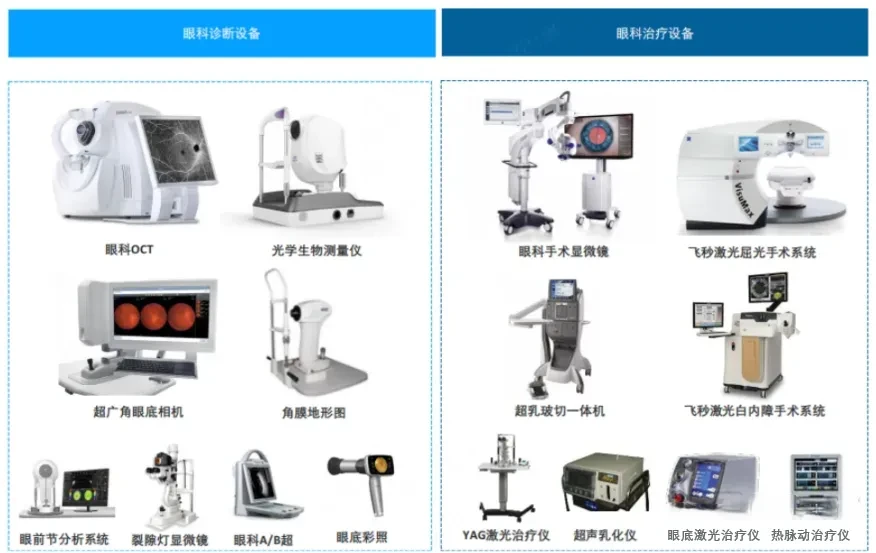
According to incomplete statistics, calculated by sales revenue,The market share of imported ophthalmic equipment suppliers has reached over 90%.Looking at the top brands in ophthalmic medical equipment, most are long-established high-end manufacturing giants from Germany, Japan, and the United States. Among them,Mid-to-high-end equipment is concentrated in hospitals at or above the secondary level, occupying the vast majority of the ophthalmic equipment market capacity.The sales of phacoemulsification and vitrectomy machines, femtosecond lasers, ophthalmic surgical microscopes, optical biometers, ophthalmic OCT, and ultra-widefield fundus cameras account for approximately three-quarters of the total sales of ophthalmic equipment. The import market share of phacoemulsification and vitrectomy machines and femtosecond lasers is nearly 100%.Taking femtosecond laser as an example, currently commonly used semi-femtosecond surgical systems in China are all imported brands, andIn the field of all-femtosecond surgical equipment, Carl Zeiss Meditec dominates the market., whose product VisuMax is the world's only equipment capable of performing full femtosecond surgeries.This reflects the past situation where domestic ophthalmic medical device companies had a significant gap in product technology strength compared to imported products and insufficient research and development. However, now,A number of Chinese innovators in mid-to-high-end ophthalmic medical devices are emerging, gradually reversing this situation.。Current Ophthalmic Medical Devices IncludeTwo Investment Logics,1. The acceleration of infrastructure construction for specialized medical institutions,Second, the acceleration of the domestic substitution process for mid-to-high-end ophthalmic medical devices., which will inevitably lead to rapid growth of local enterprises in the mid-to-high-end ophthalmic equipment sector.In the field of high-end ophthalmic equipment, ophthalmic OCT, all-femtosecond laser, ophthalmic surgical microscope, phacoemulsification and vitrectomy integrated machine, fundus camera (fluorescein angiography), and optical biometer (listed in no particular order) have attracted the most attention in the industry.These six categories of high-end instruments and equipment (including consumables bound to the equipment) each have annual sales ranging from billions to tens of billions of yuan, indicating enormous market potential.Chinese innovative enterprises are also entering the market and developing these six types of equipment.Moreover, innovative enterprises in the ophthalmic equipment field are still in a phase of rapid development and are yet to reach maturity. Therefore, the industry is in urgent need of more support.At the policy level, the country has issued a series of relevant documents to support the domestic substitution of ophthalmic medical devices., Some policies aim to enhance the innovation capabilities of China's domestic medical enterprises, with a focus on improving the quality and efficiency of medical device approvals, laying the foundation for the substitution of domestically produced products. Under this trend, the substitution of domestically produced products in the ophthalmic equipment field will continue to advance.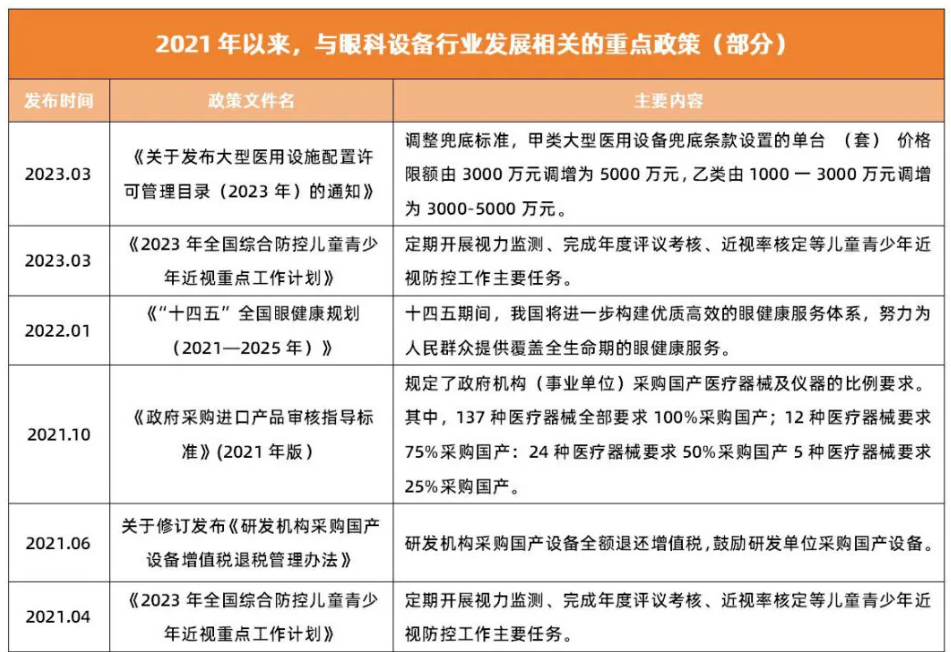
At the capital level,Venture Capital and Private Equity InvestmentThe attention to ophthalmic innovation equipment companies has reached an unprecedented height. Among them,Target enterprises with both a safety margin and the ability to ensure high growth and long-term sustainable profitabilityMore likely to gain the favor of investment institutions.Of course, the development of the industry requires continuous breakthroughs from innovative enterprises even more. In the field of mid-to-high-end ophthalmic equipment, including Big Vision Medical, Dessight Biomedical, Fuhan Medical, Intalight Saiwei, Brisight Nord, Longmu Medical, Moptim Medical, Real Clear Health, Tianchen Bio, Tupai Medical, Oculotronics, Microclear Medical, Rhino Health, FineVision, Yaoshi Medical, Zhenghong Technology, and Zhiding Medical.Chinese ophthalmic equipment innovators continue to iterate and accelerate R&D,Key breakthroughs have been achieved in multiple directions.Breaking the past low-end fixed impression of domestic ophthalmic medical device brands in the Chinese market.。In addition to the companies mentioned above, there are quite a few emerging ophthalmic device companies under the surface. Subsequently, inDriven by R&D and bolstered by capital, these companies will continue to take the baton, entering the global market competition and directly "competing" with international giants. InIn this process, the innovation story of ophthalmic devices made in China will also write a new chapter.
Editor | Zhao Qing Reviewer | Yi He