

Bioray Biosciences Releases Documentary on Thalassemia Patients: 'Editing Hope for Life' — Highlighting Gene Therapy Product BRL-101 and Commitment to a World Free of Thalassemia

BRL Medicine
Cell and Gene Therapy Drug Developer

May 10, 2024
eMedClub News
May 8, 2024 isThe 31st "World Thalassemia Day"BRL Medicine Releases First Documentary on Thalassemia Patients ——"The Hope of Editing Life" (Chinese Full Version), hoping to call on everyone to pay attention to the group of thalassemia patients. At the same time, we hope to use emerging innovative therapies to cure thalassemia patients, wishing for a world without "thalassemia".
"Every small group should be seen."
Thalassemia, first discovered in the Mediterranean population, is also known as Mediterranean anemia or hemoglobinopathy. It is caused by abnormal expression of globin genes, leading to the inability to form hemoglobin with normal function, and is an autosomal recessive genetic disorder. Notably,On September 18, 2023, the National Health Commission and five other departments jointlyPublishThe Second Batch of Rare Disease Catalog, Severe Thalassemia is included.
According to data from the "China Thalassemia Blue Book (2020)" published in May 2021, thalassemia gene carriers account for approximately 345 million people globally, with about 30 million carriers in mainland China. The number of patients with severe and intermediate thalassemia is around 300,000, and this figure is increasing at an annual rate of approximately 10%.Thalassemia is mainly distributed in tropical and subtropical regions with high incidence of malaria globally, including southern China. The vast area south of the Yangtze River in China is a high-incidence region for thalassemia, particularly in Guangxi, Guangdong, and Hainan provinces. Among them, Guangxi has the highest incidence of thalassemia, with one in every 4 to 5 people being a carrier of the thalassemia gene, and one in every 55 families having a risk of having a child with severe thalassemia. Without strict prevention and control measures, one in every 200 to 250 newborns will be a child with severe thalassemia. Next is Guangdong, where the carrier rate of the thalassemia gene is over 10%. Based on the population of 113 million in 2019, there are more than 10 million carriers of the thalassemia gene. Currently, the conventional treatments for thalassemia mainly include regular blood transfusions, iron chelation therapy, and hematopoietic stem cell transplantation. Hematopoietic stem cell transplantation is currently the only method that can cure β-thalassemia, but it is expensive and matching is extremely difficult, with only a small number of patients able to receive transplants. Therefore, the emergence of gene therapy in recent years has brought hope to thalassemia patients.
(Please click the video below for full-screen high-definition viewing)
BRL Medicine Thalassemia Patient Documentary "Editing the Hope of Life" (Chinese Full Version)
About "BRL-101"
On August 16, 2022, the clinical trial application (IND) for BRL Medicine's BRL-101 was officially approved by the Center for Drug Evaluation (CDE) of the China National Medical Products Administration, entering the registration clinical stage. Its primary indication is transfusion-dependent β-thalassemia, based on BRL Medicine’s self-developed hematopoietic stem cell platform (ModiHSC).®) Gene therapy product developed by ModiHSC®Mainly using gene editing system to genetically modify hematopoietic stem cells of patients, the modified hematopoietic stem cells are reinfused into the patient's body, rebuilding the modified cell population through self-renewal and differentiation, thereby achieving the purpose of treating hematological diseases.
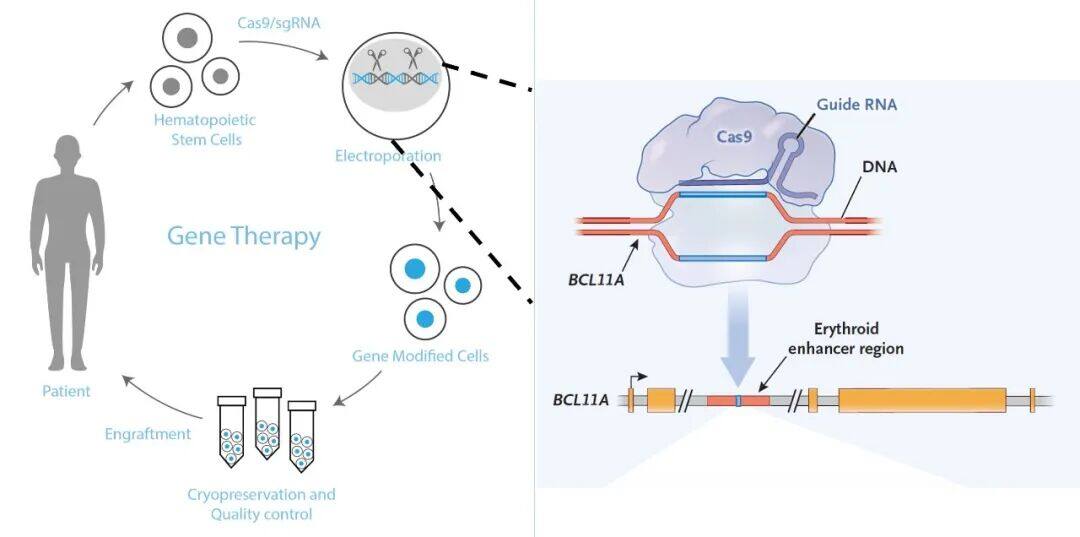
BRL-101 Gene Therapy Strategy
According to the latest announcement by BRL MedicineClinical treatment results show that all 15 patients who received BRL-101 gene therapy have completely eliminated their dependence on blood transfusions, achieving the effect of "one treatment, lifelong cure." After all patients received the transplantation treatment of gene-edited HSCs, their overall Hb and HbF levels significantly increased. Meanwhile, the average total hemoglobin level of the patients exceeded 120g/L, rapidly returning to the level of healthy individuals. The therapeutic effects were notably superior to those of foreign marketed products and domestically researched products in China. Moreover, during the entire treatment process, the majority of adverse events were consistent with the known adverse events associated with hematopoietic stem cell mobilization/apheresis, busulfan myeloablative conditioning, and autologous hematopoietic stem cell transplantation. All adverse events were resolved after medical intervention, with most outcomes being recovery/resolution. No GVHD occurred, nor did any participants withdraw from the study or die due to adverse events. Overall, compared with other gene therapies,BRL Medicine's BRL-101 gene therapy is more efficient, convenient, and safer, with advantages such as good targeting, high safety, wide range of action, and significant therapeutic effects.Is expected to become a therapy that benefits the public more.


DianDian "Share”、“Like" and "In Progress",Give me a little recharge~