

Takeda Slashes Pipeline and Restructures Amid Profit Plunge from Patent Cliffs

Takeda
Biopharmaceutical Manufacturer

On May 9, Takeda Pharmaceutical Company Limited's 2023 fiscal year report was delayed:Revenue for the year was 426.38 billion yen, a year-on-year increase of 5.9%, but net profit was halved, dropping to 14.41 billion yen.
Takeda attributed the sharp decline in profits to: multiple products encountering patent cliffs. To alleviate operational pressure, Takeda plans to simplify its employee organization structure, allocate approximately 900 million US dollars for restructuring, and streamline its drug pipeline.Clearly abandon the hematological tumor indications for TAK573, TAK981, and the CAR-NK therapy TAK007.
In the semi-annual report of the fiscal year 2023, Takeda Pharmaceutical Company Limited has already terminated the development of four drugs.Including the delisted Mobocertinib, Alzheimer's disease drug TAK920, and rare metabolic disorder drug TAK661., as well as TAK106, a drug for treating nausea and vomiting that has just completed Phase I clinical trials. In addition, at that time, Takeda also announced the discontinuation of the development of 12 projects.
Since last year, Takeda has been revising its revenue forecast downward every six months. On the same day it disclosed its fiscal 2023 report,Takeda also announced the upcoming closure of its San Diego research center, potentially affecting 340 employees.
It is foreseeable that Takeda's pipeline and personnel changes will be very frequent this year.

Engine Shutdown
Dimebolin, a treatment for attention deficit hyperactivity disorder, is one of Takeda Pharmaceutical Company Limited's best-selling products, approved for marketing in 2007. The year 2022 marked the final full sales year before the expiration of the drug's patent protection.InThe U.S. market achieved sales of $2.53 billion, making it Takeda's undisputed star product.
However, in 2023, the patents for both adult and pediatric indications of the drug successively expired. Financial reports show that in the last fiscal year, the drug's sales reached 423.2 billion yen, a year-on-year decrease of 8%.
This star drug is surrounded by strong competitors,Including Sandoz, Teva, Mylan and other companies' competition, there will be at least 12 generic drugs impacting the market.。This year, the patent for this drug will also expire in Europe.
Another blockbuster drug of Takeda, teduglutide, is a treatment for adult short bowel syndrome. It generated sales of $750 million in 2022. Its patent also expired in 2023 and it faces competition from generic drugs. The market for short bowel syndrome is large, with global demand expected to reach $3.66 billion by 2031.Including Ironwood, Zealand Pharma and other generic drug companies have flocked to the market.Analysts predict that Ironwood is expected to replace Takeda's market position.
In the U.S. market,Once generic drugs enter the market, the price of original research drugs may drop by more than 95%, which is also the root of the panic for enterprises' patented products facing the patent cliff.Takeda has already learned a bitter lesson. Its antihypertensive drug Azilsartan generated 76.3 billion yen in sales for the 2022 fiscal year, but after the patent expiration, sales plummeted to 33.6 billion yen in the 2023 fiscal year, marking a 54% decline.
Takeda has also come up with many ways to maintain the market for its star drug. To extend the "highlight period" of Thalidomide, Takeda has been making efforts in various directions,Has filed at least four patent lawsuits and extended the drug's patent term to 2028 and 2029 in some countries.
Takeda Remains Optimistic, Believing Patent Cliff Risk Will Be Limited Until at Least 2030; Company Also Forecasts Revenue and Profit Growth to Resume from 2025.

A centipede does not fall over even when it is dead.
Gastrointestinal (GI) is Takeda’s most lucrative business segment, but for cost considerations, Takeda has cut four R&D pipelines. In 2023, the candidate drug TAK-105 for treating nausea and vomiting was withdrawn from the early-stage development due to data not supporting further development.Starting from October, Mobocertinib will be gradually withdrawn from the global market.Weeks later, the stem cell therapy Alofisel failed in a Phase III trial, resulting in a direct impairment loss of $190 million.
"Cutting costs and increasing efficiency" has become a common practice among large pharmaceutical companies. Takeda's current strategy is to reduce investment in early-stage drug research and development, focusing its resources on later-stage projects instead.Takeda CEO Christophe Weber: Takeda to Have Six Phase III Projects This Year
Takeda's latest annual report disclosed that the company had a total of 3.118 billion US dollars in cash at the end of the fiscal year, with the proportion of cash in current assets at its lowest level in nearly 10 years. The company’s R&D investment has been over 4 billion US dollars annually, and its net profit margin is only 3.38%.If the sales of its main products encounter any minor setbacks, Takeda could very likely face losses, which is the top issue that Takeda Pharmaceutical Company Limited must address.
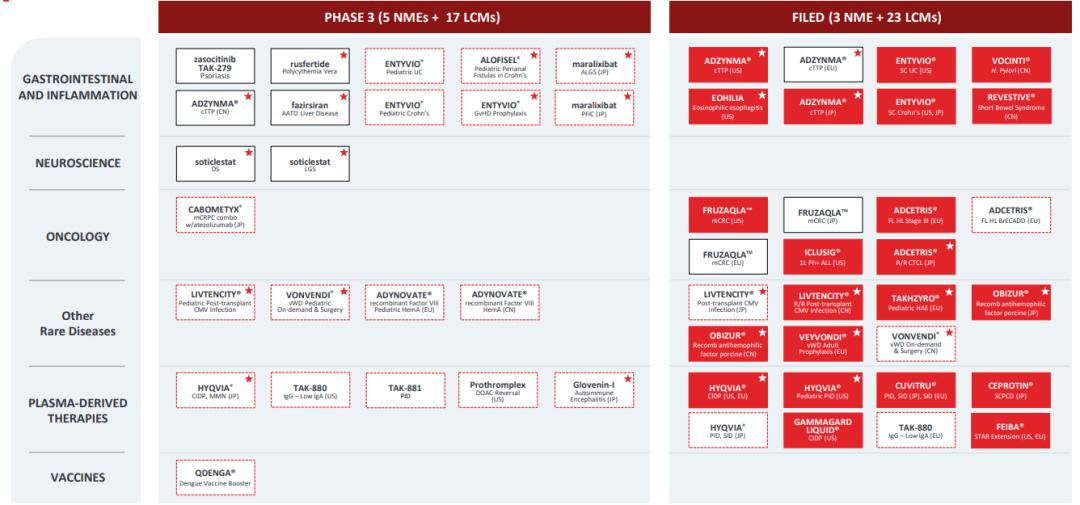
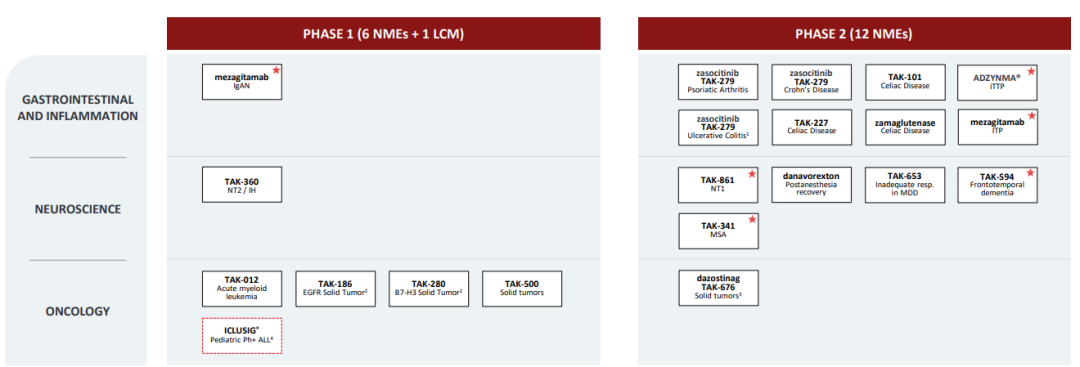
Source: Takeda Official Website
In the 2022 JPM conference, analysts predicted,By 2025, patent-expired drugs are expected to bring Takeda an additional $9 billion in sales.At the same time, Takeda also hopes to gain more advantageous varieties through acquisitions. On April 16, Takeda spent $1.3 billion to sign an exclusive licensing agreement with Kumquat for oncology drugs, jointly developing novel small-molecule inhibitors in immuno-oncology.
Takeda's goal isStarting from 2025, the core operating profit margin will increase by 1%-2.5% annually, eventually stabilizing at 30%.
But the continuous cutting of pipelines and "employee adjustment plans" both show that it is very difficult to achieve this goal.
Author|Miaomiao
Editor|Jiang Yun, Jia Ting
Operation | Zhu Ying
Statement: Original content by Jian Shi Ju, please do not reprint without permission.



Yunnan Baiyao Hit by Scandal, Former Chairman and 5 Senior Executives Detained
New Development | BeiGene Invests $74 Million to Build Shanghai R&D Center

Scan the code to add me: Join the group for communication, report information, or request authorization for republication.
If there are any issues with the content, please contact us by email:
jianshiju@boyamedia.com
For business cooperation, please contact: 13288688512