Recently, according to a report by Endpoints, Takeda Pharmaceutical Company Limited will close its R&D center in San Diego, California.This R&D center was established in 2019 and functions to address the shortcomings of the existing R&D base.The closure of the center is part of a larger strategic reorganization, allowing the company to better focus on other more promising late-stage pipelines and optimize its workforce, according to a company spokesperson.Takeda declined to comment on the timeline for the plant's closure or the number of jobs that might be affected.The company stated that there are currently about 340 full-time employees working at the site, and some employees will be transferred to other research bases in Cambridge, Massachusetts, and Shonan, Japan (the coastal area of northern Sagami Bay in Kanagawa Prefecture, Japan).Although it is unclear which pipelines are specifically related to the R&D center, there were actually signs of the company's pipeline cuts beforehand.
Takeda Withdraws Multiple Pipelines
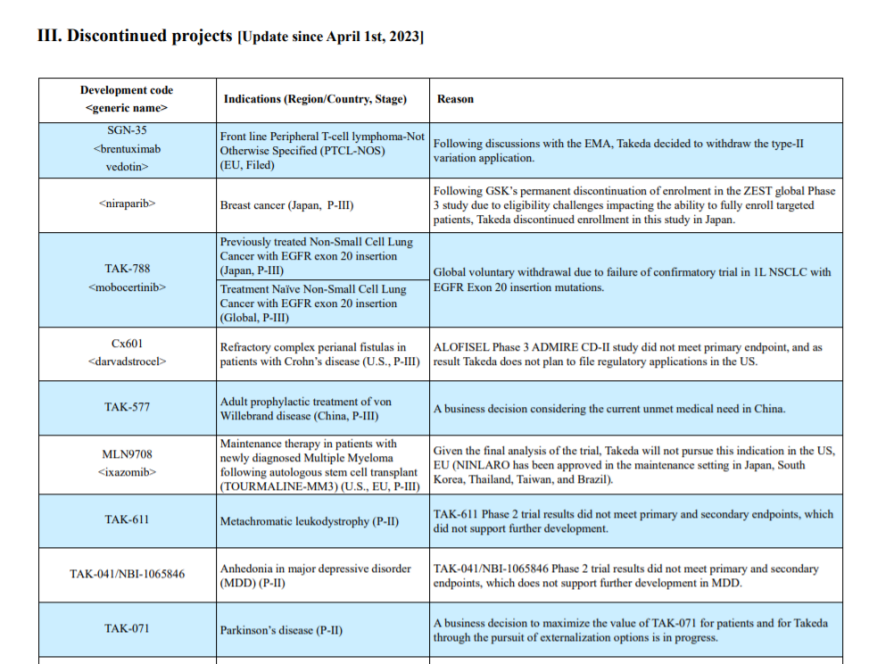
According to the company's previously released Q4 2023 financial report, Takeda's revenue for the fiscal year ending March 31, 2024, exceeded $27 billion. This figure represents a 1.5% increase from its 2023 fiscal year revenue of $25.8 billion. Despite significant revenue growth, Takeda's net profit for this year dropped by 57% to $925 million, compared to approximately $2 billion in net profit for the previous fiscal year.Takeda's operating profit also took a 50.3% hit, dropping from $3.15 billion to $1.37 billion in the fiscal year 2023.And in order to address this issue, restructuring and layoffs are inevitable, and pipeline cuts are no exception. Looking ahead to the remainder of the 2024 fiscal year, Takeda has even lowered investor expectations and reduced its core operating profit guidance by approximately 10%.Throughout 2023, the company axed 24 different projects across its pipeline, including the abandonment of indications for pipelines already in Phase II and III clinical trials, as well as the complete removal of some pipelines.Even looking at the completely canceled Phase I clinical projects, the number is quite astonishing. For example, TAK-920/DNL919, TAK-103, TAK-102, TAK-940, TAK-426, TAK-647, and so on.Considering the delicate timing of 2019 (when Takeda acquired Shire and incidentally gained several pipeline assets from Shire), the closure of the R&D center might be associated with some Phase I clinical trials.Seeing the prefix DNL indicates that this is a product of the collaboration between Takeda and Denali (also in California). Technically, it uses an antibody transport vehicle (ATV) to deliver the TREM2 antibody into the brain. By activating TREM2, DNL-919 aims to enhance the phagocytic activity and immune response of microglia, thereby improving the pathological state and cognitive function in the brains of Alzheimer's patients.However, it is obvious that this cooperation project signed in 2021 was bound to encounter difficulties when choosing Alzheimer's disease as the indication.In fact, this drug did not pass the FDA's toxicology evaluation during the independent preclinical assessment and was shelved. Although it officially entered clinical trials in July 2022, issues resurfaced in August 2023.The study observed safety signals of moderate, reversible hematological effects at the highest tested dose, indicating a narrow therapeutic window for TAK-920/DNL919:This actually may indicate that TREM2 might not have much effect at low doses, while safety issues at high doses start to emerge.Therefore, it was abandoned.
TAK-102 (NIB-102) and TAK-103 (NIB-103)
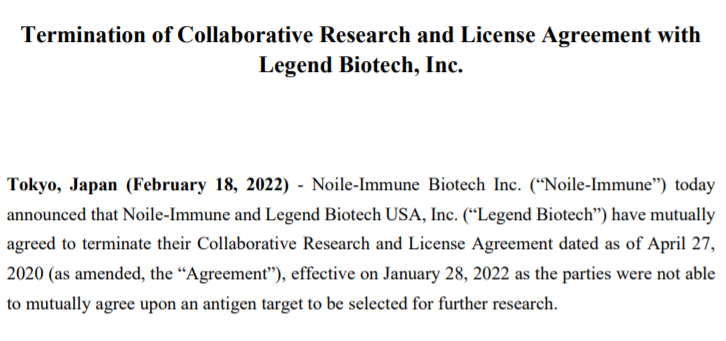
TAK-102 and TAK-103 were both licensed to Takeda by Noile-Immune Biotech, a Japanese company, in 2017. TAK-102 is being developed for GPC3-CAR-T solid tumors, while TAK-103 is aimed at MSLN-CAR-T solid tumors.Because both are Japanese companies, and the clinical trials are set up in Japan, it seems unnecessary to deliberately open a research and development center in the United States. The R&D projects of TAK-102 and TAK-103 should be unrelated to the closure of this R&D center.However, even so, TAK-102 and TAK-103 are still worth a look.Technically speaking, it is relatively reasonable for Noile-Immune Biotech to cut two of its pipelines. They adopted a CAR-T structure capable of secreting CCL19 and IL7, hoping to use IL-7 to promote the growth and survival of T cells and CCL19 to enhance the migration of T cells and dendritic cells. Of course, the idea is nice, but actual clinical validation is another matter.In fact, in 2022, Noile-Immune Biotech was returned by Legend Biotech, which may indicate a lack of recognition for the technology of this Japanese pharmaceutical company.TAK-940 is a project in collaboration with Memorial Sloan Kettering Cancer Center.According to the report at ASH, TAK-940 is a CD19-CAR-T developed for hematological malignancies. This new CAR-T utilizes an optimized 1XX signaling domain to replace the natural CD3ζ immune receptor tyrosine-based activation motif. The 1XX design extends the functional persistence of CAR T cells and enhances their potency in mice.In clinical trials, this CD19-CAR-T appears to have increased expression of CD57 and the activation marker TIM3, with CD57 expression being associated with an aging phenotype. It remains questionable whether TAK-940 can improve persistence.Therefore, it seems quite reasonable to be cut.
TAK-647(SHP647,Ontamalimab,PF-00547659)
TAK-647 is an anti-MAdCAM-1 antibody associated with inflammatory diseases in terms of mechanism. It was initially developed by Pfizer, later licensed to Shire, and subsequently acquired by Takeda when Shire was acquired.MAdCAM-1 is an adhesion molecule primarily expressed on vascular endothelial cells in the gastrointestinal tract and other mucosal tissues. It plays a key role in the migration of lymphocytes to areas of intestinal inflammation. By specifically binding to MAdCAM-1, TAK-647 can prevent these lymphocytes from migrating to inflamed sites, thereby alleviating Inflammatory Bowel Disease (IBD).Despite the mechanism, the development in Crohn's disease was not successful. Subsequent studies have shown that the ineffectiveness seems to be due to the presence of compensatory pathways in cell trafficking. Therefore, TAK-647 cannot achieve efficacy perfectly and may instead suppress innate immunity...Later, Takeda also wanted to use this drug to develop NASH. Considering the current first-mover advantages in the GLP-1 and NASH fields, it is reasonable for Takeda to abandon TAK-647.
Overall, the recent weakening trend of the yen may also impact Japanese pharmaceutical companies in 2024, though it remains unclear how significant the effect on Takeda will be. Takeda could become a special case under this unique backdrop. The closure of the R&D center holds a certain degree of reasonableness.https://www.fiercebiotech.com/biotech/takeda-denali-drop-alzheimers-asset-after-phase-1-peak-reveals-narrow-therapeutic-windowhttps://ashpublications.org/blood/article/142/Supplement%201/349/503114/Role-of-Cell-Therapy-Product-Characteristics-inSchulze LL, Becker E, Dedden M, Liu LJ, van Passen C, Mohamed-Abdou M, Müller TM, Wiendl M, Ullrich KAM, Atreya I, Leppkes M, Ekici AB, Kirchner P, Stürzl M, Sexton D, Palliser D, Atreya R, Siegmund B; TRR241 IBDome consortium; Neurath MF, Zundler S. Differential Effects of Ontamalimab Versus Vedolizumab on Immune Cell Trafficking in Intestinal Inflammation and Inflammatory Bowel Disease. J Crohns Colitis. 2023 Nov 24;17(11):1817-1832. doi: 10.1093/ecco-jcc/jjad088. PMID: 37208197.The content of the article is for reference only and does not constitute investment advice. Investors who take actions based on this information bear their own risks. The article maintains a neutral stance on the statements and viewpoints expressed, and does not provide any explicit or implicit guarantees regarding the accuracy, reliability, or completeness of the content.
The articles published in this official account are intended for sharing. If there is any infringement, please contact us and we will handle it.
Scan the QR code to follow us
Reply "Readership", let's chat with the小伙伴们 in the biopharmaceutical industry~"
Forward, like, check, and arrange?