On May 8, developed by Google DeepMind and other teamsAlphaFold3Published in Nature, artificial intelligence has once again set life sciences ablaze.Compared to its predecessor, AlphaFold3 has made significant improvements in accuracy while achieving an unprecedented breadth: expanding the prediction scope from proteins to more biomolecules such as DNA, RNA, ligands, and ions, providing a powerful unified framework for humanity to understand the biological world.Not only that, but people also discovered that the newly released AlphaFold3 has swept through almost every field in a triumphant manner.Including AutoDock, RoseTTAFold, and other well-known models have become its defeated opponents.Even industry leader David Baker admitted defeat, frankly stating that this is better than the similar algorithms developed by his team.However, inRNAField, AlphaFold3 has hit a snag,Zelixir's AAlchemy_RNA2Still maintaining a significant advantage,DeepMind researchers call it"Best Performer Under Artificial Intervention"。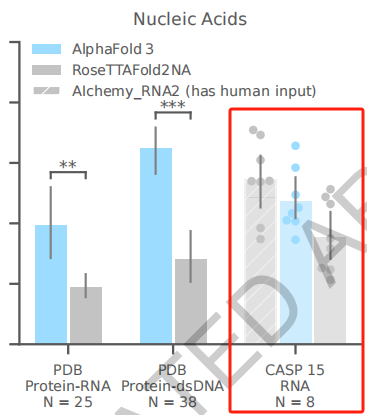
Figure: AlphaFold3's performance in RNA structure prediction falls short of AIchemy_RNA2's results in CASP15.Data shows that at the 15th Critical Assessment of Protein Structure Prediction (CASP 15), Zelixir, founded in April 2021, performed astonishingly.Achieved the championship and top three outstanding results in the two tracks of RNA structure prediction and protein-small molecule ligand complex structure prediction, respectively.。The CEO of the company isWang ShengDr., Ph.D., Postdoc under Professor Xu Jinbo, known as the "World's No.1 in AI Prediction of Protein Structures," was formerly a senior research expert at Tencent AI Lab, leading the development of the tFold tool, which ranked first weekly for half a year on the global protein structure prediction assessment platform CAMEO.A strong startup team and research achievements have made Zelixir highly favored by capital, with the company successfully completing three rounds of financing. Investors includeHillhouse Ventures, CDH Investments, Clearpool Ventures, Huiding CapitalWell-known institutions such asIn May last year, the company, which completed an A-round financing of over 100 million yuan, stated that it would further cultivate "AI + synthetic biology," including building a new generation AI generative synthetic biology intelligent manufacturing platform and promoting rapid product implementation.In recent years, AI has continued to bring surprises to the life sciences, and the existence of companies like Zelixir proves thatChina has a world-class team in this field., providing an unmissable opportunity for local industries and investment institutions. The First: How It Was Made
As a global event for biomolecular structure prediction, the CASP competition, held every two years, attracts top research teams from various countries.At the 15th CASP held at the end of 2022, two new fields were added: protein-small molecule complex prediction and RNA structure prediction, demonstrating the academic community's enthusiasm for expanding into more molecular domains.Among them, Alchemy RNA2, developed by the Zelixir team, outperformed many competitors to become the champion in the RNA structure prediction track.This is Zelixir's first participation in CASP, and its stunning debut has drawn attention from the industry.As a senior scholar in the field of protein structure prediction, Dr. Wang Sheng, CEO of Zelixir, is naturally no stranger to CASP. Since 2008, he has participated in eight sessions and achieved first place multiple times.Data shows that Wang Sheng has over ten years of experience in protein structure prediction research. He earned his Ph.D. from the Institute of Theoretical Physics at the Chinese Academy of Sciences and completed his postdoctoral research under the guidance of a professor at the Toyota Technological Institute at Chicago.Xu Jinbo, once served as the main developer of the RaptorX-Contact method, which was the first to demonstrate the feasibility of using deep learning methods to predict protein structures.In the RNA field, the company has proposed two structure prediction tools, one of which is an AI-based prediction method.AIchemy_RNA, and the other is the statistical energy functionAIchemy_RNA2。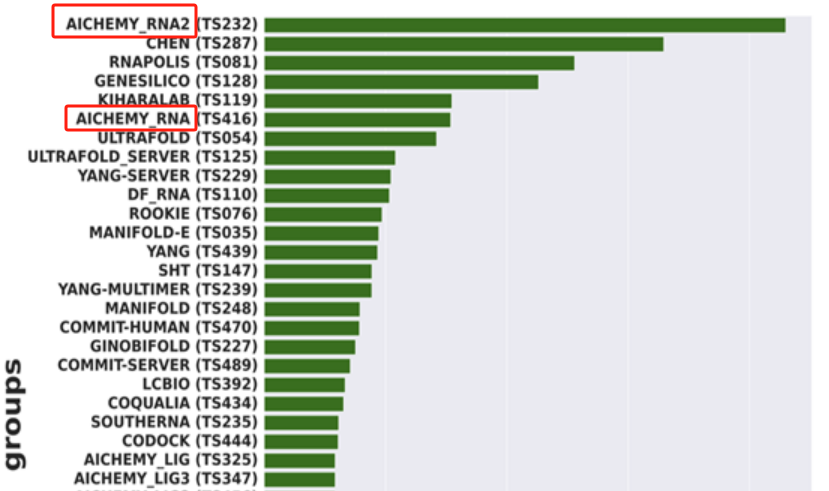
Figure: Top-performing models in RNA structure prediction at CASP15Among them, AIchemy_RNA2 was developed under the leadership of Dr. Peng Xiong, the CTO of Zelixir at the time. Its core is the RNA-BRiQ statistical energy function that he led the development of while working in Prof. Yaoqi Zhou's research group. It shows excellent performance in modeling artificially synthesized RNA or natural RNA structures that have never appeared in the PDB database.
In the face of the remarkable achievements made by his talented students, a globally renowned expert in structural bioinformaticsYaoqi ZhouPraised as: "The team led by Xiong Peng from Zelixir, as newcomers in the field of RNA 3D structure prediction,Surpassing multiple experts who have been working in this field for many years in one fell swoop, becoming the first person., which is an incredible and highly challenging achievement."And AIchemy_RNA also achieved good results, with itsRanked first among all AI prediction methods, referred to by DeepMind researchers as "The Best Performing Machine Learning System”。It is reported that the underlying algorithm of AIchemy_RNA, named RhoFold, was jointly developed by Zelixir, Professor Li Yu from The Chinese University of Hong Kong, and Professor Sun Siqi's team from Fudan University. It is the world’s first end-to-end deep learning model for predicting RNA 3D structures.Through its unique design, AIchemy_RNA has trained a relatively efficient and accurate model on limited RNA structure data. For homologous sequences of natural RNA, it can predict their 3D structures with high precision. The entire process takes only a few minutes, which is faster than physical methods.For RNAs unsuitable for Multiple Sequence Alignment (MSA), such as synthetic RNAs or natural RNA structures never found in the PDB database, AIchemy_RNA will provide a prediction confidence score and indicate the need for further processing.It is worth noting that, although the academic community has made breakthroughs in the field of RNA structure prediction, the accuracy of prediction is still far behind compared to protein structure prediction, and even farther from practical application.The biggest obstacle is data issues.Currently, people know very little about the advanced structure information of RNA: as of July 2022, in the Protein Data Bank (PDB), there are only 1,644 and 4,371 entries for pure RNA and RNA-protein complex structures, respectively, accounting for only 0.9% and 2.2% of the total. Dedicated to Synthetic Biology
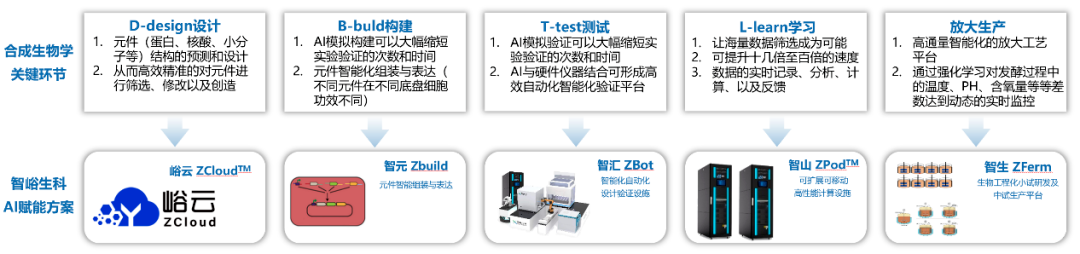
With the breakthrough of AI in large molecules (including proteins, nucleic acids, and their complexes), Zelixir has set its sights on the emerging track of synthetic biology.According to Boston Consulting data, the global synthetic biology industry market size grew from $5.3 billion in 2018 to over $17 billion in 2023. It is expected that the global synthetic biology market will maintain rapid growth momentum in the foreseeable future, reaching nearly $50 billion by 2028.Specifically, the upstream of the synthetic biology industry focuses on the disruption of underlying technologies, mainly revolving around Design-Build-Test-Learn (DBTL). In these four key stages, Zelixir has provided corresponding AI-enabled solutions.InZCloudTaking the platform as an example, this is a comprehensive bio-computing software platform independently developed by the company, covering many fields such as macromolecular design, molecular simulation, free energy calculation, and sequence and structure retrieval. It has achieved significant breakthroughs in the design and modification of core catalytic components (e.g., enzymes).Not only that, Zelixir further expands the downstream of synthetic biology,Accelerate the Industrialization Landing Process。It is reported that, not long after its establishment, the company absorbed a synthetic biology team with considerable experience in the synthetic biology industry. This team has rich experience in metabolic fermentation engineering and has previously produced various synthetic biology products at the kilogram and ton levels.CompanyHope to bridge the upstream computing and design end to the downstream pilot stage, embodying the capability of protein design into specific products, and then selecting based on the future commercial prospects of the product and the difficulty of scaled production.Self-production and sales or authorization to partner organizations through technology transfer。Last year, Zelixir collaborated with Jiangsu, which focuses on natural food additives and other formula-based products.Yiming BioZelixir has reached a cooperation with the stock limited company. According to the memorandum, the company will design and optimize the industrial enzyme and its production system that Yiming Biology focuses on, helping it improve industrial efficiency and reduce generation costs. The Rise of Chinese Teams
With the support of artificial intelligence, domestic teams have achieved catch-up and surpass in some fields against the West.In the arena of protein prediction, the rankings were previously dominated by top biolabs from Europe and the US. In recent years, the entry of some AI companies in China has gradually changed the landscape.At CASP 15, includingHelixon, Deep Potential, Tianrang, Molecular之心, ZelixirSeveral Chinese companies, including Zelixir, have begun to make a name for themselves. In the RNA structure prediction category, the team led by Xiong Peng from Zelixir ranks first; in the protein-ligand complex prediction category,Pumeirui BioDr. Chang Shan's team ranked first.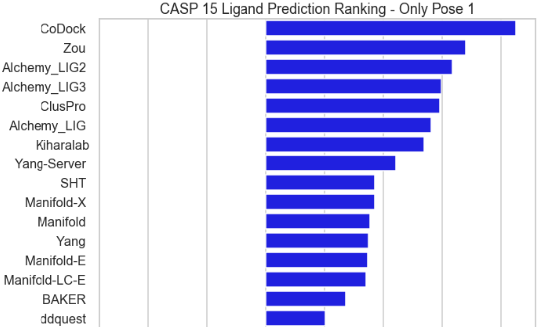
Figure: Pumeirui CoDoc Wins First Place in Protein/RNA-Ligand Complex Structure PredictionMoreover,Tsinghua, Peking, Renmin, Shandong, Zhejiang University of Technology, Jiangsu University of Science and Technology, ShanghaiTech, Westlake University, Institute of Computing Technology, Chinese Academy of SciencesThe university team also achieved remarkable results in monomer protein prediction.Yang Jianyi, Shandong UniversityRanked first in the team; in the category of accuracy assessment of protein complex interface contact residuesZhejiang University of Technology, Zhang GuijunThe team ranked first.Some professionals believe that China and foreign countries are basically at the same starting line in the AI + synthetic biology field, and the vast, mature industrial chain system provides an advantage for domestic teams in the application of technology.At the same time, as an important new track of "new quality productivity," biomanufacturing has recently become a market focus. According to reports from central media,Relevant departments are studying and formulating a top-level planning document for biomanufacturing at the national level.。In the future, with the joint efforts of academia, market, and government, China's synthetic biology will undoubtedly usher in a new era.Great development, andAIAs one of the important engines, it will also greatly promote the rapid development of related industries in China.Globally, a massive technological revolution is unfolding, and China is playing an increasingly important role in it.—The End—
Recommended Reading