

Google DeepMind and Isomorphic Labs Launch AlphaFold 3: A Proprietary, Usage-Limited AI Platform Ushering in the Era of Paid Biomolecular Prediction

Isomorphic Labs
AI Drug Developer

Internet-related services and product providers
On May 8 Eastern Time, Google DeepMind and Isomorphic Labs (founded by the founder of DeepMind) announced the launch of a new generation of AI biomolecular structure model, AlphaFold 3.
It is reported that the new model is not only limited to the prediction of protein structures, but it can also predict the structures and interactions of life molecules such as DNA, RNA, and ligands. It can even predict the impact of post-translational modifications (PTM) and ions on the corresponding molecular system structures. Researchers only need to input a basic description of a biomolecular complex, and a few seconds later, they will obtain an accurate prediction of the 3D structure of the complex.
"Accurate structure prediction of biomolecular interactions with AlphaFold 3," published in Nature, provides a detailed demonstration of the model's capabilities.
According to the data in the paper: Compared with existing prediction methods, AlphaFlod 3 achieves accuracy that is already 50% higher than the best traditional methods on the PoseBusters benchmark (in some special scenarios, it can reach 100%) without requiring any structural information input. Theoretically, it surpasses existing physics-based biomolecular structure prediction tools.
However, the use of any tool cannot be separated from reality. After several days of testing, many experts and scholars have introduced practical problems to evaluate the capabilities of AlphaFold 3. Based on the current test results, AlphaFold 3 does show great potential, but it is not yet enough to "disrupt" this field.
Similar to previous tools in the AlphaFold series, AlphaFold 3 also employs a neural network architecture and is trained on global molecular structure data from the Protein Data Bank (PDB). However, AlphaFold 3's prediction accuracy far exceeds that of its predecessors in most scenarios, and it has significantly expanded its range of predictions.
These capability upgrades stem from the key new components introduced in AlphaFold 3, including the upgraded Evoformer module (now the Pairformer module), the all-new Diffusion Network, and more. Among these, the Diffusion Network predicts coordinates by probabilistic diffusion from point clouds, thereby achieving higher prediction accuracy.
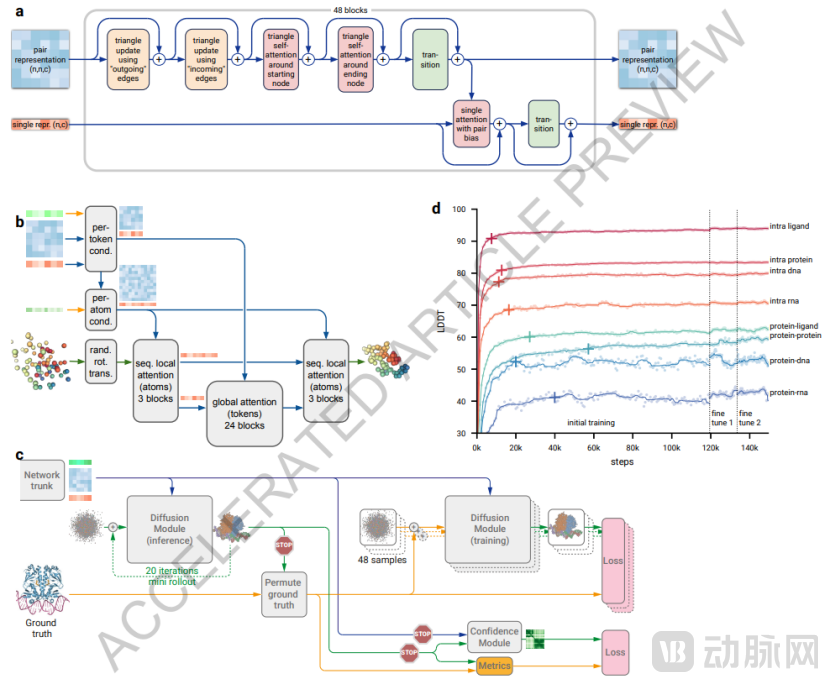
In addition, some innovations in the model have also optimized the prediction results of AlphaFlod 3. In cases such as chiral molecules with similarly shaped structures, algorithms often make prediction errors. In these situations, AlphaFlod 3 adopts a cross-distillation approach, allowing AlphaFlod 2, which is equipped with a Transformer model, to make predictions first, and then adds the prediction data to the training of AlphaFlod 3, improving the accuracy of predictions to a certain extent.
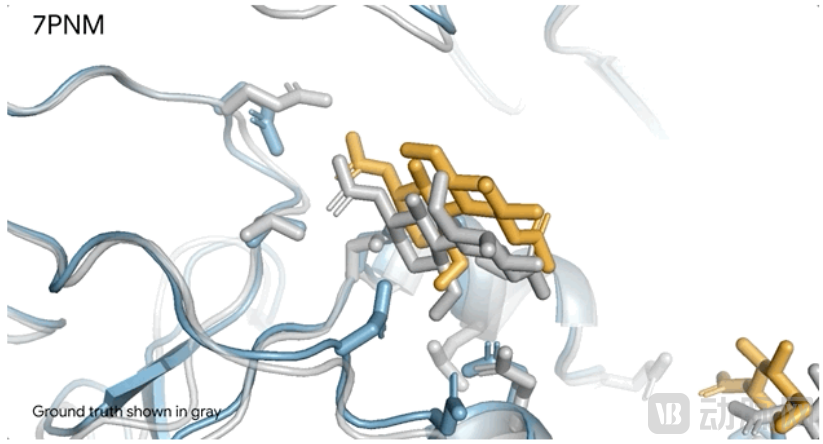
The paper showcases some of AlphaFold 3's prediction results. For instance, the structural prediction of the interaction between the cold virus spike protein (blue) with antibodies (turquoise) and monosaccharides (yellow), which accurately matches the actual structure (grey).
In China, it almost completely matches the results obtained in the laboratory (gray area).
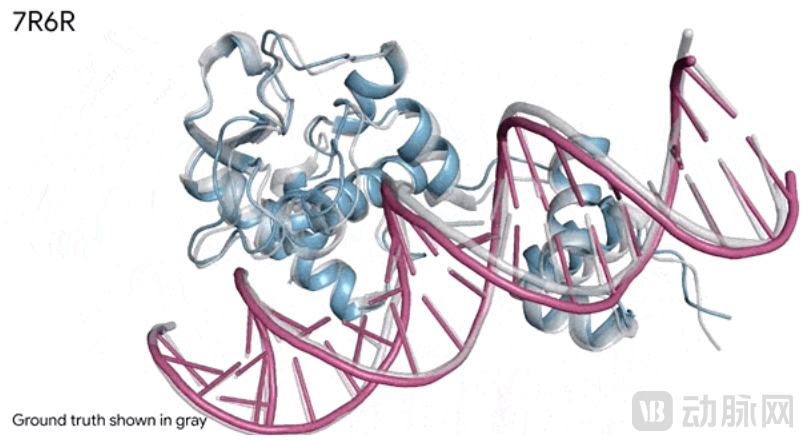
The molecular complex of protein and DNA binding (7R6R - DNA binding protein) was predicted, and the predicted model also perfectly matches the experimentally determined real molecular structure (gray), with an atomic-level accuracy far surpassing other models.
After generating the prediction results, AlphaFlod3 also provides a confidence score to evaluate the accuracy of the prediction, serving as a reference for researchers.
The capabilities of AlphaFlod3 presented in the paper are crucial for understanding various aspects of the human immune response and designing new antibodies. This new tool can clearly help researchers understand how to approach new disease targets, thereby developing new methods to pursue previously unreachable targets, ultimately accelerating drug design and increasing its success rate.
In addition, the predictive power of RNA mentioned in the paper also has great room for imagination.
In the past, most drug targets were protein targets. However, RNA could become a better potential target. By blocking RNA expression or preventing RNA from forming complexes with proteins, thereby inhibiting protein function, the efficacy of drugs might perform better than with protein targets.
However, in the past RNA 3D structure predictions using non-AlphaFold tools, the vast majority of prediction errors exceeded 10 angstroms, showing a certain gap from physics-based prediction methods. Theoretically, to achieve applications related to RNA structure calculations, the accuracy should ideally be controlled within 2-3 angstroms.
If AlphaFold 3 can overcome the challenge of RNA structure prediction, bringing its predictive accuracy to a level comparable to that of protein prediction, this tool could potentially optimize protein expression of mRNA, enhance its stability, accelerate drug design targeting RNA, and even expedite the development of RNA itself as a novel therapeutic modality.
In an ideal scenario, phenomena that previously required significant time, effort, and funding to observe can now be analyzed within minutes by simply inputting parameters into DeepMind's interface. This generates high-resolution and highly accurate biomolecular models, even detailing the biochemical processes inside the macromolecular cellular system, demonstrating how they interact with antibodies and nucleic acids. Such capabilities have caused a sensation in the industry.
But in actual tests, the capabilities of AlphaFlod 3 may not be as ideal as everyone expected.
Professor Yan Ning's team stated on Weibo that AlphaFold's prediction for a glycoprotein was inferior to the previous version. "I think this server version is a trade-off between speed and accuracy, and the correctness rate is not the best. I currently have three rather unusual proteins. Previously, my own AF2 multimer setup could find one or two correct conformations at a very low ranking position, but this server version failed completely in testing."
Some scholars have found after trying AlphaFold 3 that DeepMind did not release the protein-small molecule ligand prediction task, which was boasted about in the article. Users still cannot perform complex structure prediction (aka docking) with custom ligands.
In addition, AlphaFlod 3 has also sparked intense discussions in the academic community due to not being open-sourced yet.
Currently, DeepMind has only released a public interface for this model, named AlphaFold Server, which imposes restrictions on the molecules that can be experimented on. It allows only 10 predictions per user each day and does not provide protein structures that may bind to drugs.
In practice, to achieve the highest accuracy, researchers need to generate a large number of predictive structures and rank them, especially for antibody-antigen complexes, where prediction quality significantly improves with an increasing number of model seeds, thus raising considerations for the tool's screening capabilities. After all, pharmaceutical companies don't care how many small molecules researchers can identify, nor whether the provided molecules are self-generated or screened from a database—they only care about finding the most suitable small molecule to inhibit a protein.
However, in terms of the services that the AlphaFold Server can currently provide, it is difficult for researchers to achieve the expected value with this tool. The usage restrictions of AlphaFold 3 clearly state that the prediction results cannot be used for commercial purposes, nor can they be used for docking and virtual screening.
Industry insiders believe that the open-sourcing of AlphaFold 3 will likely wait until after the conclusion of CASP16 in December. However, considering Isomorphic Labs' involvement in the development of AlphaFold 3, DeepMind may not open-source its inference code or executable file this time, nor will it release the algorithm and principles. After all, these algorithms have become core assets of Isomorphic Labs.
In January this year, Isomorphic Labs announced two drug discovery agreements worth $3 billion with Eli Lilly and Novartis. The collaborations involve the discovery of treatments targeting various disease-related proteins and pathways, closely related to AlphaFold 3's predictive capabilities for antigen-antibody complexes, protein-ligand complexes, and protein-nucleic acid complexes.
From this perspective, the future of AlphaFold 3 may be packaged into a commercial software like GPT, with different versions launched for different users. For instance, ranking predicted structures might become part of a paid service, requiring researchers to pay for its use. Currently, the majority of researchers are accustomed to including AlphaFold 2 prediction results in their papers, but as the tool becomes closed-source, this habit may gradually change.
However, whether open-source or closed-source, free or commercial, we should respect the choices made by DeepMind and Isomorphic Labs. After all, in addressing the challenge of understanding molecular biology and modulating the complex atomic interactions within biological systems, AlphaFold 3 has indeed taken a significant step forward for the industry, with the potential to achieve accurate predictions of the structures of various biomolecular systems within a unified framework.
Therefore, reasonable commercialization might further support DeepMind and Isomorphic Labs, propelling the entire industry into the next era of molecular biology more rapidly.