BenevolentAI and AstraZeneca Select Novel AI-Discovered Target for Heart Failure

BenevolentAI
AI Drug Discovery Developer

AstraZeneca
Biopharmaceutical Manufacturer
On May 15, BenevolentAI announced the discovery of a novel heart failure target based on its AI drug discovery platform, which has been experimentally validated by AstraZeneca.
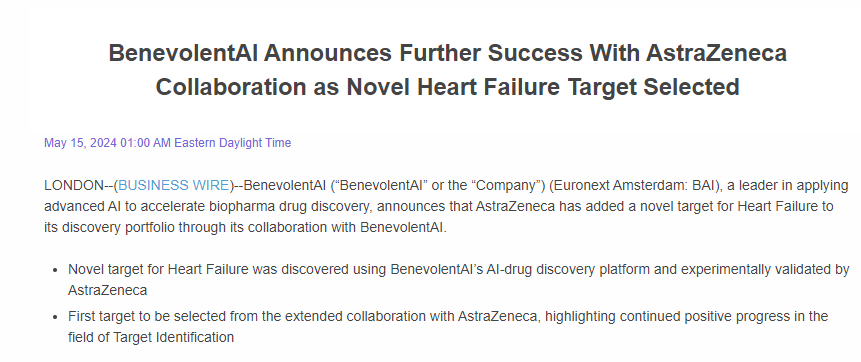
(News Release Screenshot)
This is the first target selected since the expanded collaboration with AstraZeneca, highlighting continued positive progress in target identification.
AstraZeneca's collaboration with BenevolentAI began in 2019, focusing on developing innovative therapies for chronic kidney disease (CKD) and idiopathic pulmonary fibrosis (IPF). This partnership has identified two novel targets, which have been incorporated into AstraZeneca's R&D pipeline.
In 2022, the two parties expanded their cooperation to include the development of new drugs for Systemic Lupus Erythematosus (SLE) and Heart Failure (HF) in their research scope.
This innovative collaboration structure allows scientists and technicians from both companies to work side by side, combining BenevolentAI's AI-driven drug discovery platform and biomedical knowledge with AstraZeneca's scientific and disease expertise, enabling novel and powerful target identification. Both the initial collaboration and its expansion were established under similar terms, including signing fees, research funding, and discovery, development, and commercial milestones. Additionally, BenevolentAI will receive tiered royalties on net sales of any commercialized products.
This target confirmation, if it triggers a milestone payment, will undoubtedly be a much-needed boost for BenevolentAI. Just last month, BenevolentAI implemented a series of restructuring plans in order to extend the company’s cash runway to the third quarter of 2025. (Related reading: Closure of U.S. office, veteran AI pharmaceutical company announces another round of layoffs)
Heart failure is a long-term chronic disease that worsens over time. Chronic heart failure is the leading cause of hospitalization for patients over 65 years old, resulting in significant clinical and economic burdens. Heart failure can be classified based on the left ventricular ejection fraction (LVEF), which is the percentage of blood pumped out of the heart with each contraction, into: heart failure with reduced ejection fraction (LVEF ≤40%), heart failure with mildly reduced ejection fraction (LVEF between 41% and 49%), and heart failure with preserved ejection fraction (LVEF ≥50%). Approximately half of all heart failure patients have either mildly reduced or preserved ejection fraction, but treatment options for these types are very limited.
Regina Fritsche Danielson, Senior Vice President of AstraZeneca and Head of Cardiovascular, Renal, and Metabolic Research and Early Development, stated: "Our ongoing collaboration with BenevolentAI helps uncover new insights into complex diseases such as CKD and heart failure. This shared expertise, combined with the power of artificial intelligence, has the potential to identify the right treatment targets for heart failure patients and help deliver the next generation of innovative therapies."
For a long time, the cardiovascular, renal, and metabolism business has been AstraZeneca's second-largest source of revenue. The representative drug in this field is Farxiga (Dapagliflozin), which became AstraZeneca's top-selling product in 2023 with sales revenue of $5.963 billion, representing a year-on-year growth rate of 39%.
Dapagliflozin is an oral, once-daily sodium-glucose cotransporter 2 (SGLT2) inhibitor, initially approved for the treatment of type 2 diabetes.
In May last year, dapagliflozin was approved in the United States to expand its heart failure indication, used to reduce the risk of cardiovascular death, heart failure hospitalization, and emergency heart failure visits in adult patients with heart failure.
According to AstraZeneca's press release, dapagliflozin was previously approved in the United States for adult heart failure patients with reduced ejection fraction. This time, the drug has been approved in the United States to reduce the risk of cardiovascular death and heart failure hospitalization in a broader patient population, meaning that heart failure patients can benefit from dapagliflozin treatment regardless of left ventricular ejection fraction (LVEF).
In August of the same year, the heart failure indication for dapagliflozin was also approved for expansion in China, covering heart failure patients with a full range of ejection fractions in China.
References
Company Announcement

Editor: Baiji
Disclaimer: This article is a reprint from Yaozhi.com. The images and text are the original property of the author, and the purpose of the reprint is to convey more information. It does not represent the views of this platform. If there are any issues regarding the content, copyright, or other aspects, please leave a message on this platform, and we will address it promptly.