

Sanofi Announces Over €1 Billion Investment to Expand Biologics and Vaccine Manufacturing Capacity Across Three French Sites

Sanofi
Pharmaceutical R&D Developer
Recently, at the 7th "Choose France" Summit,Sanofi to Invest Over 1 Billion Euros (Approx. 7.85 Billion RMB) in Three Production Bases in France: Vitry, Le Trait, and Lyon GerlandThis investment complements Sanofi's major projects initiated since the pandemic, aiming to increase France's capacity for new drugs and vaccines to continue producing medicines and vaccines in France for patients around the world. Sanofi stated that over 60% of its global production takes place in the EU, with only 5% of active ingredient production coming from Asia.
Including recent other investments,Sanofi has committed to invest more than 3.5 billion euros in France for the production of medicines and vaccines.Sanofi stated, "France will always be the strategic core of the company. The investment will significantly enhance France's current and future capabilities to control the production of essential medicines and establish France as a 'center of excellence' for vaccine research and development."
In addition, biopharmaceutical giants such as Pfizer, AstraZeneca, GlaxoSmithKline (GSK), AbbVie, and Novartis have also invested to expand their respective manufacturing and R&D capabilities in France.
This more than 1 billion euros investment by Sanofi will mainly be used to expand its bioproduction capacity at three plants in France.
Among them,Sanofi Invests €1 Billion in Vitry Plant in Vitry-sur-Seine to Double Monoclonal Antibody Production CapacityAmong them, Sanofi's 12 potential blockbuster products for the treatment of chronic obstructive pulmonary disease (COPD), asthma, multiple sclerosis, or type 1 diabetes are all manufactured at this plant to meet the needs of millions of patients in France and around the world. Sanofi expects this investment to create 350 jobs.
Sanofi will also invest 100 million euros in its Le Trait plant in Normandy to develop new production capacities for biologics, filling, device assembly, and packaging.. The factory will support the future launch of Sanofi's biologics and vaccines. This investment will support 150 job positions.
Importantly,Sanofi's best-selling anti-inflammatory antibody drug Dupixent will also be produced at the Le Trait plant.Dupixent has been applied in a variety of inflammatory diseases and may soon become the first biologic for COPD. Sanofi announced on Monday that the FDA will give priority review to the sBLA application for Dupixent to treat adolescent patients with chronic rhinosinusitis with nasal polyps, with a decision potentially coming in September.
Besides,Sanofi to Invest €10 Million in Establishing TZield Production Base in Gerland, Lyon, FranceTZield is a biologic approved for delaying the onset of type 1 diabetes, which Sanofi acquired through the purchase of Provention Bio in April last year. To date, the drug has only been produced outside of Europe.
Before splashing out 1 billion euros, Sanofi is streamlining and restructuring by cutting expenses and saving funds through pipeline resource adjustments and layoffs.
Sanofi's specific measures include: reorganizing its vaccine commercial operations in the United States and implementing layoffs; divesting assets of Amunix Pharmaceuticals, an immuno-oncology product development company acquired for $1 billion in 2022; closing Kiadis Pharma, an NK cell therapy development company acquired in 2021; cutting collaboration with IGM Biosciences, abandoning three originally planned targets in the oncology field, and focusing solely on developing three IgM agonist antibodies for immunology and inflammation...
And Sanofi's series of bold streamlining and reorganization plans are aimed at supporting the "Play to Win" strategy proposed by its CEO Paul Hudson in 2019.Previously, when Sanofi released its third-quarter financial report and announced a downward revision of its 2024 profit forecast, Paul Hudson had already reiterated the "Play to Win" strategy. The company focuses on maintaining long-term profitability and implementing cost-cutting measures. Paul Hudson stated,The "pipeline resource reallocation" from oncology to immunology alone could save the company 700 million euros, with approximately 20 billion euros in savings by the end of 2025.。
"The funds saved through meticulous planning have become the driving force for Sanofi to accelerate its expansion into the immunology and rare disease fields, developing a new generation of immunology products and seeking out rare disease products with differentiated advantages to consolidate its position in these two markets."Sanofi executive Houman Ashrafian also outlined Sanofi's ambition in an email to employees — to build a powerhouse in immunoscience.。
To this end, Sanofi has been making frequent moves in the autoimmune and rare disease fields, introducing new candidate pipelines. For instance, it acquired Losmapimod, a candidate drug for treating Facioscapulohumeral Muscular Dystrophy (FSHD), for $1.055 billion; purchased INBRX-101, a recombinant alpha-1 antitrypsin (AAT) augmentation therapy, for $2.2 billion; and acquired Provention Bio, a biopharmaceutical company specializing in autoimmune diseases, for $2.9 billion…
From the current pipeline composition, Sanofi's determination to focus on autoimmune and rare disease fields is evident. As of now, Sanofi has laid out 11 pipelines in the rare disease sector, with six candidate products in Phase 3 clinical trials; in the autoimmune field, there are 33 ongoing pipelines, 27 of which are in Phase 2 or Phase 3 clinical trials.
At the same time,Sanofi is upgrading its blockbuster product DupixentIn 2023, Sanofi's revenue was approximately $47.097 billion, a year-on-year increase of 5.3%. Dupixent alone contributed about $11.58 billion, accounting for nearly a quarter of the total revenue. However, over-reliance on and heavy pressure from a single product also poses risks. As a result, Sanofi is expanding new indications for Dupixent and has already submitted an sBLA application for Dupixent to the FDA.
In addition, other autoimmune candidate drugs in Sanofi's pipeline have also achieved success in clinical trials. In April this year, Sanofi announced that the Phase 3 LUNA 3 trial of BTK inhibitor Rilzabrutinib (SAR444671/PRN-1008) for the treatment of persistent or chronic immune thrombocytopenia (ITP) in adult patients met its primary endpoint.
With the rapid advancement of candidate drug research and continuous capacity expansion, Sanofi's next batch of blockbuster products is on the way.。
Except for Sanofi,Including Pfizer, AstraZeneca, GSK, AbbVie, Novartis, Chiesi, Kenvue and other MNCs will invest to expand their operations in France, with a total investment exceeding 200,000 euros.
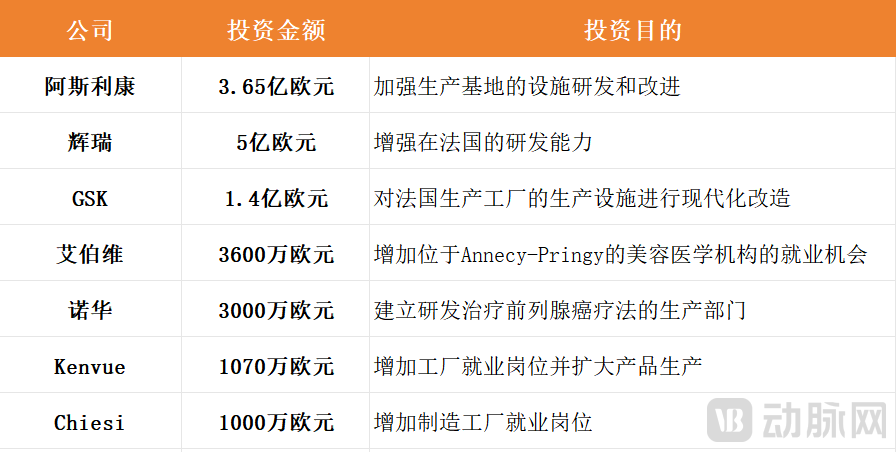
Similar to Sanofi, the aforementioned MNCs are also investing in France while cutting expenses and saving costs. The reason behind France's ability to continuously attract significant investments from MNCs lies in its multifaceted reform measures., such as attractive tax policies. These include reductions in corporate and production taxes, a 30% tax credit for research activities, and tax credits for new industrial projects in areas like wind power and solar panels, covering everything from production equipment to key raw materials. In addition, the formulation of the "France 2030 Plan" aims to make large-scale investments in innovative projects. This includes substantial investment in higher education, significant expansion of nuclear and renewable energy, building a digital government, and streamlining procedures.
Currently, the global pharmaceutical industry is entering a new cycle of innovation, and finding new industrial breakthroughs has become an urgent task for enterprises. Amid a cooling capital market, investments need to be more prudent, balancing innovation with value creation.
For MNCs, they hope that through investment they can further establish broader scientific cooperation in France and ensure that their production bases in France continue to meet evolving business needs, while accelerating the development of new technologies by creating new innovation centers.