

Eli Lilly Announces Positive Phase 3 Results for Once-Weekly Insulin Efsitora Alfa in Type 2 Diabetes

Eli Lilly
Global Pharmaceutical R&D and Production Company
▎WuXiEdited by Kant Content Team
Today, Eli Lilly and Company announced positive results from its Phase 3 clinical trials QWINT-2 and QWINT-4, which evaluated the efficacy of its investigational once-weekly insulin efsitora alfa (efsitora) in adult patients with type 2 diabetes who were either insulin-naïve or required multiple daily insulin injections. Analysis showed,Both trials met their primary endpoints. Compared with commonly used daily basal insulin globally, efsitora demonstrated non-inferiority in reducing patients' glycated hemoglobin levels (HbA1c).
QWINT-2 evaluated the efficacy and safety of once-weekly efsitora compared to once-daily insulin degludec over a 52-week period. Treatment-naïve adults with type 2 diabetes were randomized to receive either once-weekly efsitora or once-daily active comparator. The trial also assessed the efficacy of efsitora in patients using or not using GLP-1 receptor agonists.
Analysis showed that the trial met the primary endpoint, meaning that at week 52, the HbA1c reduction in the efsitora group was non-inferior compared to the control group.HbA1c levels in the Efsitora group decreased by 1.34 percentage points to 6.87, while HbA1c levels in the control drug group decreased by 1.26 percentage points to 6.95.One of the key secondary endpoint assessments showed,In subjects with and without GLP-1 receptor agonists, efsitora demonstrated non-inferiority in reducing patients' HbA1c levels compared to the active control drug.
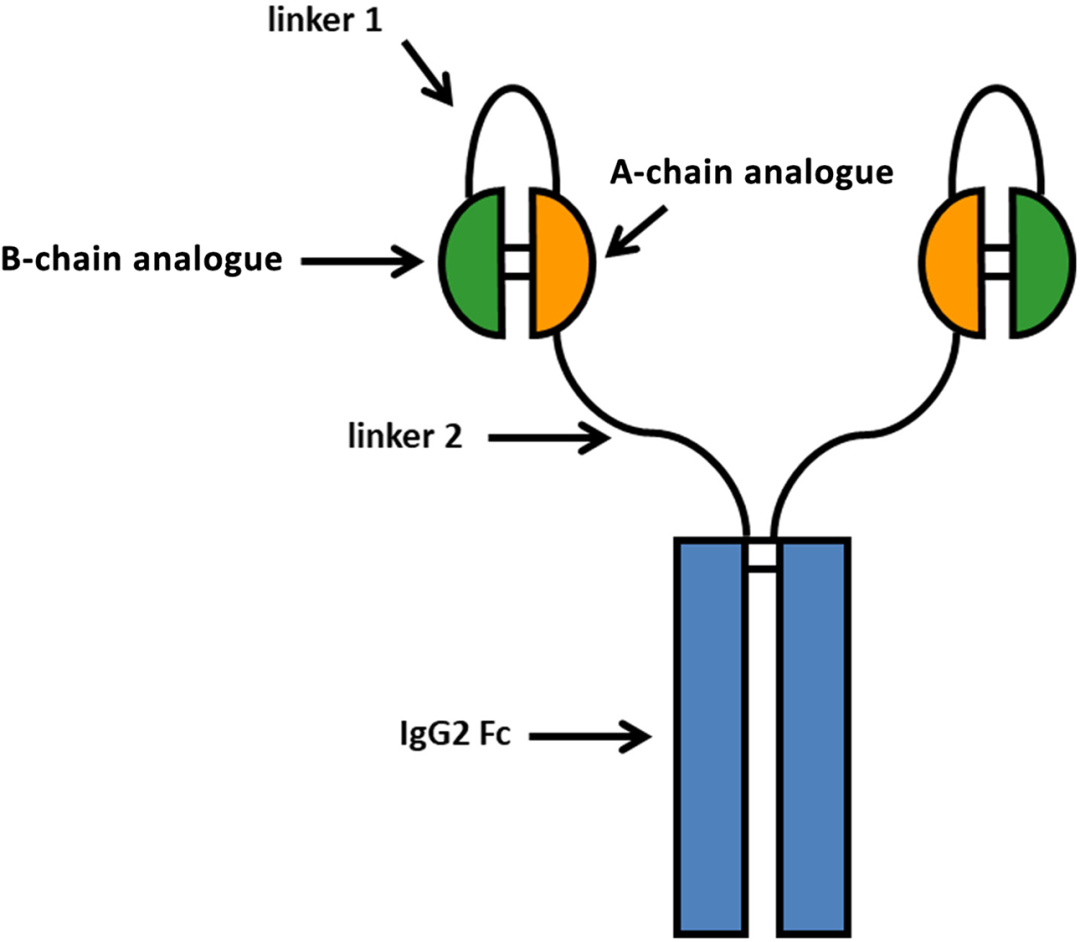
▲Efsitora Structure Diagram (Image Source: Reference [2])
The QWINT-4 trial evaluated the efficacy and safety of efsitora compared to insulin glargine in adult patients with type 2 diabetes who had previously been treated with basal insulin and required at least two daily injections of mealtime insulin. The trial lasted 26 weeks. Participants were randomly assigned to receive either once-weekly efsitora or once-daily active comparator, both in combination with insulin lispro.
Analysis shows that the trial met its primary endpoint, with the efsitora group demonstrating non-inferiority in HbA1c reduction compared to the active control drug at week 26.Efsitora and the active control drug both reduced patients' HbA1c levels by 1.07 percentage points, with final HbA1c levels of 7.12% and 7.11%, respectively.
In the QWINT-2 and QWINT-4 trials, efsitora demonstrated good safety and tolerability.
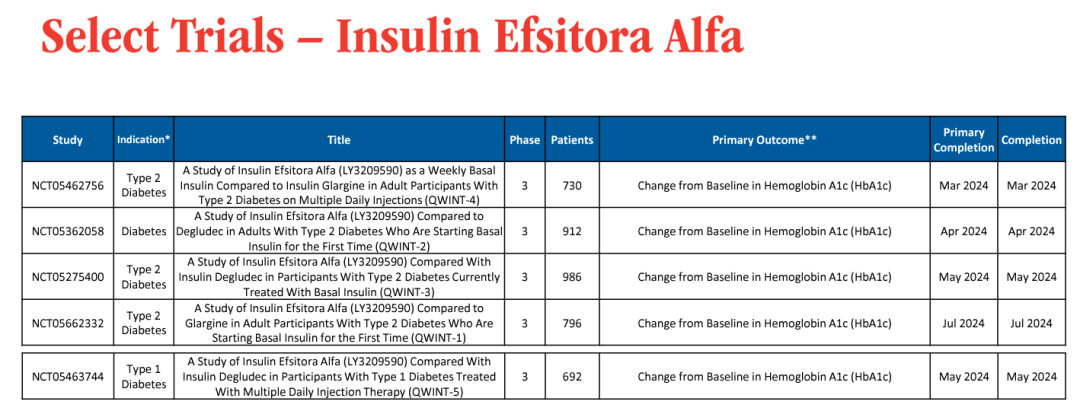
▲ Evaluation of Phase 3 Clinical Trial of Efsitora (Image Source: Reference [3])
Eli Lilly launched the global Phase 3 clinical development program (QWINT) for efsitora in diabetes treatment in 2022.To date, more than 4,000 patients with type 1 or type 2 diabetes have been enrolled in five global registration studies.The detailed results of the QWINT-2 trial will be announced at the 2024 European Association for the Study of Diabetes (EASD) Annual Meeting. The topline data of QWINT-1, QWINT-3, and QWINT-5 are expected to be released later this year.
Efsitora is a once-weekly subcutaneous injectable basal insulin. Efsitora is a fusion protein that combines a novel single-chain insulin variant with the human IgG2 Fc domain.Due to its low peak-to-valley ratio, it is expected to provide patients with more stable blood glucose levels throughout the week (reducing blood glucose fluctuations).
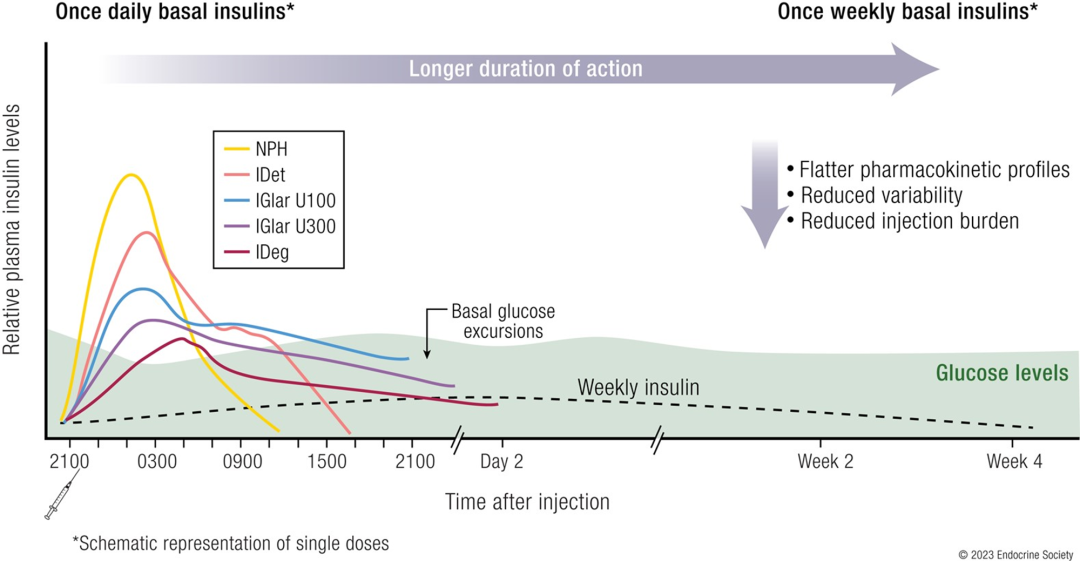
▲Comparison of Once-Daily and Once-Weekly Insulin (Image Source: Reference [5])
In the past few decades, compared with earlier insulin preparations, the pharmaceutical industry has developed long-acting, soluble once-daily basal insulin analogs, which have significantly improved the efficacy and safety of diabetes treatment. However, for these patients,Treatment adherence and persistence remain lower than expected.Once a weekInsulin TherapyThe characteristic of a stable pharmacokinetic curve can reduce the injection burden and blood glucose fluctuations for patients, thus potentially improving adherence to and persistence with insulin therapy.
Also in development of a once-weekly ultra-long-acting insulin is Novo Nordisk. In March this year, the European Medicines Agency's Committee for Medicinal Products for Human Use (CHMP) adoptedPositive OpinionIt is recommended to grant its weekly Awiqli (basal insulin weekly formulation icodec insulin) marketing authorization for the treatment of adult diabetes. Novo Nordisk is expected to receive the final marketing authorization from the European Commission within this month. Currently, the U.S. FDA is reviewing this therapy and is scheduled to hold an Endocrinologic and Metabolic Drugs Advisory Committee meeting on May 24 to discuss the approval of this therapy. Novo Nordisk has also completed the submission of the marketing application for this therapy to the Chinese regulatory authorities and is currently awaiting the announcement of the review results.

▲To learn more about the application of cutting-edge technologies in the biopharmaceutical industry, please long-press and scan the QR code above to access "WuXi Live Studio" and watch live discussions and exciting replays on related topics.


Share,PointLike,In view, Focus on Global Biomedical Health Innovation