

Johnson & Johnson's IL-23 Inhibitor Guselkumab Meets Primary Endpoint in Phase 3 QUASAR Trial for Ulcerative Colitis, Showing Remission in Nearly Half of Patients with Every-Eight-Week Dosing

Johnson & Johnson
Healthcare Product Manufacturers, Health Service Providers
▎WuXiEdited by Kant Content Team
Today, Johnson & Johnson announced the first batch of data from the QUASAR Phase 3 maintenance study of its anti-IL-23 antibody Tremfya (guselkumab) for the treatment of patients with moderate to severe active ulcerative colitis (UC). The analysis shows,Guselkumab Achieves Primary Endpoint in Trial, Significantly Relieves Symptoms in Patients with Ulcerative Colitis.Johnson & Johnson submitted to the U.S. FDA in March this yearSubmitSupplemental Biologics License Application (sBLA) seeking approval for guselkumab to treat adult patients with moderately to severely active ulcerative colitis (UC).

Ulcerative colitis is a type of inflammatory bowel disease (IBD), which is a condition caused by chronic inflammation of the large intestine.Due to the overactive response of the immune system, inflammation occurs in the lining of the colon, leading to the formation of ulcers. Symptoms in patients include persistent diarrhea, abdominal pain, rectal bleeding, poor appetite, weight loss, and fatigue, among others. The severity of symptoms and the unpredictable recurrence of the disease place a heavy burden on patients and often result in disability. Millions of people worldwide are affected by ulcerative colitis.
QUASAR is a randomized, double-blind, placebo-controlled, parallel-group, multicenter Phase 2b/3 trial designed to evaluate the efficacy and safety of the selective IL-23 inhibitor guselkumab in adult patients with moderate to severe active UC who have had an inadequate response to or are intolerant of conventional therapies, other biologics, and/or JAK inhibitors.

Image Source: 123RF
Analysis shows that guselkumab met the primary endpoint.Among patients with moderately to severely active UC who received subcutaneous injections of 200 mg guselkumab every four weeks, 50.0% achieved the primary endpoint of clinical remission at week 44 (p<0.001), while 45.2% of those receiving 100 mg guselkumab every eight weeks reached this endpoint (p<0.001), compared to only 18.9% in the placebo group.In an additional analysis of patients who have reached clinical remission,At week 44, 67% and 71% of patients achieved endoscopic remission (defined as Mayo Endoscopic Subscore [MES] = 0), indicating normal appearance of the intestinal mucosa.
In addition, both cohorts receiving guselkumab treatment achieved all key secondary endpoints, showing highly statistically and clinically significant improvements compared to placebo. Partial secondary endpoint results of the 44-week maintenance study are shown in the table below:
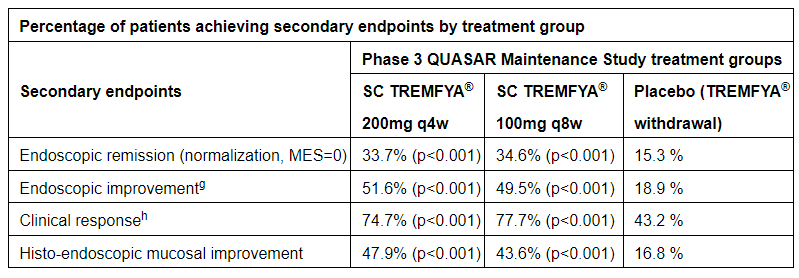
▲GSummary of Key Secondary Endpoint Results from the Ustekinumab Trial (Image Source: Reference [1])
In terms of safety, the proportion of patients experiencing one or more adverse events (AE) was similar across all treatment groups. GSafety Data of Uselkumab in Two Combined GroupsAndCompared with placebo,The most common AEs were COVID-19 (11.2% vs 14.1%), UC (11.2% vs 29.7%), and arthralgia (6.1% vs 6.8%), respectively.The safety results are consistent with the safety profile of guselkumab in approved moderate to severe plaque psoriasis (PsO) and active psoriatic arthritis (PsA) indications.
Guselkumab is a humanized monoclonal antibody that selectively inhibits IL-23 signaling by binding to the p19 subunit of the IL-23 receptor.Currently, guselkumab has been approved in the United States, Canada, Japan, and many other countries/regions for the treatment of moderate to severe plaque psoriasis, as well as psoriatic arthritis.

Developing effective therapies for ulcerative colitis is a goal for many pharmaceutical and biotech companies.Last October, Eli Lilly and Company's "first-in-class" monoclonal antibodyOmvoh(Mirikizumab) has been approved by the U.S. FDA for the treatment of adult patients with moderately to severely active UC. The press release noted that this is the first IL-23 p19 antagonist used to treat this patient population. AbbVie, on the other hand, submitted its IL-23 p19-targeted monoclonal antibody to the U.S. FDA and the European Medicines Agency (EMA) in August of last year.Skyrizi(risankizumab) for the extended indication application to treat adult patients with moderate to severe UC. Additionally, Ventyx Biosciences announced its oral small molecule therapy in October last year.VTX002Met the primary endpoint of clinical remission in the Phase 2 trial, with a high proportion of complete endoscopic remission. Meanwhile, Roivant Sciences announced in June last year its potential "first-in-class" anti-TL1A antibody.RVT-3101Positive long-term results were achieved in the Phase 2b clinical trial for treating UC patients, with the proportion of patients achieving endoscopic improvement reaching 50% at 56 weeks.

▲To learn more about the application of cutting-edge technologies in the biopharmaceutical industry, please long-press and scan the QR code above to access "WuXi Live Studio" and watch live discussions and exciting replays on related topics.


Share,PointLike,In view, Focusing on Global Biomedical Health Innovation