

Roche's Inavolisib Combination Therapy Receives FDA Breakthrough Therapy Designation with PFS More Than Doubled in PIK3CA-Mutated HR+/HER2- Advanced Breast Cancer

Roche
Oncology Drug Research, Development, and Manufacturing
▎WuXiEdited by Kant Content Team
Roche announced today that the U.S. FDA has granted Breakthrough Therapy Designation (BTD) to its investigational oral small molecule inavolisib, in combination with the CDK4/6 inhibitor Ibrance (palbociclib) and fulvestrant, for the treatment of tumors withPIK3CAMutations, hormone receptor (HR)-positive, human epidermal growth factor receptor 2 (HER2)-negative locally advanced or metastatic breast cancer in adult patients who relapsed within 12 months after completing adjuvant endocrine therapy.
HR-positive breast cancer is the most common type of all breast cancers, accounting for approximately 70%.HR-Positive Breast Cancer Refers to Breast Cancer That Expresses Estrogen Receptor (ER) and/or Progesterone Receptor (PR), Which Can Promote Tumor Growth. Patients Diagnosed With HR-Positive Metastatic Breast Cancer Often Face the Risk of Disease Progression and Treatment Side Effects, Thus Requiring Additional Treatment.The PI3K signaling pathway is often dysregulated in HR-positive breast cancer, mostly due toPIK3CACaused by activating mutations, which has been identified as one of the potential mechanisms of resistance to standard endocrine therapy combined with CDK4/6 inhibitor therapy.
Image Source: 123RF
The US FDA granted inavolisib combination therapy BTD primarily based on the positive results of the Phase 3 INAVO120 clinical trial. This trial is a randomized, double-blind, placebo-controlled study designed to evaluate inavolisib in combination with Ibrance and fulvestrant compared to placebo plus Ibrance and fulvestrant in the treatment.PIK3CAEfficacy and safety in patients with mutant, HR-positive, HER2-negative locally advanced or metastatic breast cancer who experienced disease progression during treatment or within 12 months after completing adjuvant endocrine therapy and have not received systemic therapy for metastatic tumors. The study enrolled 325 patients, with the primary endpoint being investigator-assessed progression-free survival (PFS), defined as the time from randomization to disease progression or death from any cause. Secondary endpoints include overall survival, objective response rate, and clinical benefit rate.
The analysis shows,Compared with the placebo combination (PFS=7.3 months), the inavolisib combination therapy (PFS=15.0 months) reduced the risk of disease progression or death by 57% (HR=0.43, 95% CI: 0.32-0.59, p<0.0001).The overall survival data are not yet mature, but a clear positive trend has been observed (stratified HR=0.64, 95% CI: 0.43-0.97, p=0.0338). Follow-up for overall survival will continue until the next analysis. Data from the INAVO120 trial are also being submitted to other global regulatory authorities, including the European Medicines Agency (EMA).
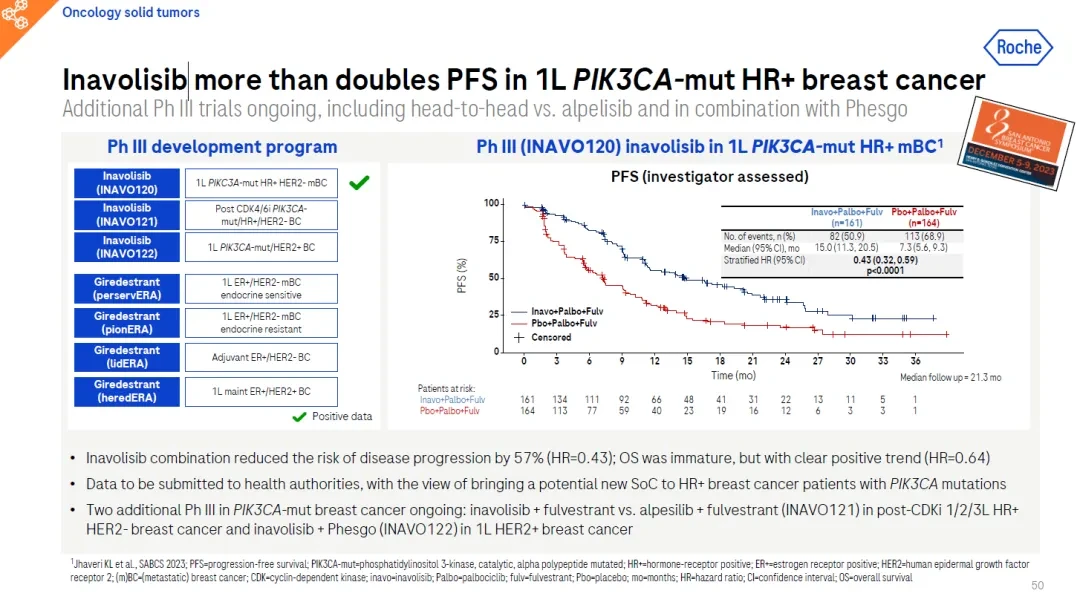
▲Trial results of Inavolisib for breast cancer (Image source: Reference [2])
Inavolisib combination therapy was well tolerated, with adverse events consistent with the known safety profile from previous studies, and no new safety signals were observed.
Inavolisib is an oral therapy with high in vitro potency and selectivity for PI3Kα inhibition, capable of specifically triggering the degradation of mutant PI3Kα proteins.Through this unique dual mechanism of action, inavolisib may provide a new treatment option for HR-positive/HER2-negative,PIK3CAPatients with mutant advanced breast cancer provide well-tolerated, durable disease control and potentially improved outcomes. About 40% of HR-positive breast cancer patients carryPIK3CAGene mutation, which may lead to uncontrolled tumor growth, disease progression, and resistance to endocrine therapy.

In addition to INAVO120, Roche is currently conducting two other Phase 3 clinical studies to evaluate the combination therapies of inavolisib with different drugs for patients withPIK3CAThe Role in Patients with Locally Advanced or Metastatic Breast Cancer Harboring Mutations, including (1) The INAVO122 trial examining the efficacy of inavolisib combined with fulvestrant compared to PI3K inhibitor alpelisib plus fulvestrant in HR-positive/HER2-negative breast cancer patients who have previously received CDK4/6 inhibitor and endocrine combination therapy. (2) The INAVO122 trial also evaluating the role of inavolisib combined with pertuzumab and trastuzumab subcutaneous injection compared to pertuzumab plus trastuzumab subcutaneous injection along with endocrine therapy chosen by physicians, as a maintenance therapy for HER2-positive disease.

▲To learn more about the application of cutting-edge technologies in the biopharmaceutical industry, please long-press and scan the QR code above to access "WuXi Live Studio" and watch live discussions and exciting replays on related topics.
References:
[1] FDA grants Breakthrough Therapy Designation to Roche’s inavolisib for advanced hormone receptor-positive, HER2-negative breast cancer with a PIK3CA mutation. Retrieved May 21, 2024 from https://www.roche.com/media/releases/med-cor-2024-05-21
[2] Rche Reporting,Retrieved Feb 2, 2024 from https://assets.roche.com/f/176343/x/ac48d3ba3b/irp240201-a.pdf
Disclaimer: The content team of WuXi AppTec focuses on introducing the research progress in global biopharmaceuticals and health. This article is for information exchange purposes only, and the views expressed in the article do not represent the position of WuXi AppTec, nor does it mean that WuXi AppTec supports or opposes the views in the article. This article is not a recommendation for treatment plans. If you need guidance on treatment options, please visit a正规 hospital.
Copyright Statement: This article is from the content team of WuXi AppTec. Individuals are welcome to share it on their social media platforms, but unauthorized reproduction by media or institutions in any form to other platforms is prohibited. For authorization to reproduce, please reply with "reprint" on the WeChat Official Account of "WuXi AppTec" to obtain reprint guidelines.


Share,PointLike,In view, Focusing on Global Biomedical Health Innovation