

Aktis Oncology Announces $1.1B Collaboration with Eli Lilly to Develop Targeted Alpha Radiopharmaceuticals for Solid Tumors

Aktis Oncology
Developer of Novel Targeted Radiopharmaceuticals
Eli Lilly
Global Pharmaceutical R&D and Production Company
On May 21 local time, Aktis Oncology announced a collaboration agreement with Eli Lilly and Company to jointly develop radiopharmaceuticals for solid tumors. Under the terms of the agreement, in addition to Eli Lilly's equity investment in Aktis, Aktis will also receive a $60 million upfront payment for the collaboration, potential preclinical, clinical, regulatory, and commercial milestone payments of up to $1.1 billion, as well as tiered royalties.
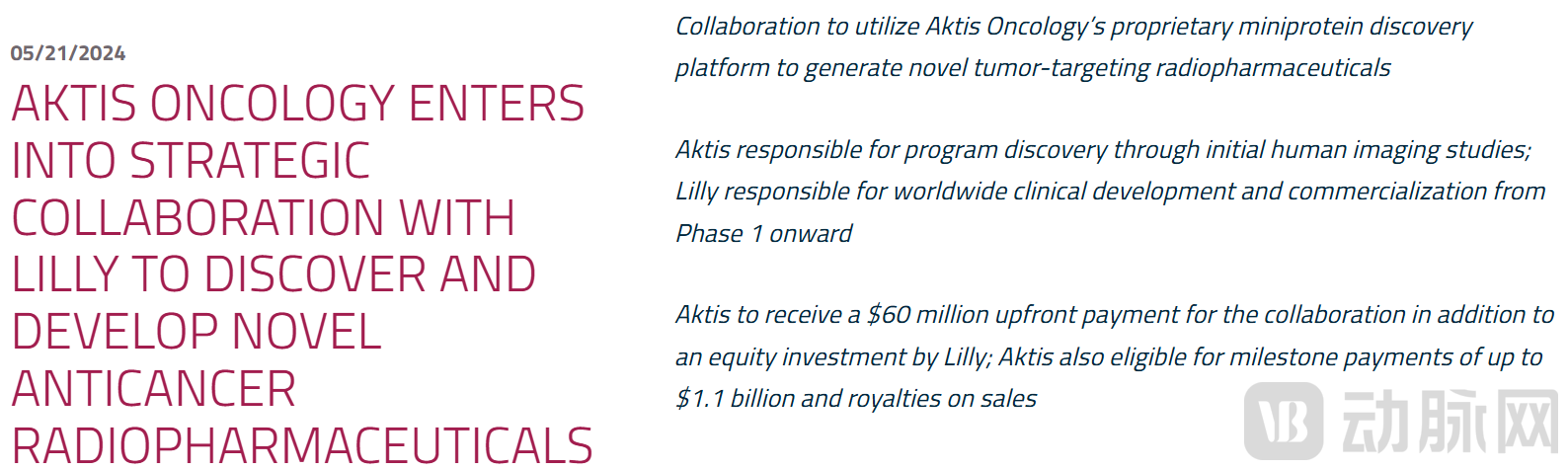
Source: Aktis Oncology Official Website
According to the news released by Aktis, Eli Lilly will obtain the rights to develop radiopharmaceuticals and diagnostic products targeting a series of specific targets selected by Eli Lilly and discovered by Aktis. Aktis will retain full ownership of its proprietary pipeline, which currently consists of seven projects, including the clinical-stage project targeting Nectin-4.
"The Hottest Newcomer" Aktis,
Received investments from Merck, Novartis, and BMS
In fact, before gaining recognition from Eli Lilly and reaching this significant collaboration, Aktis Oncology had already become the "rising star" in the innovative nuclear medicine field, with several top multinational corporations (MNCs) and global pharmaceutical giants having previously invested in the company.
In March 2021, Aktis Oncology completed a $72 million Series A financing round, with investment institutions including MPM Capital, EcoR1 Capital, Vida Ventures, Octagon Capital, and TCG Crossover.Novartis, Bristol-Myers Squibb.
In August 2022, Aktis Oncology completed an $84 million Series A+ financing round, with investment institutions includingMRL Ventures Fund, BMS, Novartis, Cowen Healthcare Investments, ArrowMark Partners, Mirae Asset Venture Investment, Timefolio Capital, Pappas Capital, and other companies and institutions.
What is the Charm of Aktis that Wins Recognition from Leading Institutions and Pharmaceutical Companies? According to its official website, Aktis, headquartered in Boston, is a biotechnology company that discovers and develops innovative targeted alpha-particle radiopharmaceuticals for treating various solid tumors. Founded and incubated by MPM Capital, the company has built a proprietary technology platform to produce tumor-targeting drugs with ideal therapeutic effects.The proprietary technology platform of Aktis Oncology, Inc. is characterized as follows:
① Precise Positioning:The specific targeting ability can penetrate deeply into tumors and accumulate for a long time, "concentrating firepower" to destroy tumors.② Unique Molecular Design:Custom-designed radiopharmaceuticals deliver potent alpha particles directly to tumor tissues while rapidly clearing from non-target tissues in the body, minimizing systemic isotope exposure.③Strong tumor-killing ability:The tumor-killing capability of α particles is approximately 1000 times that of β particles, effectively inducing double-strand DNA breaks and preventing the acquisition of drug resistance.

Aktis Proprietary Technology Platform, Image Source: Aktis Official Website
Tumor-targeted therapies designed based on their proprietary platform have the potential to become "best-in-class" drugs. According to previous data, the company's novel α-radiotherapy has high tumor permeability and can be quickly cleared from other parts of the body to maximize tumor elimination while minimizing potential treatment side effects.
Currently, Aktis' core project targets the Nectin-4 antigen. Nectin-4 is widely present in solid tumors and exhibits high expression in urothelial carcinoma, breast cancer, lung cancer, head and neck cancer, ovarian cancer, and other tumors. It promotes tumor proliferation and migration by activating the P13K/Akt pathway, making it an ideal target for anti-tumor drugs. Compared with popular targets such as EGFR, HER2, and Trop2, there are currently fewer targeted drugs for Nectin-4, representing a new and promising area for development.
Heavyweight deals frequently appear,
MNCs Rush to Enter the Blue Ocean of Nuclear Medicine
In fact, this is not the first time that Eli Lilly has bet on the nuclear medicine track. On October 3 last year, Eli Lilly acquired all outstanding shares of Point at a price of $12.50 per share (for a total of $1.4 billion), officially entering the nuclear medicine field.This price represents an 87% premium over Point Company's closing price of $6.68 per share on October 2, and a 68% premium over the 30-day volume-weighted average price.
Point's core asset is PNT2002. PNT2002 combines the PSMA-targeting ligand PSMA-I&T with the beta-emitting radioisotope lutetium-177 (Lu-177). It is currently the fastest progressing core radiopharmaceutical product in Point Biopharma’s clinical pipeline and is also a direct competitor to Novartis' radiopharmaceutical Pluvicto, making it highly anticipated.
Pluvicto and PNT2002 have similar mechanisms of action, focusing on the same indication. Meanwhile, the Phase III study PSMAfore of Pluvicto is similar to the Phase III study SPLASH of PNT2002. Previously, many investors expected PNT2002 to achieve better overall survival data in the SPLASH trial, believing that PNT2002 would demonstrate greater potential than Pluvicto, allowing it to compete with Pluvicto.
But in December last year, Point announced that the pivotal Phase III SPLASH study evaluating its core product 177Lu-PNT2002 had met its primary endpoint. Although this Phase III trial reached the primary endpoint, basically meeting Eli Lilly's expectations, it fell short of analysts' anticipations. Some analysts stated that compared to Novartis’ Pluvicto, the results of PNT2002 were disappointing.
Based on cross-trial comparisons, the data and efficacy of PNT2002 are roughly equivalent to those of Pluvicto. However, the risk ratio for PNT2002 is 1.11, compared to 1.16 in previous trials of Novartis' Pluvicto. In terms of PFS, PNT2002 also lags behind Pluvicto. The median PFS in the PNT2002 cohort was 9.5 months, compared to 6 months in the control group. The corresponding figures from the Pluvicto clinical trial were 12 months and 5.6 months, respectively.
Finally, whether PNT2002 or Pluvicto is truly "one step ahead" can only be verified over time.
In fact, behind the two nuclear medicine products, PNT2002 and Pluvicto, lies a microcosm of the fierce competition among major MNCs in the nuclear medicine field in recent years. In addition, Bayer, Johnson & Johnson, BMS, AstraZeneca, and other MNC giants are also actively seizing this blue ocean.
Among them, Novartis quickly built up its radioligand therapy technology platform through acquisitions and owns two blockbuster products, Lutathera and Pluvicto, securing the leading position in RDC.
Lutathera was approved by the FDA in January 2018 for the treatment of SSTR-positive gastrointestinal pancreatic neuroendocrine tumors (GEP-NETs) and is the world's first commercially available RDC. Pluvicto was approved by the FDA in March 2022 for the treatment of patients with castration-resistant metastatic prostate cancer (mCRPC) who are PSMA-positive and have previously received ARPI and taxane chemotherapy.
At the same time, in the Chinese market, IPO companies such as Dongcheng Pharmaceutical, Grand Pharmaceutical, and China Isotope & Radiation Corporation are rapidly expanding. Now, new players like Lan Nacoming, Grand Pharmaceutical, Nuoyu Pharmaceutical, Xiantong Pharmaceutical, Fulllink Pharmaceutical, and Hexin Pharmaceutical have joined the competition, making the nuclear medicine market highly prosperous.
Radiopharmaceuticals have already demonstrated their advantages in precise targeting, powerful killing, limited damage, and integrated diagnosis and treatment to the market, gradually becoming the next significant wave of innovation in the field of cancer treatment. It is not difficult to see that the radiopharmaceuticals market is unfazed by the winter.
References:
1.Favored by Novartis and BMS, Developing New Targeted Cancer Therapies, Startup Completes $72 Million Series A Financing
2. Merck, BMS, and Novartis Support Simultaneously! Radiology Startup Completes $84 Million Financing