Amid Geopolitical Headwinds, Chinese CRO KangLong Pharma Offloads Stake for $102M

Pharmaron
Life Science R&D Service Provider

Proteologix
Immune Disease Drug Developer

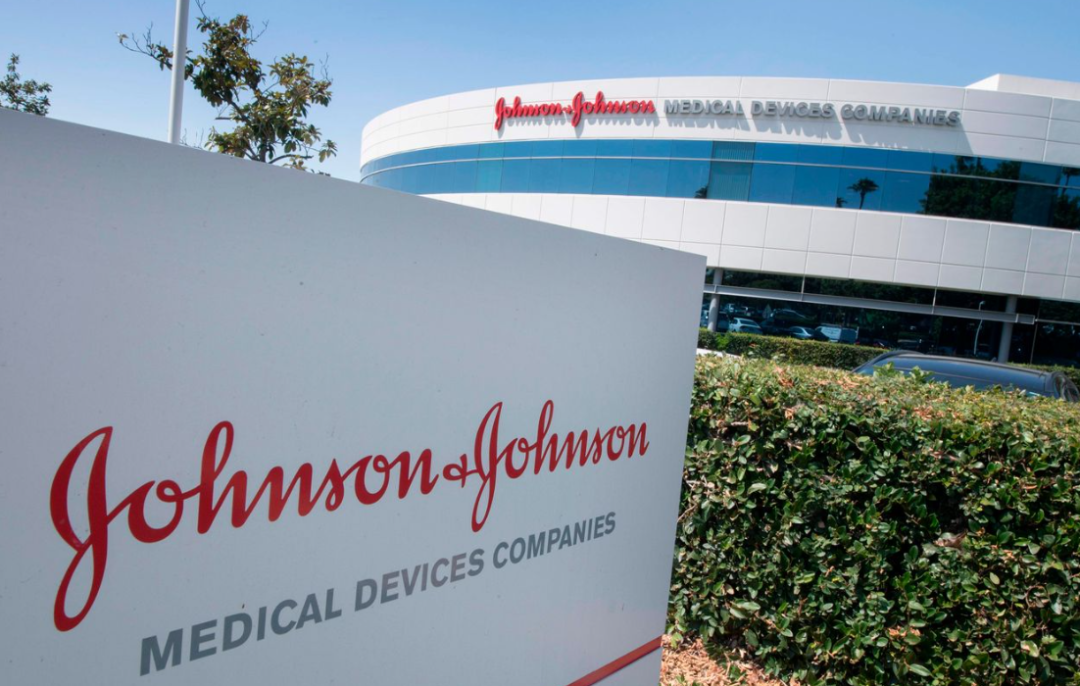
Johnson & Johnson
Medical Device R&D and Manufacturer
WuXi AppTec
New Drug R&D and Production Service Provider
Recently,PharmaronAnnouncement on the Sale of Equity in an Overseas Participating Company. Its wholly-owned subsidiary, Pharmaron Hong Kong Investment, holds equity in Proteologix.10.21% Equity, for approximately US$102 million (approximately RMB 738 million)Consideration, sold to Johnson & Johnson by Proteologix through a merger and acquisition.Johnson & Johnson)。
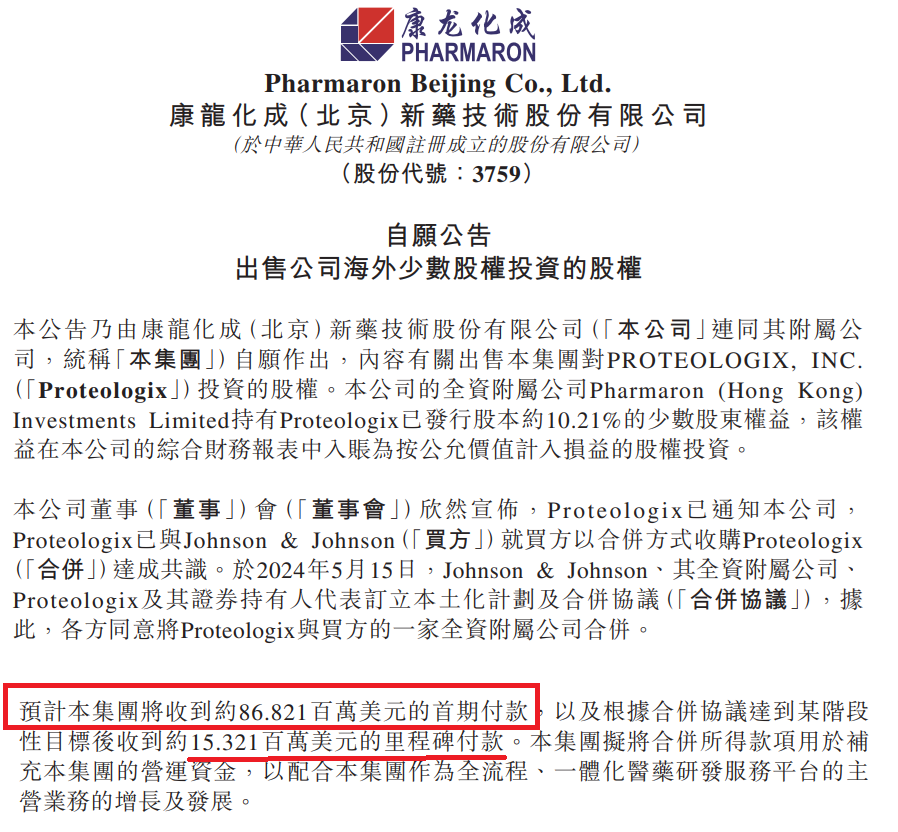
▲ Source of the image: Announcement of HKEX listed company
It is worth mentioning that the equity interest in Proteologix held by Pharmaron Hong Kong Investment mainly came from the subscriptions made by Pharmaron in September 2021 and November 2022, using its own funds of $3 million and $4 million, respectively.
A rough calculation shows that if Johnson & Johnson's acquisition is successfully completed, its value will have grown during the investment period.More than 13 times, which will also have a significant positive impact on Pharmaron's net profit performance in 2024.
After the effectiveness date of the merger and acquisition,Johnson & Johnson needs to pay Pharmaron via a paying agent within 60 days.Approximately USD 86,821,000 as the down payment; Johnson & Johnson or its affiliated companies complete the R&D project milestone events as agreed in the contract within 60 days after payment through an agent.Pay Pharmaron approximately US$15.321 million for milestone events。
The风波 of the U.S. Biosecurity Act just concluded on the 15th,Pharmaron Sells Proteologix Equity, Industry Analysis Points Out,This may be related to the风波 surrounding the U.S. "Biosecurity Bill" that has garnered significant attention in China's biopharmaceutical industry. Although Pharmaron is not on the watchlist in the revised draft of the "Biosecurity Bill," the sale of this equity stake could be an effort to alleviate American concerns.
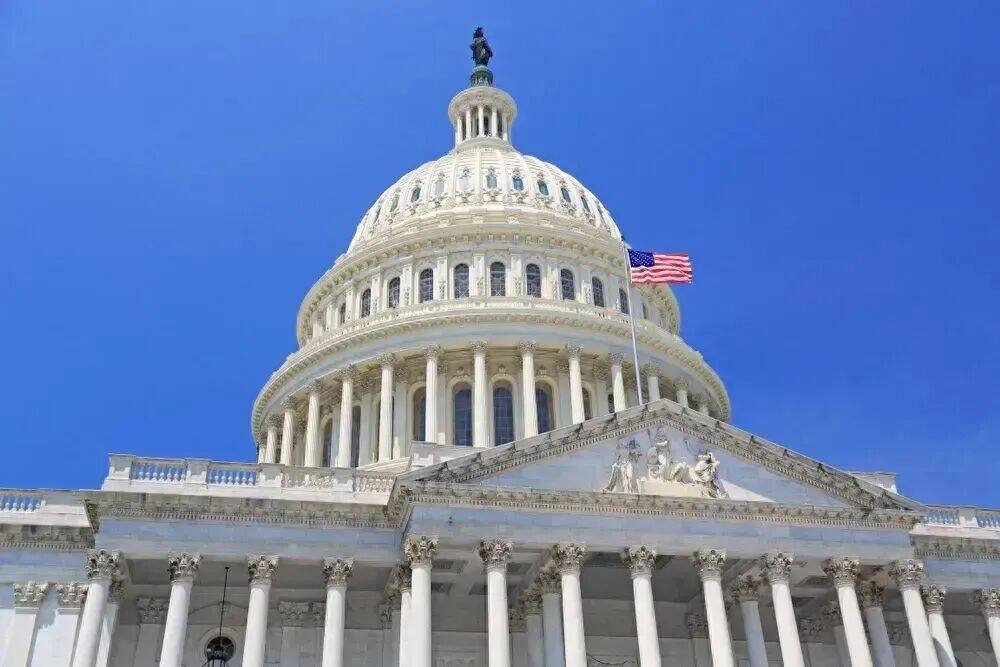
Beijing time on the evening of May 15, the U.S. House Oversight and Accountability Committee voted on-site to approve the Biosecurity Act, moving to the next legislative procedure.The new version of the bill requires companies involved in existing contracts/productsExemption RightsExtended to January 1, 2032, requiring U.S. companies to end cooperation with companies covered by the Act before 2032.This means that WuXi AppTec and other related companies will have an 8-year grace period for their operations in the U.S.
The Bill passed this time is the latest version published on May 10, and its content is more moderate for Chinese companies compared to previous versions.Currently, the companies involved in the "Bill" include WuXi AppTec,WuXi BiologicsAnd BGI, etc.
Chinese CDMO companies such as WuXi Biologics are competitive in the global pharmaceutical industry and possess various advantages. These companies have sufficient time to self-adjust to adapt to changes in the external environment and may respond positively to any marginal improvements in the external environment.
The风波 surrounding the U.S. Biosecure Act, which has been fermenting since the end of January this year, has brought considerable pressure to CXO (contract research and manufacturing organizations) companies in China.WuXi AppTec, the leading company in pharmaceutical R&D services, has experienced multiple sudden plunges in its stock price, with a decline of nearly 40% year-to-date.
WuXi AppTec relies heavily on overseas revenue. From 2021 to 2023, the proportion of WuXi AppTec's revenue from foreign markets was 74.67%, 80.88%, and 81.81%, respectively, making it significantly affected by the Act.
Industry insiders pointed out,Pharmaron and other CXO companies are closely tied to the most cutting-edge pharmaceutical firms, granting them access to the most advanced biotechnology in the U.S., which is what the U.S. fears.CXO companies invest in these startups and cutting-edge technologies as part of their business strategy.With the equity of this company, it can better facilitate cooperation and advance projects. During project collaboration, there may also be access to internal materials of the other company, including some cutting-edge technologies, which is why the U.S. cannot tolerate it.
In response, Pharmaron stated that the sale of its equity in an overseas joint venture company is not related to the "Biosecurity Act" and is not intended to reduce U.S. concerns."For now, the 'Biosecure Act' incident has not impacted our operations in the U.S. market, as it has just passed the voting stage at the House Oversight and Accountability Committee. We still need to wait for the final confirmed version and implementation details. Currently, we are signing contracts with U.S. clients as usual, and related businesses are proceeding normally."
According to the research report by Minsheng Securities, the global demand for China's R&D outsourcing is rapidly increasing.CXOThe basic market for steady growth remains overseas. After about fifty years of development, the overseas CXO industry has entered a mature stage, cultivating a large market scale. Large CXO companies such as Lonza, IQVIA, and Charles River Laboratories occupy most of the global market share. As the CXO industries in Europe and America mature, multinational pharmaceutical companies seek international emerging markets to reduce R&D and production costs. The penetration rate in emerging Asian markets such as China and India continues to increase, and global CXO production capacity keeps shifting to China.
According to Sullivan data, global demand for China's R&D outsourcing doubled from 6% in 2016 to 12% in 2021, and will nearly double again by 2026. In terms of revenue structure, more than 70% of the income of most top domestic CXO companies comes from overseas markets.
If the U.S. market is significantly affected by the "Biosecurity Act," how should China-based CXO companies find a way out?
In the past two years, the CXO sector has generally experienced significant adjustments. Coupled with a decline in performance growth rates and constraints from external human factors, the industry is currently in a low period.
In the first quarter of this year,WuXi AppTecTotal revenue in the first quarter was 7.982 billion yuan, a year-on-year decrease of 10.95%; net profit attributable to shareholders was 1.942 billion yuan, a year-on-year decrease of 10.42%.
Revenue of Other Leading CXOs in China for the First Quarter:
AsymchemTotal revenue in the first quarter was 1.4 billion yuan, a year-on-year decrease of 37.76%; net profit attributable to parent company was 282 million yuan, a year-on-year decrease of 55.27%;
TigerMedTotal revenue in the first quarter was 1.66 billion yuan, a year-on-year decrease of 8%; net profit attributable to shareholders was 235 million yuan, a year-on-year decrease of 58.65%.
Pharmaron's Total Revenue in Q1: 2.671 Billion Yuan, Down 1.95% Year-on-Year; Net profit attributable to母公司 decreased by 33.8% year-on-year to 231 million;
Pharmaron's Q1 revenue decline was the smallest, demonstrating its resilience. Additionally, the number of R&D employees at Pharmaron has increased compared to the same period last year. If nothing unexpected occurs, year-over-year revenue growth can be anticipated in H1.
Pharmaron Sells Equity Stake in Affiliate to Johnson & Johnson for $102 Million: A Positive Move to Alleviate 2024 Performance Pressure
The financial report shows that, mainly due to the impact ofImpact of Global Pharmaceutical and Healthcare Industry Investment and Financing Slowdown and Temporary Deceleration in Customer Demand Growth Amid Market Environment, therefore, during the reporting period, PharmaronStage-based Revenue Decline. But at the same time, in the first quarter of 2024, PharmaronGlobal customer inquiries and visits have warmed up compared to the same period in 2023., New orders signed increased by more than 20% year-over-year.。
SPDB International Research Report Analysis: In the First Quarter of 2024, Pharmaron's Revenue and Adjusted Net Profit Attributable to Shareholders Were Both Below Expectations.
The lower-than-expected revenue was mainly due to weak industry financing and Pharmaron's integration of laboratory services businesses in Shanghai, Ningbo, and Beijing, including the closure of the Shanghai laboratory. The adjusted net profit attributable to shareholders was significantly below expectations, impacted not only by one-time losses from closing the Shanghai laboratory (approximately RMB 44 million) but also by rising employee costs (mainly from new hires in the second half of 2023), decreased gains from changes in the fair value of biological assets, and increased financial expenses. The overall gross margin was 32.2%, decreasing by 2.6 percentage points year-over-year and 3.4 percentage points quarter-over-quarter, falling short of expectations.
The U.S. Bio Bill has granted Chinese companies a few years of transition period, which the market interprets as a major positive. For the companies involved and the entire industry, this means more time to adapt to the new policy environment and actively adjust their business structures. Pharmaron was the first to respond by divesting related equity to mitigate the negative impacts brought by geopolitical factors. In the future, China’s CXO industry will find the most suitable development model amidst challenges and revitalize the industry's strength.
Disclaimer:
The content of the article is for reference only and does not constitute investment advice. Investors who take action based on this information bear their own risks. The article maintains a neutral stance on statements and viewpoints, and does not provide any express or implied guarantees regarding the accuracy, reliability, or completeness of the content. Readers are advised to use it only as a reference and assume full responsibility for their actions. The various articles published by this public account aim to share information; if there is any infringement, please contact us and we will delete the content.