丨Medicine Hunter Club Research TeamOn May 27, the AstraZeneca/Daiichi Sankyo jointly developedDatopotamab Deruxtecan (Dato-DXd) Phase 3 TROPION-Lung01 Study in Advanced NSCLCOverall Survival (OS) ResultsShows that, compared with chemotherapy:In the overall trial population of adult patients with locally advanced or metastatic NSCLC who have received at least one front-line therapy, Dato-DXd showed superiority in survival rates but did not reach statistical significance. In the pre-specified subgroup of patients with non-squamous NSCLC, Dato-DXd demonstrated clinically meaningful improvement in OS.
At the 2023 European Society for Medical Oncology (ESMO), the results of the Phase 3 clinical study TROPION-Lung01 for Dato-DXd showed:In the overall trial population of NSCLC, one of the primary endpoints, progression-free survival, showed a statistically significant improvement.Another primary endpoint of the study, overall survival (OS), had not yet matured at the time of this analysis.On February 19, 2024, based on the results of the Phase 3 TROPION-Lung01 study,Dato-DXd's Biologics License Application (BLA) for the treatment of adult patients with locally advanced or metastatic non-squamous non-small cell lung cancer who have previously received systemic therapy has been accepted by the U.S. FDA.The application is currently under review by global regulatory agencies, including those in the United States and the European Union.
TROPION-Lung01 Study: Dato-DXd Group Shows Greater OS Benefit
Datopotamab deruxtecan (Dato-DXd) is designed using Daiichi Sankyo's proprietary DXd ADC technology and is an ADC that links a humanized, Trop2-targeted monoclonal antibody with an innovative DNA topoisomerase I inhibitor.
TROPION-Lung01 is an ongoing global, randomized, multi-center, open-label Phase 3 trial evaluating the efficacy and safety of Dato-DXd (6.0mg/kg) compared to Docetaxel in patients with locally advanced or metastatic NSCLC who have previously received at least one prior treatment and have no actionable genomic alterations.The dual primary endpoints of TROPION-Lung01 are PFS and OS, as assessed by Blinded Independent Central Review (BICR).Key secondary endpoints included PFS assessed by the investigator, objective response rate, duration of response, time to response, disease control rate assessed by BICR and the investigator, and safety.2024 ELCC Conference Reports Non-Squamous Subgroup Data: Dato-DXd Group Shows Greater OS BenefitThe pre-specified non-squamous subgroup results of the TROPION-Lung01 study were reported at the 2024 ELCC conference. The study enrolled 468 patients with non-squamous cell carcinoma, who were randomly assigned in a 1:1 ratio to receive either Dato-DXd (6 mg/kg, n=234) or docetaxel (75 mg/m², n=234) treatment (Q3W). Investigators conducted PFS and OS subgroup analyses based on histological characteristics, while PFS and tumor response were assessed by BICR according to RECIST 1.1.
As of March 29, 2023, the median follow-up times for the Dato-DXd group and the docetaxel group were 12.9 months and 12.7 months, respectively.Median PFS for Dato-DXd showed better clinical benefit compared to docetaxel, at 5.5 months versus 3.6 months, respectively., reducing the risk of disease progression or death by 37% (HR=0.63; 95%CI 0.51-0.79).The 6-month PFS rate (46.6% vs 28.2%) and 9-month PFS rate (34.8% vs 15.7%) in the Dato-DXd group), all higher than the docetaxel group.OS is not yet mature, and the study will continue follow-up; however, the interim analysis results support that the Dato-DXd group has more OS benefit compared to the docetaxel group (13.4 months vs 11.4 months, HR=0.79; 95%CI 0.60-1.02).In terms of tumor remission,The ORR in the Dato-DXd group reached 31%.Four patients achieved complete response (CR); the ORR in the docetaxel group was only 13%, with no patients achieving CR. Additionally, the median duration of response (DoR) was 7.7 months in the Dato-DXd group and 5.6 months in the docetaxel group, while the disease control rates (DCR) were 80% and 61%, respectively.In terms of safety, Dato-DXd demonstrated good tolerability, with an incidence rate of ≥3 grade treatment-related adverse events (TRAEs) at 22%, lower than the 41% in the docetaxel group.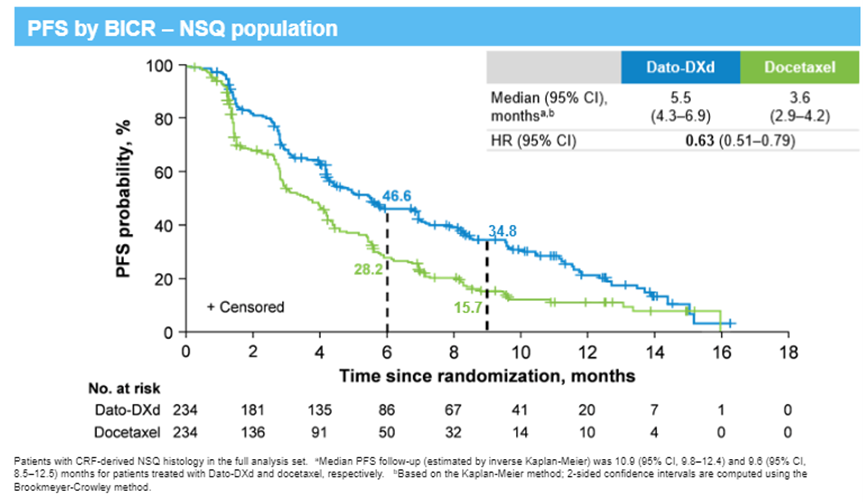
2023 ESMO Congress Reports First Positive Pivotal Phase 3 Clinical Study ResultsAt the 2023 European Society for Medical Oncology (ESMO), AstraZeneca reported significant results from the Phase 3 TROPION-Lung01 study of Datopotamab deruxtecan. At the time, this was the first Phase 3 clinical study in the lung cancer field to publicly disclose results for a Trop2 ADC, drawing considerable attention.The study results showed that the objective response rates (ORR) for the Dato-DXd group and the docetaxel group were 26.4% and 12.8%, respectively. Dato-DXd demonstrated significant efficacy in the non-squamous cell carcinoma subgroup, with notable improvements in ORR (31.2% vs 12.8%) and PFS (5.6 months vs 3.7 months), reducing the risk of disease progression by 37%. For non-squamous cell carcinoma patients, across key subgroups, regardless of the presence of AGA or brain metastases, patients benefited from Dato-DXd treatment, with those carrying AGA experiencing a more pronounced reduction in progression risk (HR 0.38).2024 ASCO:Dato-DXd Multiple Research Results Await Announcement
The 2024 American Society of Clinical Oncology (ASCO) Annual Meeting will be grandly held in Chicago, USA, from May 31 to June 4 local time. Dato-DXd will present five related results at this conference, including biomarker analysis predicting efficacy, the efficacy of Dato-DXd in Chinese treated NSCLC patients, updated subgroup data of the first-line population from the TROPION-Lung02 study, and intracranial efficacy data from the TROPION-Lung05 study.
Abstract 1: ICARUS-LUNG01 Phase II Study: Predicting the Efficacy of Dato-DXd in Heavily Pretreated Advanced NSCLC Patients Through Serial Tissue Biopsies and Biomarker Analysis
ICARUS-LUNG01: A phase 2 study of datopotomab deruxtecan (Dato-DXd) in patients with previously treated advanced non-small cell lung cancer (NSCLC), with sequential tissue biopsies and biomarkers analysis to predict treatment outcome
Abstract 2: Dato-DXd in Chinese Patients with Advanced or Metastatic NSCLC: Results from the Phase I/II TROPION-PanTumor02 Study
Datopotamab deruxtecan (Dato-DXd) in Chinese patients (pts) with advanced or metastatic non-small cell lung cancer (NSCLC): Results from the phase 1/2 TROPION-PanTumor02 study
Abstract 3: Intracranial Efficacy of Dato-DXd in Patients with AGA-Treated Advanced/Metastatic NSCLC: Results from the TROPION-Lung05 Study
Intracranial efficacy of datopotamab deruxtecan (Dato-DXd) in patients (pts) with previously treated advanced/metastatic non-small cell lung cancer (a/m NSCLC) with actionable genomic alterations (AGA): Results from TROPION-Lung05
Abstract 4: Dato-DXd + Pembrolizumab ± Platinum-based Chemotherapy as First-line Treatment for Advanced NSCLC: Subgroup Analysis from TROPION-Lung02
Datopotamab deruxtecan (Dato-DXd) plus pembrolizumab (pembro) with or without platinum chemotherapy (Pt-CT) as first-line (1L) therapy for advanced non-small cell lung cancer (aNSCLC): Subgroup analysis from TROPION-Lung02
Abstract 5: Analysis of Drug-Related Interstitial Lung Disease (ILD) in Hospitalized Patients Treated with Dato-DXd
Analysis of drug-related interstitial lung disease (ILD) inpatients (pts) treated with datopotamab deruxtecan (Dato-DXd)
AstraZeneca: Continues to Double Down on ADC FieldAstraZeneca is continuing to strengthen its presence in the ADC field.
- In April 2019, AstraZeneca and Daiichi Sankyo reached a $6.9 billion collaboration on DS-8201, successfully placing themselves in the first tier of the ADC field.
- In July 2020, AstraZeneca partnered with Daiichi Sankyo again, acquiring non-Japanese rights to the Trop-2 ADC candidate DS-1062 for $6 billion.
- In 2023, AstraZeneca partnered with Chinese pharmaceutical companies Connaught Medical and Limin Pharmaceuticals to introduce the Claudin 18.2 ADC new drug CMG901 and the GPRC5D ADC new drug LM-305.
- On May 20, 2024, AstraZeneca announced a plan to invest $1.5 billion in building an ADC production base in Singapore. This will be AstraZeneca's first end-to-end ADC production center and will receive strong support from the Singapore Economic Development Board. The plant is scheduled to begin operations in 2029.
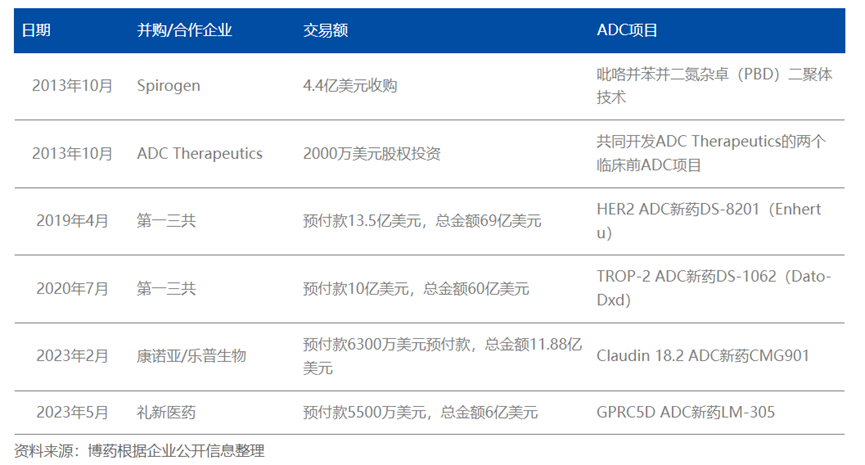
Summary of AstraZeneca's ADC Deals, Source: Bo YaoOn May 21, 2024, AstraZeneca proposed a target of achieving $80 billion in revenue by 2030 during its Investor Day event, listing products with peak annual sales potential exceeding $5 billion. The list includes multiple ADC projects:Dato-DXd, as well as multiple ADC projects in clinical phases 1-2 (targeting CLDN18.2, B7H4, EGFR/cMET, FRα, GPRC5D, CD123, etc.).
Enhertu (Trastuzumab Deruxtecan):Enhertu (DS-8201) is a HER2-targeted ADC. On April 5, 2024, Enhertu (DS-8201) was approved by the U.S. Food and Drug Administration (FDA) for the treatment of patients with metastatic HER2-positive solid tumors who have received prior therapy, becoming the first approved ADC drug for HER2-positive pan-solid tumors. DS-8201 is the first ADC drug with a tumor-agnostic indication, following the revolutionary PD-1 inhibitors that led to changes in immunotherapy (for MSI-H patients) and some targeted drugs (for RET, NTRK, and other gene-positive patients).In recent years, DS-8201 has stood out in the field of anti-HER2 therapy with its excellent broad-spectrum anticancer efficacy. Currently, DS-8201 has been approved for the following five types of indications:1. Unresectable or metastatic HER2-positive (IHC3+ or ISH-positive) breast cancer, previously treated with anti-HER2-based therapy.2. Metastatic or unresectable HER2-low (IHC1+ or IHC2+/ISH-) breast cancer, with prior chemotherapy received, or disease recurrence occurred during/within 6 months after adjuvant chemotherapy completion.3. Locally advanced or metastatic HER2-positive (IHC3+ or IHC2+/ISH positive) gastric or gastroesophageal junction adenocarcinoma, previously treated with trastuzumab regimen.4. Unresectable or metastatic HER2 (ERBB2) mutated non-small cell lung cancer, previously treated with systemic therapy.5. HER2-positive (IHC3+) unresectable or metastatic solid tumors (recently approved), previously treated with systemic therapy, and no other satisfactory alternative treatment options available.Datopotamab deruxtecan(Dato-DXd):Designed with Daiichi Sankyo's proprietary DXd ADC technology, it is an ADC composed of a humanized, Trop2-targeting monoclonal antibody linked to an innovative DNA topoisomerase I inhibitor. On February 19, 2024, the Biologics License Application (BLA) for Dato-DXd was accepted by the U.S. FDA in the United States for the treatment of adult patients with locally advanced or metastatic non-squamous non-small cell lung cancer who have previously received systemic therapy. The FDA is set to make a regulatory decision in the fourth quarter of 2024. If approved, this product will become the world’s first Trop2-targeted ADC for lung cancer treatment. In April this year, another BLA application for Dato-DXd for the treatment of unresectable or metastatic HR-positive, HER2-negative breast cancer in adult patients was also accepted by the U.S. FDA.AstraZeneca, in addition to collaborating with Daiichi Sankyo on the development of DS-8201 and Trop2 ADC, is also actively building its own ADC R&D pipeline. This includes acquiring global rights outside Greater China for the Claudin18.2 ADC from Connaught/LePu Biopharmaceuticals. Additionally, five self-developed ADCs are in the early clinical stages, including GPRC5D ADC, FRα ADC, B7H4 ADC, CD123 ADC, and EGFR/cMET bispecific ADC, among which TOP1 inhibitors are mostly used as payloads.References: Tumor News, Oncology Channel of MedicineFeatured Article Recommendations


Disclaimer
1. All information provided by the "Drug Hunter Club" is for reference only and should not be used as a basis for any commercial transactions or medical services. If there are any discrepancies arising from the independent use of the content from the "Drug Hunter Club," our company will not assume any responsibility, including but not limited to legal liability or compensation.
2. "Drug Hunter Club" is committed to providing reasonable, accurate, and complete information, but does not guarantee the reasonableness, accuracy, or completeness of the information, and shall not be liable for any loss or damage caused by unreasonable, inaccurate, or omitted information.
3. Some article information in the "Drug Hunter Club" is sourced from online reprints for the purpose of conveying more information, and does not imply endorsement or verification of the accuracy of its content. If you have any questions about the content, please contact our company promptly.
4. For issues not covered in this statement, please refer to relevant national laws and regulations. In the event of any conflict between this statement and national laws and regulations, the latter shall prevail.