

Divergent Paths in Cell and Gene Therapy: Legend Biotech Embraces Non-Viral Platforms While Merck Bets on Viral Vectors
Legend Biotech
Tumor Cell Immunotherapy Developer

MaxCyte
Cell Engineering Platform Technology Supplier

Mirus Bio
Nucleic Acid Technology and Product Developer

Merck Group
Pharmaceutical R&D Developer


May 28, 2024
eMedClub News
On May 22, Legend Biotech and Merck KGaA announced news of collaboration on cell and gene therapy-related transactions on the same day.Merck Group said it would$600 Million AcquisitionLife Sciences Company Mirus Bio,Legend Biotech Announces Collaboration withMaxCyte Signs Strategic Platform License Agreement to Accelerate Cell Therapy Development
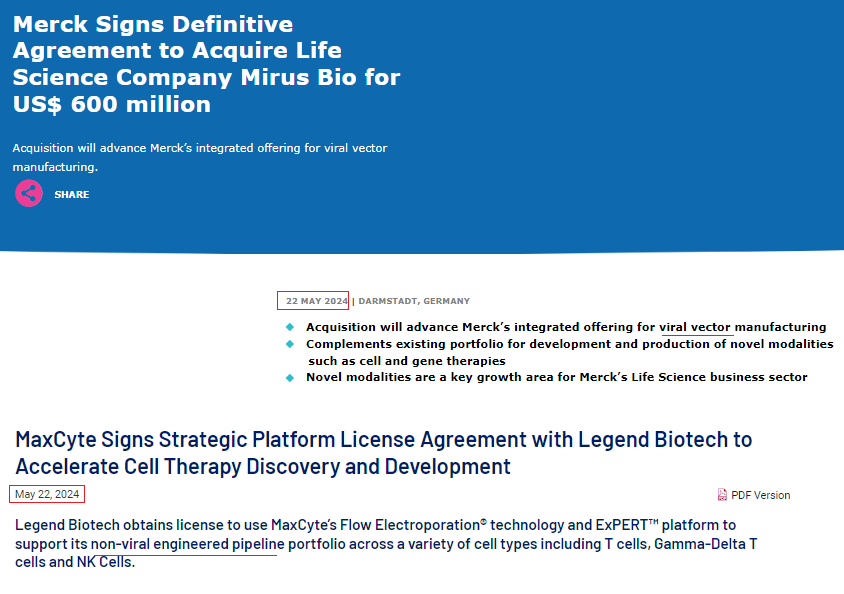
Interestingly,Merck Group has chosen to double down on the viral vector products technology track, while Legend Biotech has opted to collaborate with MaxCyte's non-viral cell engineering technology., mainly due to its electroporation technology.
Merck's Choice
eMedClub
Merck Group stated that the acquisition of Mirus Bio will complement its existing portfolio for the development and production of novel therapies such as cell and gene therapies. Located in Madison, Wisconsin, U.S., Mirus Bio is a specialist in the development and commercialization of transfection reagents. Transfection reagents, such as the company’s TransIT-VirusGEN product, are used to help introduce genetic material into cells. These reagents play a crucial role in cell and gene therapies.Viral VectorPlays a key role in the production.
In the past 10 years,Cell and gene therapies based on viral vectors have proven their potential, with over 20 therapies approved.Currently, there are approximately 1,500 such molecules under development globally, and the market is expected to grow by 30% by 2028. Viral vectors are highly effective tools for introducing genetic material into cells. In their natural state, viruses can enter human cells and introduce genetic material, causing the cells to produce more viral particles. Scientists harness this ability to introduce genetic material but modify the virus so that it does not cause disease. Instead, it becomes a carrier, or "vector," capable of delivering therapeutic genes to human cells. As a result, viral vectors are widely used in medical research and treatment, including cell and gene therapies.
Legend Biotech's Choice
eMedClub
Through cooperation withMaxCyteThrough cooperation, Legend Biotech will obtain the latter's Flow Electroporation®Technology and ExPERT™ Platform Non-Exclusive Clinical and Commercial Rights, toSupportNon-viralEngineered cell combination products, including T cells, Gamma-Delta T cells, and NK cellsMaxCyte will receive corresponding licensing fees and related project revenue.
Dr. Ying Huang, CEO of Legend Biotech, stated: "Our goal is to transform the treatment landscape by creating a broad portfolio of cell therapies to help enhance patients' immune systems and combat diseases. MaxCyte's clinical-grade production platform, non-viral cell engineering technology, and regulatory expertise will support our development of a product pipeline across various cell types and modalities.”
It is worth mentioning that, in 2023, MaxCyte'sElectroporation TechnologyContributed to the launch of the world's first CRISPR/Cas9 gene-editing therapy, Casgevy, in the UK and the US for the treatment of sickle cell disease (SCD).
Conclusion
eMedClub
In the vast field of cell and gene therapy, viral vectors and non-viral vectors, though different in approach, both aim to achieve the same grand goal—precisely delivering therapeutic genes to target cells to improve or cure diseases. These two technological approaches, like two parallel streams, each have their own characteristics, but ultimately converge into the great river of cell and gene therapy.
With the continuous development of biotechnology, viral vectors and non-viral vectors will play an increasingly important role in cell and gene therapies. Researchers will continue to optimize these two technological pathways, enhancing their safety, efficiency, and specificity. Meanwhile, with the ongoing advancements in technologies such as gene editing and cell reprogramming, cell and gene therapies will demonstrate their unique advantages in more fields. We have reason to believe that, in the near future, viral vectors and non-viral vectors will jointly drive the development of cell and gene therapies, bringing benefits to more patients.
June 14-15
IBI EXPO
Recommended Thematic Forums
Scan the code
Limited Time Offer
Free Tickets


June 14-15
IBI EXPO
Recommended Thematic Forums
(Swipe up and down to view more)
Scan the code
Limited-time Claim
Free Tickets




DianDian "Share”、“Like"and"In Progress", charge me up a bit~"