丨Compiled by the PharmaHunter Club Research TeamRecently, according to industry insiders, MSD is about to$1.3 billionCash down payment, potential$1.7 billionMilestone Payment, Acquisition of Ophthalmic Biotechnology CompanyEyeBio。After the acquisition is completed, Merck will leverage its global resources and expertise to accelerateEyeBioThe clinical development and commercialization process of the product brings new treatment hope to patients with ophthalmic diseases worldwide.
About EyeBio
EyeBio is a clinical-stage ophthalmology biotechnology company that brings together a team of experienced leaders, innovators, and entrepreneurs to develop next-generation therapies for eye diseases. The company was co-founded by Dr. David Guyer and Dr. Anthony P. Adamis, who have a successful track record in the field of ophthalmology, particularly in the development of the first anti-vascular endothelial growth factor drug for the treatment of age-related macular degeneration.- David Guyer is a Venture Partner at SV Health Investors and the co-founder, former CEO, and Executive Chairman of Iveric Bio (formerly Ophthotech). Prior to co-founding EyeBio, he served as the Chair and Professor of the Department of Ophthalmology at NYU School of Medicine, bringing extensive academic research and industry experience in the field of ophthalmic therapeutics.
- Anthony P. Adamis co-founded EyeBio with Dr. Guyer in 2021 and founded Eyetech in 2002. He previously served as Senior Vice President of Product Development and Innovation at Genentech, a member of the Roche Group.
The company announced in July 2023 the successful completion of a $65 million Series A financing round led by SV Health Investors, with participation from Samsara BioCapital and Jeito Capital, and additional financial support provided by MRL Ventures.In November 2023, the company announced the successful completion of a $65 million Series A extension financing round, with new investors Bain Capital Life Sciences, Omega Funds, and Vertex Ventures HC joining this round.To date, the company's total financing has reached$130 million。It is worth noting that,MRL Ventures is the venture capital arm of Merck & Co., Inc.。(II) Technical Platform and Product IntroductionEyeBio is committed to developing a new generation of treatments for eye diseases, particularly for conditions that are currently undertreated.Its innovative product pipelineRestoretIs a trispecific antibody in the clinical stage, administered via intravitreal injection to activate the Wnt pathway, restoring and maintaining the retinal blood barrier, thereby eliminating leakage symptoms in retinal vascular diseases. Currently, the drug is being developed for the treatment of retinal diseases characterized by leakage, including neovascular age-related macular degeneration, diabetic macular edema, and familial exudative vitreoretinopathy.In February 2024, the company disclosed Week 12 data from the first-in-human Phase 1b/2a AMARONE trial of Restoret, showing: (1) Diabetic Macular Edema (DME) patients (n=26) receiving Restoret monotherapy had a mean improvement in Best Corrected Visual Acuity (BCVA) of +11.2 letters and a mean reduction in retinal thickness of -143 microns as measured by Optical Coherence Tomography (OCT). (2) Patients with Neovascular Age-Related Macular Degeneration (NVAMD) (n=5) receiving Restoret in combination with aflibercept also observed similar results. (3) Multiple monthly doses of Restoret (both as monotherapy and in combination with aflibercept) were well tolerated.Market Prospects of Retinal Diseases
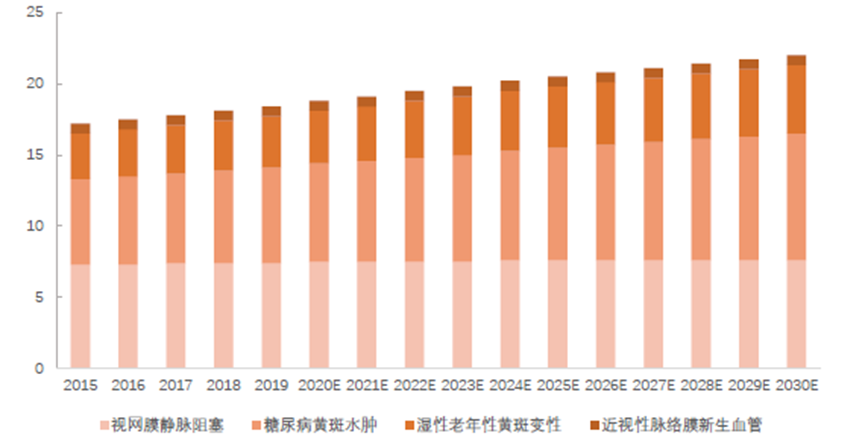
Retinal diseases include wet age-related macular degeneration (AMD), diabetic macular edema (DME), retinal vein occlusion (RVO), and myopic choroidal neovascularization (pmCNV), which can easily lead to blindness in affected populations. These conditions are typically characterized by fluid leakage, bleeding, and fibrotic scarring in the eye. Among them, AMD patients account for approximately 10% of those with age-related macular degeneration and are prone to vision loss; pmCNV is a complication of pathological myopia, primarily affecting individuals with myopia; DME is one of the complications of diabetes, and with the intensifying trend of aging, the number of patients is expected to increase, leading to a continuous rise in treatment demand.According to data statistics from Frost & Sullivan, the number of patients with the four major retinal diseases causing visual impairment and blindness worldwide increased from 17.1 million in 2015 to 2019.18.5 million, and is expected to grow to by 203022 million。Number of People Affected by Major Retinal Diseases (Million) from 2015 to 2030
Currently, the most mainstream treatments for retinal diseases are anti-VEGF drugs and laser photocoagulation. With the widespread use of anti-VEGF drugs, common fundus diseases such as central retinal vein occlusion, diabetic macular edema, and age-related macular degeneration have been treated effectively. However, there are still many patients who respond poorly to anti-VEGF drugs. In addition, the use of anti-VEGF drugs requires doctors to monitor patients monthly and administer frequent repeated injections, which imposes a significant burden on both patients and doctors. Traditional laser photocoagulation can also accelerate photoreceptor atrophy, induce ocular inflammation, and cause side effects such as preretinal scarring, choroidal neovascularization, and visual field defects. Finding new drug targets and mechanisms of action will be the main trend in this field.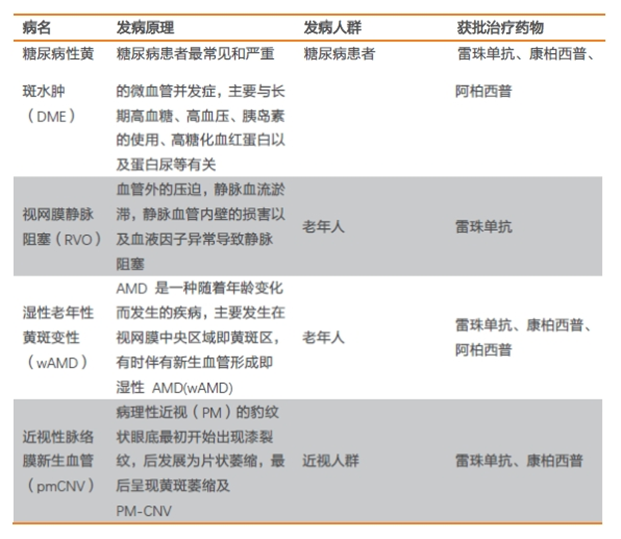
MSD's Deals and Acquisitions Layout in 2024
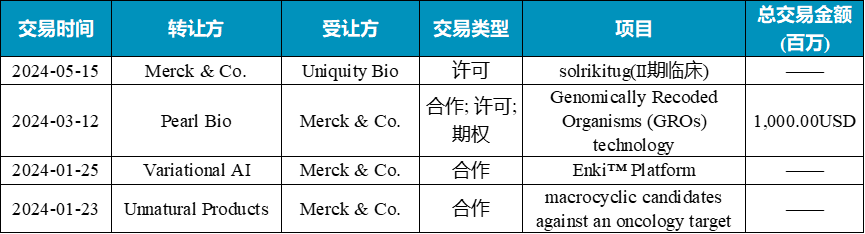
According to incomplete statistics, as of now, Merck & Co., Inc. (MSD) has generated 1 acquisition and 4 deals in the current year: including the $680 million acquisition of Harpoon, a company focused on antibody development, and reaching medicine and/or technology licensing agreements with four companies.
1. Company Official Website
2, Southwest Securities, Danke Research Institute, Tianfeng Securities
Featured Article Recommendations
Disclaimer
1. All information provided by the "Drug Hunter Club" is for reference only and should not be used as a basis for any commercial transactions or medical services. If there are any deviations resulting from the independent use of the content from the "Drug Hunter Club," our company assumes no responsibility, including but not limited to legal liability or compensation.
2. "Drug Hunter Club" is committed to providing reasonable, accurate, and complete information, but does not guarantee the reasonableness, accuracy, or completeness of the information, and assumes no responsibility for any loss or damage caused by unreasonable, inaccurate, or omitted information.
3. Some article information in the "Drug Hunter Club" is sourced from online reprints for the purpose of conveying more information, and does not imply endorsement of the views or confirmation of the authenticity of the content. If you have any questions about the content, please contact our company in a timely manner.
4. For issues not covered in this statement, please refer to relevant national laws and regulations. In case of any conflict between this statement and national laws and regulations, the latter shall prevail.