▲Source of the article: Medical Device Business Review, Eshare Medical Device Hub
▲Please indicate the above source at the beginning of the article when reprinting.
Orthopedic surgical robots have become one of the hottest tracks in the medical device industry. Under the monopoly of high technical barriers and high market share of the da Vinci surgical robot, many medical device giants are continuously innovating to break through in the orthopedic细分赛道.
Recently, it has been hailed as "the next Da Vinci"Medtronic Robot Brings New Spine Surgery Technology to the Orthopedic Field!
Medtronic Spine Surgery Robot Launched in China
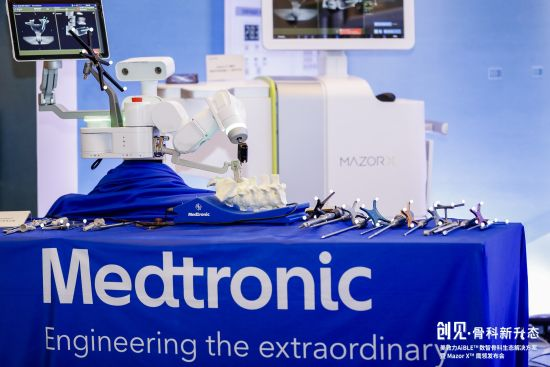
According to Medtronic's announcement, the fully upgraded version of itsMazor X™️ Integrated Platform for Spine Surgery Robotics Successfully Launched in China.As an innovative "pioneer" in the field of spinal surgery robotics, the Medtronic Mazor X Spine Surgery Robot has continuously led the industry's technological advancements since its launch in 2021, accumulating a vast amount of clinical data and experience, and now covers nearly all complex spinal surgeries.The officially launched Mazor X™️ Eagle Spine Surgical Robotics Integrated Platform this time features a full-dimensional upgrade from its original foundation, characterized by global foresight, precise execution throughout the procedure, and full-dimensional visualization. With Medtronic's advanced surgical planning system and an artificial intelligence system with higher algorithmic capabilities, it ushers spinal surgery into the era of intelligence.Source: Official WeChat account of the company
Continuous Scaling Up
Leading the Spine Surgery Robot Track in China
With the continuous expansion of the population with orthopedic injuries and spinal diseases in China, the market size of orthopedic robots in China is also growing.According to calculations by Eshare Medical Device Aggregation, the market size of orthopedic robots in China was 500 million yuan in 2022.。$1.6 Billion! Medtronic Makes a Bold Move to Master the Core of Surgical Robotics
As early as 2018, Medtronic$1.64 billion(Approximately RMB 11.2 billion)) acquired Mazor Robotics, an Israeli surgical robotics company, thereby acquiring the Mazor X surgical platform. The completion of this acquisition established Medtronic's absolute leading position in the spinal surgery robotics field. Since then, the company has never ceased in its steps to develop new products and invest in promising industry players, setting an example for the industry.
The core technology of surgical robots lies in the ability to achieve coordinated control between the surgical navigation system and the robotic arm.Worldwide, only a handful of companies have mastered the core technology of orthopedic surgical navigation and positioning robots and entered clinical application, with Israel's Mazor Robotics being one of the leading players. This is also the most important factor why Medtronic chose to acquire Mazor.Through acquisitions, Medtronic secures its technological sources., integrating with its own surgical navigation system, leveraging existing channel advantages, focusing on market expansion, and solidifying its leading position in the spinal surgery robotics field.
Notably, prior to Medtronic's acquisition of Mazor Robotics, more than 200 Mazor systems had already been clinically deployed across four continents, guiding the placement of over 200,000 implants in 45,000 surgeries, making minimally invasive spinal surgery a standard procedure in many hospitals.
Expansion of Territory, Continuous Investment in the Spine Robotics Market
Since entering the orthopedic market, Medtronic has continuously increased its focus on the spine sector. Following the approval of the first-generation Mazor spinal surgery robot for use in the United States, Medtronic, leveraging technology from Mazor Robotics, has continuously upgraded and iterated the Mazor spinal surgery robot. It has subsequently expanded its investment and presence in Europe, India, and other countries, launching the second-generation MazorX and the MazorX Stealth Edition robotic guidance systems for surgeries., marking the beginning of the global commercialization process for spinal surgery robots.
According to the data, after a series of mergers and acquisitions, Medtronic has now become the world's largest spinal manufacturer, with a market share of approximately 28%.. In Medtronic's strategic layout for surgical robotics, China has become an important part.
In 2012, Medtronic spent $816 million to acquire the then-leading Chinese spinal company.Kanghui, especially with Kanghui's spinal business becoming the focus of R&D. Subsequently, Kanghui’s localized R&D was promoted to meet the domestic demand in the spinal market, implementing a dual-brand strategy in China's orthopedic market to capture the market.
Later, Medtronic continued to rely on China's local innovation strength and kept upgrading its spinal robotics technology. In 2021, the Mazor X Spine Surgery Intelligent Navigation Robot was launched in China.First Achieved Full Visualization Operation in Spinal Surgery, "Shaking Up" China's Orthopedic Market.
It should be pointed out that the development of the surgical robot industry is not as simple as just selling equipment. Often,"Surgical Robot + Surgical Products + Medical Services"An overall solution. As a result, the combination of Medtronic's spinal surgery robot and spinal products significantly broadens Medtronic's moat in the spinal field it has long been cultivating, encompassing both technology and market.
The launch of the Mazor X™️ Hawk spinal surgical robotic integrated platform this time represents another upgrade by Medtronic in this field. However, such a move is not only aimed at perfecting Medtronic's product line in the spinal field in the Chinese market, but more importantly, it can improve the quality of clinical treatment in China and boost the creation of an intelligent surgical ecosystem in the country.
Giant Enterprises Around, Localization Becomes the New "Landing Point" in the Track
In the past few years, not only Medtronic but also multinational giants such as Stryker, Zimmer Biomet, etc., have carried out technical acquisitions andChina Spine RobotThe track is actively planning and laying out. Currently, the surgical robot systems of various companies are at different stages of development or commercialization.
IfZimmer BiometAdopting a commercial strategy nearly identical to that of Medtronic in 2016AcquisitionFrench Surgical Robotics Company with Robot-Assisted Surgery PlatformMedtech, and subsequently developed applications that support both brain and spine surgeries on a single system.Bifunctional Robot ROSA ONE, and in March 2020Enter the Chinese market, becoming the only surgical navigation robot in China currently approved for marketing and capable of being applied simultaneously to both brain surgery and spinal surgery, starting its market layout within China.
StrykerFollowing closely, during the earnings call in November 2023, Stryker outlined the timeline for the launch of its new Mako robotic application. Stryker statedMako Spine Robotic System to Launch in China in the Second Half of 2024This robot will focus on the placement of pedicle screws, and it will be faster and smoother than the products currently on the market.
In the face of severe competition in the orthopedic market, spinal surgery robots in niche sectors represent an efficient path for manufacturers to break through the challenges of the orthopedic industry. At this stage, China's surgical robot market has completed its early education phase. Aligned with the national 5G strategy and the development direction of intelligent robots, and supported by policies promoting hierarchical medical treatment and medical insurance, orthopedic surgical robots and new technologies in more specialized orthopedic fields are witnessing positive growth in the Chinese market.
Who is the ultimate "winner"?
With the increasing popularity of spinal robots in the Chinese market and the gradual rise in public acceptance of surgical robots, this vast potential market demand, which has yet to be fully met, is leading to a boom in the industry, resulting in intense competition among various players.
Although research on spinal surgical robots in China started relatively late, apart from multinational medical device giants like Medtronic and Zimmer Biomet establishing their presence in the field, currently,Domestic MarketDriven by a favorable environment and enormous demand, there are also more and moreLocal Players Join the Competition. Moreover, Chinese surgical robot players have made certain research accumulations in key technologies, continuously achieving breakthroughs in the field of spinal surgical robots, which will continue to accelerate the localization of细分赛道.Track Competition: China-Made Innovative Power EmergesInTINAVIFor example, in October 2023, China launched its domestically developed third-generation orthopedic surgical robot.MedtronicSeries, is the world's first capable of carrying outOrthopedic Robot System for Spinal Full-Segment, Pelvic, and Limb Fracture Surgeries, with a surgical positioning accuracy of 0.8 millimeters, the technology is at an internationally leading level, achieving an innovative breakthrough for domestically produced surgical robots, transitioning from catching up, to running neck-and-neck, to taking the lead on a global scale.As of March 2024, the number of orthopedic robotic surgeries performed by the Tianji series has exceeded 70,000 cases. In the spinal surgery robot market, the "Tianji Robot" ranks first in both installation volume and surgical volume in China.Such asXin Jun Te, as a Chinese enterprise with full independent intellectual property rights, its productsORTHBOT Intelligent Spinal Orthopedic Surgery RobotIt is the first domestically produced fully intelligent orthopedic surgical robot in China that integrates navigation and surgical operation.Last year, ORTHBOT Intelligent Spinal Orthopedic Surgery Robot obtained the EU MDR CE certification, which is the first Chinese spinal robot manufacturer to obtain this certification.First MDR CE Certificate, which also means that Xinjun Special has obtained the first "passport" to enter the international market, taking the first step in laying out key regions globally.Reports show that by 2030, the total number of spinal surgeries in China will exceed 3 million. With the increase in average life expectancy and the progression of initial surgery timing, the need for spinal surgeons to utilize innovative therapies to address the challenges posed by complex degenerative surgeries will intensify. To a certain extent, the national procurement of spinal products has significantly accelerated the progress of product innovation and technology introduction, enabling faster catalyzation of local innovative enterprises to truly leverage their strengths.Looking Ahead: The Future Competition in China's Spinal Surgery Robot MarketWith the acceleration of global aging, it is foreseeable that the global spinal industry is moving towards "globalization, intelligence, and precision." The large population base and the increasing speed of aging have determinedChina Market Will Become the Largest Market for Spinal Surgery Globally。Under this major industry trend, what are the future development directions of the rising spinal surgery robot market in China?Comparing spinal surgery robot products at home and abroad, multinational medical device giants design their products in the spinal surgery robot field as an "integrated system of surgical robots + artificial intelligence + proprietary consumables." They plan to provide a complete platform solution while focusing on the Chinese market for key deployment, accelerating the commercialization process.The product design advantages of spinal surgery robots in China are mainly reflected inAccuracy, Minimally Invasiveness, ReproducibilityAt present, domestically produced spinal robots in China cannot yet perform efficient full-process surgical operations. Most are limited to navigation assistance for spinal screw placement or aiding in certain steps of replacement surgeries. In terms of commercial layout, judging from the commercialization progress of companies like Tinavi and Xinjun Special, their focus is more on深耕 (deep cultivation) of the domestic market rather than expanding overseas.In the future, Chinese spinal surgery robotics companies must secure their place in the competition.It is necessary to continuously expand coverage to find new growth points, while establishing differentiated competitive advantages by focusing on its specialized niche markets.When robotic technology becomes a practical and effective option for all hospital surgeons, it will truly become the future of spinal surgery.Taking Medtronic (Spine Division) as an example, it continuously empowers product iteration by acquiring innovative technologies. The newly launched next-generation Mazor X™ has conquered several pain points in spinal surgeries with its superior performance. The main principles of modern spinal surgery involve decompression, deformity correction, and stability. The global intelligence advantages of Medtronic’s Mazor X™ meet the operational needs of hospitals and doctors, making it an industry benchmark.Insisting on innovation and intelligence is the key focus for the future of China's spinal market.When the industry accelerates iteration, giant medical device companies with mature commercial scale will inevitably continue to break through technology, bringing more intelligent and versatile products. Meanwhile, as latecomers, high-precision Chinese medical device manufacturers have already begun to make their mark in the field and can continue to rise rapidly in the domestic market by taking advantage of favorable policies. Only in turbulent times do we see true heroes. Let us wait and see what new surprises orthopedic device companies at home and abroad will bring to the spinal field in the future!Note:The above content is for reference only and does not constitute investment advice. The interpretation of official policies in this article represents the views of this platform, and the content shall be subject to official documents.If any platform reprints this article, it must take responsibility for the article itself and will not be responsible for any impact caused by secondary dissemination after reprinting.