




Source: Lieyun Network.
Recently, Huichuang Medical completed a nearly 100-million-yuan B+ round of financing. This round was jointly led by RICHEN CAPITAL and SJ Jiacheng Investment Management Co. Ltd., marking the second hundred-million-level financing the company has received within half a year.
It is reported that the funds from this round of financing will be used to strengthen the company's leading brand position in the market for functional near-infrared spectroscopy (fNIRS) brain imaging, as well as for clinical trials and team recruitment for transcranial light modulation therapy in degenerative diseases.
Previously, Huichuang Medical has successively received support from several top investment institutions, including Tsingyuan Investment, CAS Haichuang, Daoyuan Capital, Shanlan Capital, Founder Securities Investment, Yida Capital, Wuxi Venture Capital, Hetang Venture Capital, and Hemeng Venture Capital. It has also received multiple rounds of follow-up investments from various institutions.
Danyang Huichuang Medical Equipment Co., Ltd. was established in January 2016. The chairman, Associate Professor Daihua Wang of Beihang University (formerly Beijing University of Aeronautics and Astronautics), completed his undergraduate to doctoral studies at Tsinghua University and has been dedicated to research in the field of brain science for 20 years, laying a solid technical foundation for the company's products. The general manager, Mr. Genmiao Guo, is a former senior executive and chief engineer of Mindray Medical, with extensive experience in production and sales system construction, enterprise management, and industry mergers and acquisitions. The company currently has a team of nearly 200 people, with more than 30% holding master's or doctoral degrees, most of whom graduated from renowned universities both domestically and internationally, such as Tsinghua University, Peking University, California Institute of Technology, University of Science and Technology of China, and Beihang University.
Huichuang Medical has built a large-scale R&D team, continuously leading the industry-university-research direction with an innovative and efficient R&D system. After years of R&D accumulation, the company has been constantly converting cutting-edge academic achievements into advanced engineering results and innovative market products. The company independently developed the world's first floor-standing near-infrared brain function imaging device with over 100 channels to obtain a medical device certificate, the world’s first portable near-infrared brain function imaging device to obtain a medical device certificate, and the highest channel infrared brain function imaging device in the world to obtain a Chinese medical device registration certificate.
Huichuang Medical has always adhered to an academic-driven strategy. The company's innovative fNIRS products have provided the academic research community and clinical medicine field with new research tools, created new research methods, and opened up new areas of study. As of the end of March 2024, Huichuang Medical's fNIRS series has supported expert users in publishing 241 SCI papers in top journals such as *Nature Human Behaviour*, *Advanced Functional Materials*, *NeuroImage*, *Cerebral Cortex*, and *Asian Journal of Psychiatry*. This represents an increase of over 50% compared to September 2023, when the company completed its Series B financing round. On average, every 1-2 days, a high-level SCI paper based on Huichuang Medical’s fNIRS products is published.
fNIRS Brain Function Imaging Device: The "Functional MRI Worn on the Head"The fNIRS brain function imaging device has been hailed as the "functional MRI worn on the head." Due to its non-invasive, portable, and accurate performance advantages, it has rapidly gained attention in both research and clinical settings in recent years. According to statistics from Google Scholar, currently, more than 5,000 articles related to fNIRS are published globally each year. Renowned institutions such as Harvard Medical School, Stanford University, Mayo Clinic, and the University of Tokyo have published a large number of high-impact articles. Clinically, fNIRS applications in China now cover thousands of tertiary hospitals and are widely used in departments such as psychiatry, rehabilitation, neurology, and pediatrics. It shows great potential as a next-generation biomarker for detecting and evaluating conditions like depression, autism, cognitive impairment, and stroke rehabilitation.
In addition to the currently relatively mature diagnostic paradigms, fNIRS is also a clinical and multi-field potential application tool with great imagination:
Clinical Fields: Supporting brain function solutions across multiple departments and fields such as cognition, rehabilitation, emotion, psychiatry, obstetrics and gynecology, ENT, audiology, and ophthalmology. Facilitating the development of brain disease and brain function examination, widely applied in auxiliary disease assessment, early screening, prognosis evaluation, efficacy prediction, real-time treatment feedback, and optimization of diagnosis and treatment plans.
In the field of education and sports: Explore the brain development patterns of individual learning and training, assist in identifying learning and training styles, monitor mental states, and enhance training effectiveness and competitive levels; assist in optimizing the evaluation of teaching and training quality and measuring educational outcomes.
Industrial Safety Field: Explore the real-time monitoring of mental and psychological states to drive key industrial processes, optimize job matching, scientifically schedule project timelines, and promptly identify abnormalities in personnel health. Provide new industrial safety solutions for scenarios with extremely high safety standards, such as power grids, hazardous chemical transportation, and fleet logistics.
Cultural Entertainment Field: Interactive solutions through fNIRS technology, combined with the metaverse, virtual reality, and augmented reality, promote brain-state-based interactive control and user-state awareness, enhancing user immersion.
Aging Health and Wellness Field: Timely alerts on brain health, brain load, brain cognition, and brain fatigue to enable early warning and intervention for abnormal mental health and vital sign anomalies. Leverage brain-computer interface technology for early screening and intervention of key physiological functions in the elderly, promoting the maintenance, recovery, or enhancement of related functions.
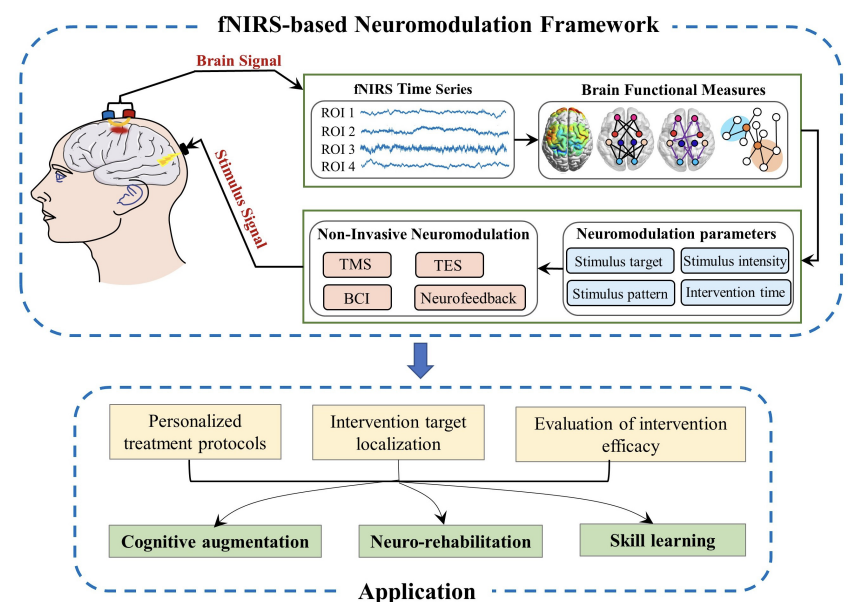
The Application Prospects of fNIRS in Fields Such as Neurofeedback and Brain-Computer Interfaces, by Wang Daifa et al.
Functional near-infrared spectroscopy in non-invasive neuromodulation. Neural Regeneration Research, 19(7), 1517-1522.
Moreover, in the field of brain-computer interfaces, non-invasive brain-computer interface interaction platforms based on fNIRS technology exhibit significant advantages over other types of brain-computer interaction interfaces. These include easy installation and debugging, good physiological response stability, high spatial resolution, strong resistance to electromagnetic interference, strong resistance to motion interference, and convenient and comfortable wearability. Such features make it an ideal information interaction interface and solution for brain-computer interfaces and brain-inspired intelligence technologies. It also has broad application prospects in areas such as motor imagery brain-computer interfaces and cognitive brain-computer interfaces.
In terms of sales and operations, Huichuang Medical has established a comprehensive sales system covering medical institutions and scientific research institutes at all levels across China, and has achieved sales coverage in overseas regions such as Southeast Asia. Huichuang Medical's fNIRS devices have been sold and demonstrated in clinical departments of top-tier hospitals such as the Sixth Hospital of Peking University, Peking Union Medical College Hospital, Ruijin Hospital Shanghai, and West China Hospital of Sichuan, as well as in renowned universities and institutes nationwide including Tsinghua University, Beijing Normal University, and the Chinese Academy of Sciences. These devices have already gained substantial benchmark customers who have made repeat purchases.
In recent years, Huichuang Medical's revenue scale has continued to rise against the trend, maintaining nearly 100% growth for several consecutive years.
It is worth mentioning that in July 2023, Eisai Co., Ltd. and Biogen Inc. launched Lecanemab, the first new Alzheimer's disease (AD) drug to receive full FDA approval in 20 years, bringing new hope to this long-dormant field. The drug slows the rate of cognitive decline in patients by clearing excessive Aβ protein plaques in the brain. Although the introduction of this new therapy is exciting, it can only slow disease progression, requires a long treatment course, and offers relatively limited improvement and efficacy. For China’s over 10 million AD patients, 35 million high-risk individuals, and 173 million people at potential risk, the development of more groundbreaking interventions and treatment methods is imperative.
Huichuang Medical applied for the earliest principle patent in China for the treatment of degenerative diseases using near-infrared light as early as 2019, and proactively conducted extensive foundational validation and research in the early stages of the industry. Recently, Huichuang Medical's phototherapy AD product has made clear progress: dozens of patient clinical trials have been completed, and the product has received special review (green channel) as a national innovative medical device.