

Pfizer's Lorlatinib Shows 94% Reduction in Brain Metastasis Progression Risk in Phase 3 CROWN Trial

Pfizer
Pharmaceutical R&D Developer
▎WuXiEdited by Kant Content Team
Today, Pfizer participated in the 2024 American Society of Clinical Oncology (ASCO).Annual MeetingPublication of Long-term Follow-up Results from the Phase 3 CROWN Study. This study aims to evaluate the efficacy and safety of the third-generation anaplastic lymphoma kinase (ALK) inhibitor Lorviqua (lorlatinib, English trade name: Lobrena) in previously untreated ALK-positive advanced non-small cell lung cancer (NSCLC) patients. The analysis shows,Compared with the first-generation ALK inhibitors, the risk of disease progression or death in patients treated with Lorlatinib was continuously reduced by 81%, and the risk of brain metastasis progression decreased by 94%.
Lung cancer is one of the leading causes of cancer-related deaths worldwide. Lung cancer is primarily divided into two types: small cell lung cancer and NSCLC.NSCLC is the most common type of lung cancer, accounting for approximately 80-85% of all lung cancer patients, and ALK-positive tumors occur in about 3-5% of NSCLC cases.Due to the large patient population, although ALK-positive NSCLC accounts for a small proportion, the number of new cases each year is still not negligible. Although many ALK-positive metastatic NSCLC patients respond well to initial treatment,Tyrosine Kinase Inhibitor (TKI)Therapy produces a response, but their tumors often worsen again. For patients who have received second-generation ALK TKI treatment but continue to experience disease progression, their treatment options are very limited. Additionally,Approximately 25-40% of ALK-positive advanced NSCLC patients have brain metastases at initial diagnosis., facing the dual challenges of survival duration and quality of life.
CROWN is a randomized, open-label, parallel two-arm Phase 3 trial. In the study, 296 previously untreated patients with ALK-positive advanced NSCLC were randomly assigned in a 1:1 ratio to receive either lorlatinib monotherapy (n=149) or the first-generation ALK inhibitor Xalkori (crizotinib) monotherapy (n=147).
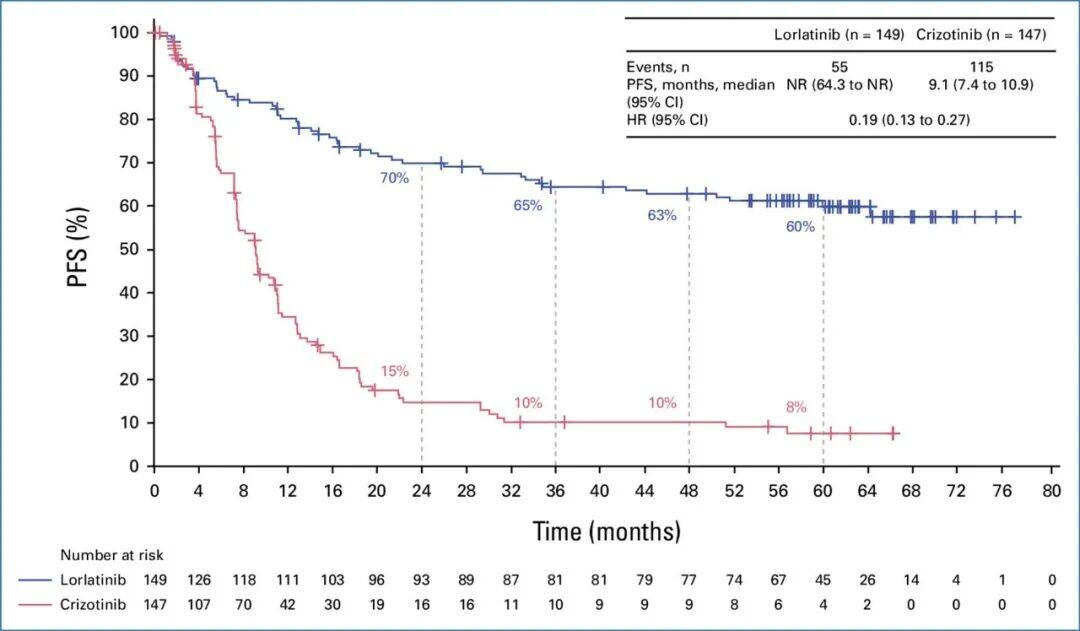
▲ InIn the CROWN study,Lorlatinib Significantly Improves PFS in Patients (Image Source: Reference [2])
The median follow-up time was 5 years, according to the assessment by the investigators,LoraTinibThe median progression-free survival (PFS) of the group has not yet been reached.The observed hazard ratio (HR) was 0.19 (95% CI:0.13-0.27)。Compared with the first-generation ALK inhibitor, lorlatinib reduced the risk of disease progression or death in patients by 81%.In addition,In the lorlatinib treatment group, 60% of patients had not experienced disease progression or death after five years (95% CI: 51-68), compared to only 8% (3-14) in the control group.These data have also been synchronized and released onJournal of Clinical OncologyJournal.
This update analysis shows,Lorlatinib reduced the risk of intracranial (IC) disease progression by 94% (HR=0.06, 95% CI: 0.03-0.12). The median time to intracranial progression was not reached in the lorlatinib group (95% CI: NR-NR), compared with 16.4 months (12.7-21.9) in the first-generation ALK inhibitor group.Among patients without brain metastases at baseline, only 4 out of 114 patients treated with lorlatinib developed brain metastases within the first 16 months of treatment, compared to 39 out of 109 patients treated with a first-generation ALK inhibitor.
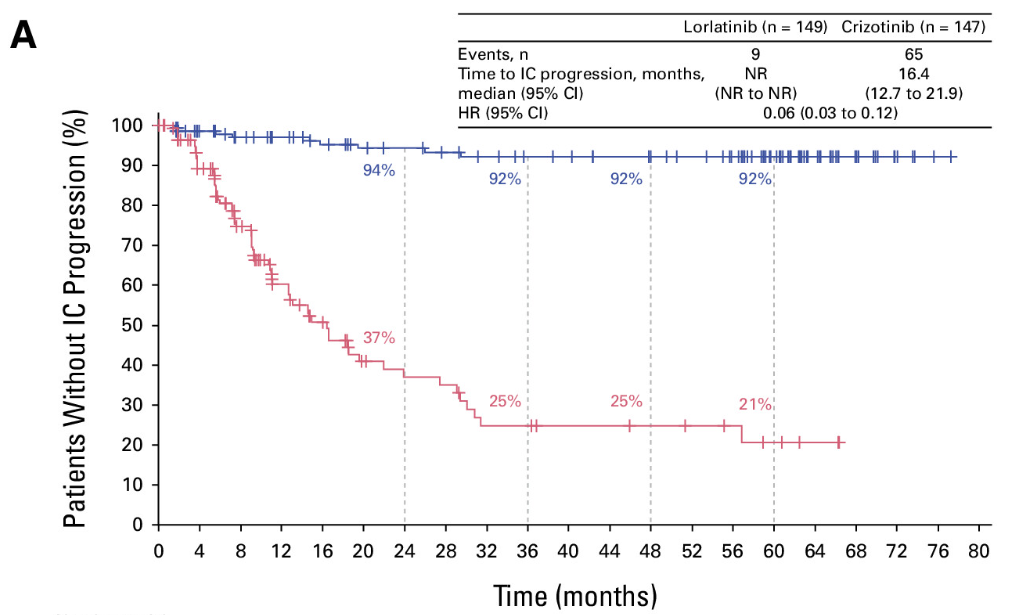
▲In the CROWN study, lorlatinib significantly reduced the risk of intracranial disease progression in patients (Image source: Reference [2]).
As of the analysis, 50% of patients in the lorlatinib treatment group in the CROWN study were still continuing treatment, compared to only 5% of patients in the first-generation ALK inhibitor treatment group.Five-year follow-up data show that the safety of the third-generation ALK inhibitor lorlatinib is consistent with previous study results, with no new safety events observed compared to the first-generation ALK inhibitors. In this analysis, the most common (≥20%) adverse events (AEs) reported by patients treated with lorlatinib are consistent with the 2020 CROWN study analysis, including edema, weight gain, peripheral neuropathy, cognitive effects, mood effects, diarrhea, dyspnea, arthralgia, hypertension, headache, cough, fever, hypercholesterolemia, and hypertriglyceridemia.
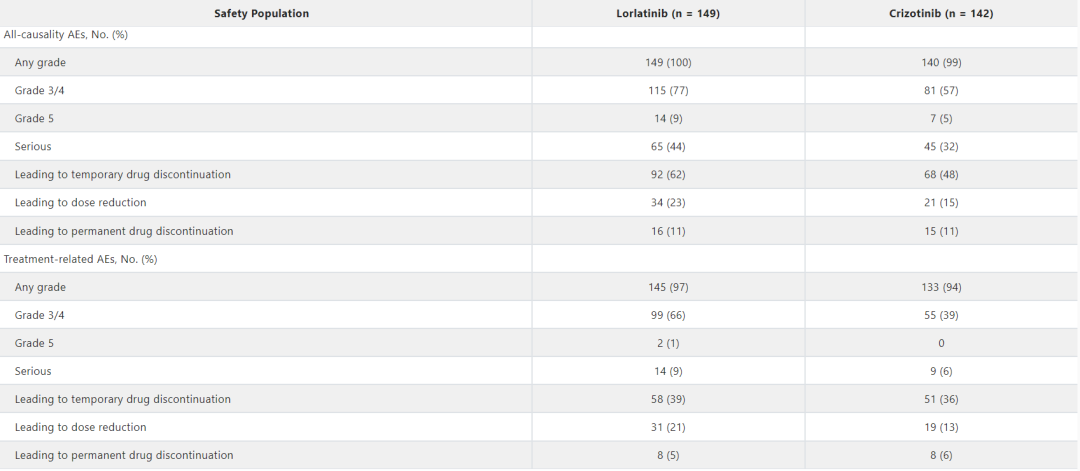
▲Summary of Safety Results from the CROWN Study (Image Source: Reference [2])
Lorlatinib is a tyrosine kinase inhibitor developed by Pfizer. It carriesALKHighly active in preclinical lung cancer models with rearrangement.The drug is able to inhibit resistance to other ALK inhibitors.ALKGene mutations, and can cross the blood-brain barrier to treat brain metastases. Lorlatinib has received Breakthrough Therapy Designation and Priority Review from the U.S. FDA, and was approved by the FDA in 2018.Accelerated ApprovalTreatment of previously treated ALK-positive metastatic NSCLC, and in 2021ApprovedFirst-line treatment for ALK-positive NSCLC. In April 2022, this therapy also received approval from the National Medical Products Administration (NMPA) of China.ApprovalFor the treatment of ALK-positive locally advanced or metastatic NSCLC patients.

It is worth mentioning that,J. Jean Cui (崔景荣)Led by the Ph.D. and developed by the teamLorlatinib and Crizotinib, two precision anti-tumor drugs.Crizotinib was approved by the U.S. FDA for marketing in 2011 to treat NSCLC with ALK mutations; Lorlatinib was approved by the FDA for marketing in 2018 for the treatment of ALK-positive metastatic NSCLC. In addition, Dr. Cui Jingrong is also the main inventor of oncology drugs TPX-0005, TPX-0022, TPX-0046, and TPX-0131. Dr. Cui is the scientific founder of precision cancer therapy company Turning Point Therapeutics, which was established in 2013 and completed its IPO in 2019. In June 2022, Bristol Myers Squibb invested over...$4 Billion AcquisitionThe company.

▲Dr. Cui Jingrong (Image Source: BlossomHill Company Official Website)
Dr. Cui also co-founded BlossomHill with biotech industry veteran Dr. Y. Peter Li in June 2020., and serves as the company's president and chief executive officer. BlossomHill is a small-molecule drug research and development company aimed at developing new chemical entities capable of addressing various drug resistance mechanisms. In February this year, the company announced the completion of a $100 millionSeries B Financing, bringing the total amount of funds raised by the company to $173 million. BlossomHill will use these funds to advance several of its internal discovery and development projects into the clinical development stage, targeting various cancers and autoimmune diseases with significant unmet medical needs.
In addition to lorlatinib, drugs used to treat ALK-positive NSCLC also include the one developed by Roche, which was just approved by the FDA last month.Alecensa(alectinib)." The press release noted,Alecensa is the first approved ALK inhibitor for the treatment of early-stage ALK-positive NSCLC patients who have undergone surgical tumor resection.In addition, Nuvalent's potential "best-in-class" ALK selective inhibitor NVL-655, which has brain penetrability, was granted by the U.S. FDA in May this year.Breakthrough Therapy Designation. Previously published trial results showed that patients with any ALK resistance mutation experienced a response after receiving once-daily treatment with NVL-655.The objective response rate (ORR) of the patients reached 54% (n=15/28), with the ORR of patients whose tumors carried the common ALK resistance mutation G1202R as high as 71% (n=12/17).

▲To learn more about the application of cutting-edge technologies in the biopharmaceutical industry, please long-press and scan the QR code above to access "WuXi Live Studio" and watch live discussions and exciting replays on related topics.
References:
[1] Pfizer Announces Latest Data from the CROWN Study of Lorbrena®: 60% of ALK-Positive Advanced Lung Cancer Participants Show Progression-Free Survival Beyond Five Years. Retrieved May 31, 2024 from https://www.prnasia.com/story/449167-1.shtml
[2] Solomon BJ, Liu G, Felip E, Mok TSK, Soo RA, Mazieres J, Shaw AT, de Marinis F, Goto Y, Wu YL, Kim DW, Martini JF, Messina R, Paolini J, Polli A, Thomaidou D, Toffalorio F, Bauer TM. Lorlatinib Versus Crizotinib in Patients With Advanced ALK-Positive Non-Small Cell Lung Cancer: 5-Year Outcomes From the Phase III CROWN Study. J Clin Oncol. 2024 May 31:JCO2400581. doi: 10.1200/JCO.24.00581. Epub ahead of print. PMID: 38819031.
Disclaimer:WuXi AppTec Content Team Focuses on Introducing Global Biomedical and Health Research Progress.This article is for informational exchange only. The views expressed in the article do not represent the position of WuXi AppTec, nor does WuXi AppTec support or oppose the views mentioned in the article.This article is not a recommendation for treatment options.For guidance on treatment options, please visit a正规 hospital.
Copyright Statement: This article is from the content team of WuXi AppTec. Individuals are welcome to share it on their social media circles, but unauthorized reproduction by media or institutions in any form to other platforms is prohibited. For authorization to reproduce, please reply with "reprint" on the WeChat Official Account of "WuXi AppTec" to obtain the reprint guidelines.


Share,PointLike,In view,Focusing on Global Biomedical Health Innovation