

Novartis Announces Scemblix Achieves Dual Primary Endpoints in Phase 3 Trial, Demonstrating Superior Efficacy Over Standard-of-Care TKIs in First-Line Ph+ CML-CP

Novartis
Drug Development and Manufacturing
▎WuXiEdited by Kant Content Team
Novartis today announced positive results from its pivotal Phase 3 ASC4FIRST trial at the 2024 American Society of Clinical Oncology (ASCO) meeting. The trial met both primary endpoints, showing superior major molecular response (MMR) at week 48 with Scemblix (asciminib) compared to investigator’s choice of standard-of-care (SoC) tyrosine kinase inhibitors (TKIs) in newly diagnosed Philadelphia chromosome-positive chronic myeloid leukemia in the chronic phase (Ph+ CML-CP) patients. The results have been submitted to the U.S. FDA.

ASC4FIRST is a head-to-head, multi-center, open-label, randomizedPhase 3The study aims to compare the efficacy and safety of once-daily oral 80 mg Scemblix with investigator-selected first- or second-generation TKIs (imatinib, nilotinib, dasatinib, or bosutinib), as well as with a subgroup of participants who selected imatinib as the TKI prior to randomization. A total of 405 newly diagnosed adult patients with Ph+ CML-CP were enrolled. The primary endpoint was the proportion of patients achieving MMR at Week 48.
ASC4FIRST Trial Meets Dual Primary Endpoints with Clinically and Statistically Significant Results.At week 48, the proportion of patients in the Scemblix treatment group who achieved MMR was nearly 20 percentage points higher numerically compared to the investigator-selected SoC TKI (67.7% vs. 49.0%), and also higher than the proportion of patients in the imatinib monotherapy group who achieved MMR at week 48.Numerically close to 30 percentage points(69.3% vs. 40.2%)。Compared with the SoC TKI and imatinib monotherapy chosen by the investigator,Patients treated with Scemblix also achieved deeper molecular responses (MR4 and MR4.5).
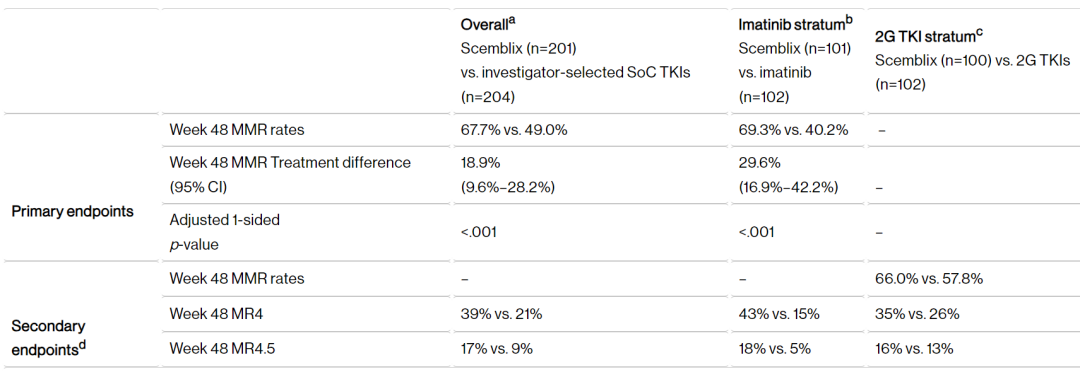
▲Summary of Efficacy Results from the ASC4FIRST Trial (Image Source: Reference [1])
In newly diagnosed patients, the safety profile was consistent with previous registration studies, and no new safety issues were observed.Compared with imatinib and second-generation TKIs, Scemblix demonstrated favorable safety and tolerability, with fewer adverse events (AEs) and discontinuations.

▲Summary of ASC4FIRST Trial Safety Results (Image Source: Reference [1])
Scemblix is an allosteric inhibitor targeting ABL1, which inhibits the activity of BCR-ABL1 by binding to the myristoyl pocket of ABL1.Since it binds to a different site on BCR-ABL1 than common TKIs, it may address the issues of TKI resistance and intolerance in the later stages of treatment for patients with chronic myeloid leukemia.The U.S. FDA in October 2021ApprovalScemblix Launched in China forTwo different indications for the treatment of chronic myeloid leukemia.This therapyPreviously received FDA Breakthrough Therapy Designation.

▲To learn more about the application of cutting-edge technologies in the biopharmaceutical industry, please long-press and scan the QR code above to access "WuXi Live Studio" and watch live discussions and exciting replays on related topics.


Share,PointLike,In View, Focusing on Global Biomedical Health Innovation