

Enhertu Shows Paradigm-Shifting Efficacy in HER2-Low and HER2-Ultralow Metastatic Breast Cancer in Phase 3 DESTINY-Breast06 Trial

AstraZeneca
Biopharmaceutical Manufacturer

Daiichi-Sankyo
Pharmaceutical R&D Developer
▎WuXiEdited by Kant Content Team
Today, AstraZeneca and Daiichi Sankyo reported detailed positive results from the Phase 3 clinical trial DESTINY-Breast06 at the American Society of Clinical Oncology (ASCO) Annual Meeting. The data showsThe重磅 antibody-drug conjugate (ADC) Enhertu significantly improved progression-free survival (PFS) in patients with HR-positive, HER2-low (IHC 1+ or 2+/ISH-) metastatic breast cancer compared to standard chemotherapy.This improvement was also confirmed in the overall trial population, including patients who are HR-positive, HER2-low, and HER2-ultralow (defined as IHC 0, with membranous staining). Dr. Susan Galbraith, Executive Vice President of Oncology R&D at AstraZeneca, stated in a press release that this result could lead to a paradigm shift in breast cancer treatment.

In the overall trial population, Enhertu reduced the risk of disease progression or death by 37% compared to chemotherapy., with a median PFS of 13.2 months compared to 8.1 months in the chemotherapy group (HR=0.63; 95% CI: 0.53-0.75; p<0.0001).
In addition, pre-specified exploratory analyses showed,Consistent, clinically significant improvements in PFS were observed in patients with HER2-low and HER2-ultralow expression.In patients with HER2 ultra-low expression, Enhertu reduced the risk of disease progression or death by 22%, with a median PFS of 13.2 months compared to 8.3 months in the chemotherapy group (HR=0.78; 95% CI: 0.50-1.21). In the Enhertu group, 13 complete responses were observed, including 9 in patients with HER2 low expression. In the HER2 ultra-low expression subgroup, there were 4 complete responses in the Enhertu group, while no complete responses were observed in the chemotherapy group.For detailed data, please see the table below:
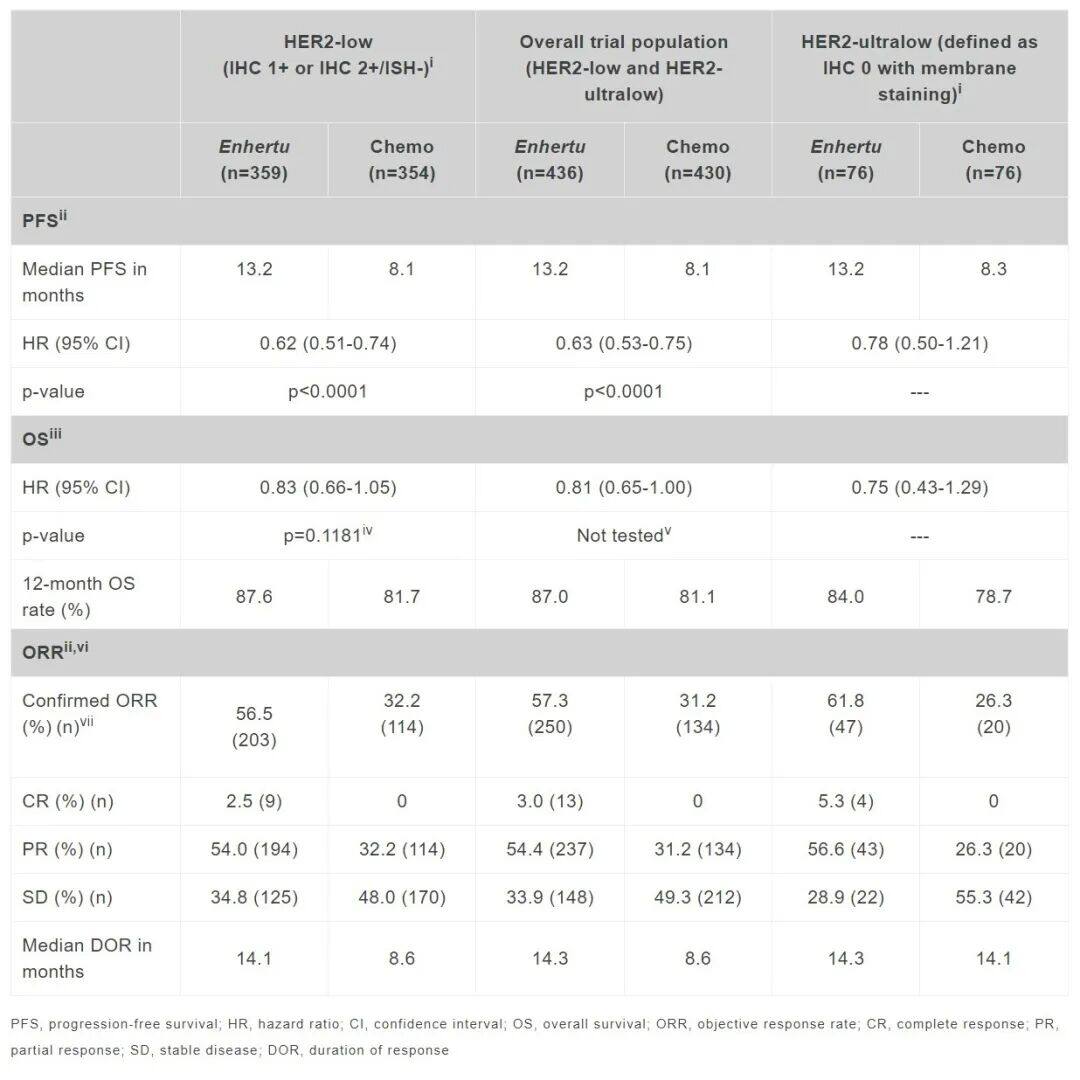
▲Summary of DESTINY-Breast06 Trial Data (Source:Reference [1])
The two companies also reported additional clinical trial data for Enhertu at the ASCO Annual Meeting. In DESTINY-Breast03, Enhertu continued to demonstrate clinically meaningful survival improvement compared to the active control ADC in treating HER2-positive unresectable or metastatic breast cancer patients over three years of follow-up. The median OS was 52.6 months in the Enhertu group and 42.7 months in the active control group (HR=0.73; 95% CI: 0.56-0.94).
Enhertu is an ADC therapy jointly developed by AstraZeneca and Daiichi Sankyo. It is designed using Daiichi Sankyo's proprietary DXd ADC technology platform, consisting of a humanized monoclonal antibody targeting HER2 linked to a topoisomerase 1 inhibitor payload via a cleavable tetrapeptide linker. Enhertu received its first approval from the U.S. FDA in 2019.Approval, for the treatment of patients with unresectable or metastatic HER2-positive breast cancer.

▲To learn more about the application of cutting-edge technologies in the biopharmaceuticals industry, please long press and scan the QR code above to access "WuXi Live Studio" and watch live discussions and exciting replays on relevant topics.
Disclaimer: The content team of WuXi AppTec focuses on introducing the research progress of global biopharmaceuticals and health. This article is for information exchange only, and the views in the article do not represent the position of WuXi AppTec, nor does it indicate that WuXi AppTec supports or opposes the views in the article. This article is not a recommendation for treatment plans. If you need guidance on treatment options, please visit a正规 hospital.
Copyright Statement: This article is from the content team of WuXi AppTec. Individuals are welcome to share it on their social media platforms, but unauthorized reproduction by media or organizations in any form to other platforms is prohibited. For authorization to reproduce, please reply with "reprint" on the WeChat Official Account of "WuXi AppTec" to obtain reprint guidelines.


Share,PointLike,In View,Focusing on Global Biomedical Health Innovation