Novartis Abandons Opnurasib (JDQ443), a Leading KRAS G12C Inhibitor in Phase III Development, Citing Intensifying Competition

Novartis
Drug Development and Manufacturing


Recently, Novartis abandoned its Phase III clinical KRAS G12C inhibitor.Opnurasib(JDQ443), due to intense competition.
According to a spokesperson for Novartis: "This decision was made considering the increasing options for patients with KRAS G12C mutation cancers, rather than being driven by clinical data, and no new safety signals were observed."
Opnurasib is a product developed by Novartis.Oral,Selective, covalent KRAS G12C inhibitor, which has advanced to Phase III clinical stage. The molecule'sThe chemical structure is different from the covalent inhibitors of KRAS G12C currently under research.OpnurasibIn addition to covalently and irreversibly binding to the Switch II loop of the KRAS G12C protein, it can also directly reach the C12 residue in a completely new binding mode, while avoiding interaction with the histidine 95 (H95) residue (Recognized Drug Resistance Pathway) directly interact, thereby "locking" KRAS G12C in an inactive state and inhibiting the overactivation of this pathway in tumors.
According to the published clinical data, Opnurasib has demonstratedCorrectEfficacy Data. At the 2023 American Society of Clinical Oncology (ASCO) Annual Meeting, Novartis announcedOpnurasibIb/II Phase Study Data on Monotherapy for KRAS G12C-Mutant Solid Tumors.
For 20 NSCLC patients, the objective response rate (ORR) across all dose-level groups was 45.0%. In NSCLC patients receiving the recommended dose of 200mg Bid, the ORR reached 57.1%, with a disease control rate (DCR) of 92.9%. In terms of safety,Adverse events (AEs) were mostly grade 1-2, with no grade 4 or higher AEs. This efficacy data is among the currently reported...KRAS G12C InhibitorThe best in China.
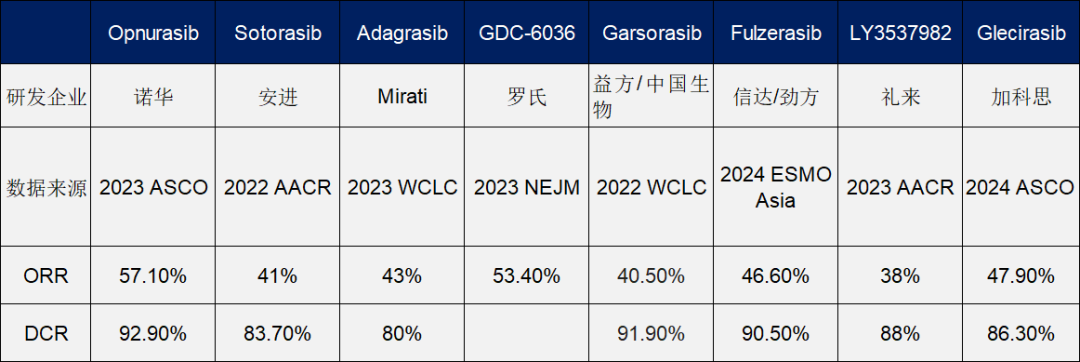
As the first discovered lung cancer driver gene, KRAS was considered an undruggable target for a long time until the approval and market launch of Sotorasib.Completely broke the "undruggable" curse of KRAS, making the notion that KRAS mutations are undruggable a thing of the past.
Following the success of Lumakras, KRAS has become one of the most sought-after targets for pharmaceutical companies in China, with at least a dozen KRAS inhibitors currently in development, three of which haveSubmitted for marketing authorization.
Gmax Biopharm's Fulzerasib is the first domestically produced KRAS G12C inhibitor to have been submitted for marketing approval in China. In November last year, Innovent Biologics/Gmax Biopharm submitted a marketing application for Fulzerasib as a single-agent treatment for second-line therapy in patients with advanced NSCLC.In addition, Yifang Biotech/China Biologic'sGarsorasibGlecirasib from Jiake Bio submitted its listing application in December 2023 and May 2024, respectively.



Recommended Articles of the Week
Reprint please contact BioValley and indicate the source clearly.