

QuantumPharm Clears HKEX Hearing Under Chapter 18C, Poised to Lead AI-Driven Drug Discovery IPO Wave
XtalPi
Computation-Driven Innovative Drug R&D Provider
The wave of AI is sweeping through all industries, and the pharmaceutical industry is no exception.
Fourteen months after the launch of the Hong Kong Stock Exchange's new rules for special technology listings (referred to as "Chapter 18C"), XtalPi, a company renowned for its "AI-driven drug discovery," recently passed the HKEX listing hearing, drawing significant attention from the pharmaceutical industry.
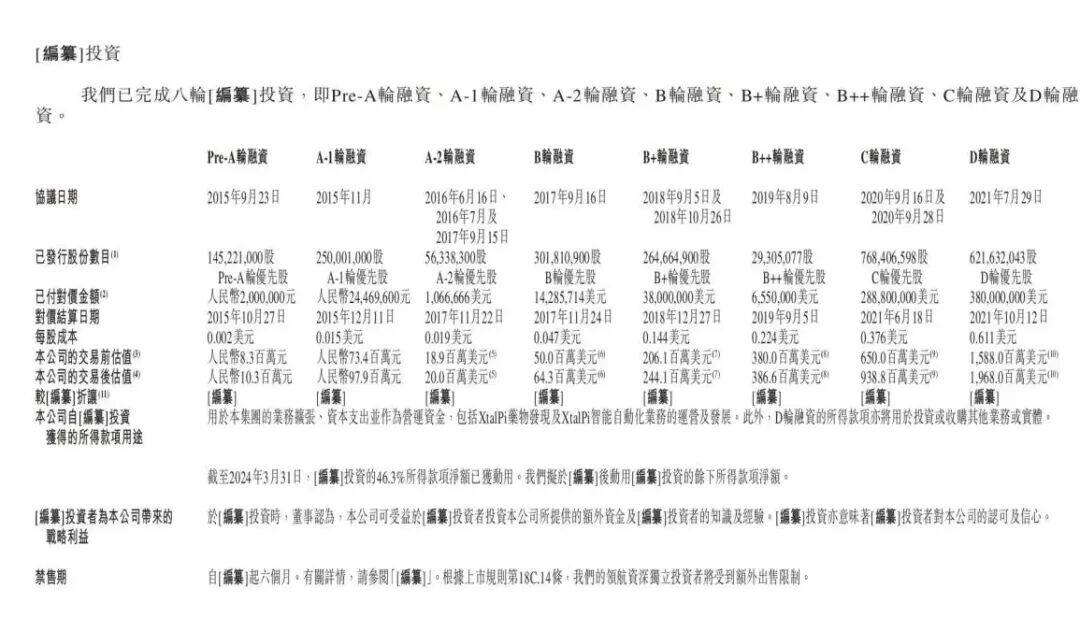
As a "unicorn" enterprise in a niche track, XtalPi was founded in September 2015. Before going public, it had completed 8 rounds of financing, with a total financing amount close to 800 million US dollars. As the scale of financing continues to expand, the company's valuation has also been rising, currently reaching 14 billion RMB.
At present, the potential of AI in the pharmaceutical field is increasingly attracting market attention. All sectors of the industry chain hope to leverage AI technology to shorten the drug research and development cycle, accelerate the launch of new drugs, thereby bringing new pathways and tools for innovation in pharmaceutical R&D.
Although AI pharmaceutical technology has not yet developed a truly marketed drug, the market is confident in the prospects of this field. Industry insiders pointed out that XtalPi passing the hearing at the Hong Kong Stock Exchange means the company has passed an important review stage before listing. The successful listing of XtalPi may encourage other AI pharmaceutical companies to accelerate their development pace, having a positive impact on the entire industry.
HKEX's "Chapter 18C" new rules officially came into effect on March 31, 2023, providing a new listing pathway for technology-based startups. The biggest feature of Chapter 18C is to lower the listing threshold for companies, allowing companies in specific industries to go public provided they meet certain conditions related to market value, R&D investment, and investor requirements.
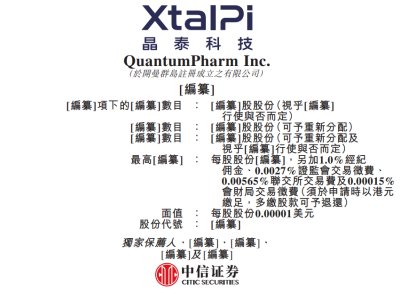
XtalPi is the second technology enterprise to submit a prospectus under the "Chapter 18C" route.
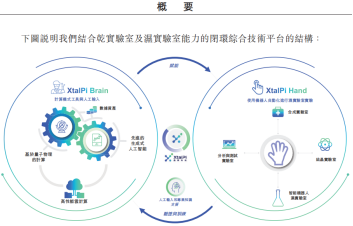
According to the post-hearing materials, XtalPi is an innovative R&D platform based on quantum physics, empowered by artificial intelligence, and driven by robotics. Its main business is divided into two parts: one is providing drug discovery solutions; the other is intelligent automation solutions.

Drug discovery solutions focus on identifying and developing molecules that exhibit pharmacological activity against specific disease-related targets. From target validation, hit identification, lead generation, lead optimization to preclinical candidate nomination, covering various modalities including small molecules, antibodies, peptides, ADCs, and PROTACs.
Intelligent automation solutions mainly include solid-state R&D services and automated chemical synthesis services. Solid-state R&D services focus on analyzing the physical and chemical properties of solid-state materials, which are crucial for drug and materials science R&D.
XtalPi's revenue sources mainly come from upfront payments, milestone payments, contingent payments and/or royalties from drug discovery collaborations, transaction service fees for drug discovery solutions and solid-state R&D services, and subscription service fees for automated chemical synthesis services.
As a pre-commercial company, XtalPi's revenue has grown rapidly over the past three years, increasing from RMB 62.8 million in 2021 to RMB 133 million in 2022, and further to RMB 174 million in 2023, representing a CAGR of 66.7%. The significant revenue growth and rapid business expansion demonstrate XtalPi's commercialization capabilities and business sustainability.
At the same time, high R&D expenses and administrative expenditures, among others, have led to less-than-ideal overall net profit performance for XtalPi. Data shows that XtalPi's net losses for the years 2021, 2022, and 2023 were RMB 2.137 billion, RMB 1.439 billion, and RMB 1.914 billion, respectively.

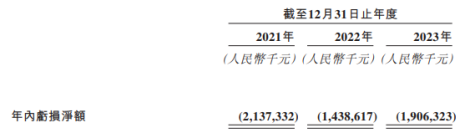
Despite losing 5.49 billion yuan within three years, given that XtalPi is on the development track of an emerging industry, the market is confident in the AI pharmaceuticals sector. Since its establishment, XtalPi has completed eight rounds of funding and raised approximately 732 million US dollars.

Data shows that the customers of XtalPi mainly include biotechnology and pharmaceutical companies in China and the United States. In 2021, 2022, and 2023, XtalPi had 75, 120, and 187 customers respectively, with revenue from the top five customers accounting for approximately 61.8%, 49.6%, and 36.3% of the total revenue in the respective years. These include Pfizer, Johnson & Johnson, Chia Tai Tianqing Pharmaceutical Group Co., Ltd., Daewoong Pharmaceutical Co., Ltd. of South Korea, and Merck of Germany.
AI Drug Discovery refers to the application of artificial intelligence technology in the drug research and development process to improve R&D efficiency, reduce costs, and accelerate the process of new drug launches. The application of AI in the pharmaceutical field includes but is not limited to multiple aspects such as drug target identification, screening of candidate drug molecules, prediction of drug properties, and optimization of clinical trial design.
Since 2015, the AI pharmaceuticals field has witnessed the rapid rise of a group of emerging companies. A large number of outstanding AI pharmaceutical companies in China have also gradually appeared, becoming the "leading players" in China's AI pharmaceutical sector. For example:
Insilico Medicine, founded in 2014, is a world-leading AI-driven biotechnology company. The core product of Insilico Medicine, ISM001-055, is a small molecule candidate drug that primarily treats fibrosis-related indications by inhibiting TRAF2 and NCK interacting protein kinase ("TNIK"), a newly discovered antifibrotic target. As of March 19, 2024, Insilico Medicine has a pipeline of 15 drug candidates covering therapeutic areas such as fibrosis, oncology, immunology, and others, six of which have received IND approval for clinical trials.
Founded in 2018, StoneWise is one of the earliest companies globally to focus its R&D efforts on AI-driven small molecule drug discovery applications. Its molecular design software platform has been adopted by several top research institutions and pharmaceutical companies, becoming the first commercially available AI-powered drug molecular design software in China.
SuiKun Intelligence, founded in 2018 and incubated by the Turing Artificial Intelligence Research Institute of Tsinghua University, is committed to promoting new drug research and development, translational medicine research, and empowering clinical applications through artificial intelligence, aiming to address the high cost, low success rate, and long cycle issues in the preclinical stage of drug candidate molecule discovery within the biopharmaceutical field.
In fact, there are many companies actively exploring and researching in the AI pharmaceutical field.

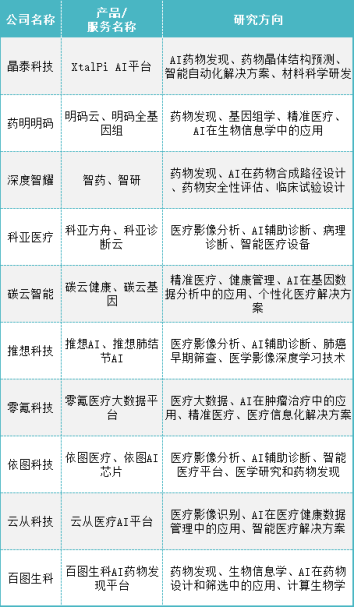
These companies represent the innovative forces in AI pharmaceuticals and related healthcare fields. They leverage artificial intelligence technology to accelerate the drug research and development process, improve diagnostic accuracy, optimize treatment plans, and provide patients with personalized healthcare services.
At the same time, traditional pharmaceutical companies are actively entering the AI drug discovery field through strategic cooperation and equity investment, in order to improve the efficiency and success rate of drug research and development. For example:
WuXi AppTec has invested in six AI drug discovery companies, including Insilico Medicine, which cover various key stages of the drug discovery process, from target identification to clinical prediction. Insilico Medicine is a company capable of applying AI technology across all aspects of drug discovery and has been recognized as one of the world's leading AI drug discovery companies. Additionally, WuXi AppTec has formed a joint venture with Schrödinger called Faxian Therapeutics, combining WuXi AppTec’s lead compound optimization services with Schrödinger’s drug design software platform to accelerate new drug discovery. These initiatives demonstrate how traditional pharmaceutical companies leverage AI technology to drive innovation and development in the pharmaceutical industry.
Sanofi Partners with Exscientia, an AI-Driven Drug Discovery CompanySanofi has partnered with Exscientia, a company that leverages AI technology to accelerate the drug discovery and development process. Through this collaboration, Sanofi aims to utilize Exscientia’s AI platform to design and optimize small molecule drugs, particularly in the fields of oncology and immunology. Additionally, Sanofi has established a partnership with Atomwise, another AI-driven pharmaceutical company. Atomwise's AI platform can rapidly screen millions of compounds to identify potential drug candidate molecules. These collaborations help Sanofi save time and costs during the drug discovery phase while increasing the success rate of R&D.
Hengrui Medicine Collaborates with French Company Iktos. Iktos is a company focused on utilizing artificial intelligence technology to develop new drug design platforms. Through this collaboration, Hengrui Medicine has introduced Iktos's AI-powered new drug R&D platform to accelerate the discovery and development process of new drugs. Iktos's MCM (Molecule Generation Challenge) technology can rapidly generate new molecules with specific attributes using AI algorithms, providing new candidate compounds for drug development.
In addition, Internet giants have also entered the field of AI pharmaceuticals. Baidu, Tencent, and Alibaba launched AI drug discovery platforms in 2020, while Huawei and ByteDance have actively deployed AI technology.
Industry experts point out that currently, AI pharmaceuticals are in the acceleration phase of industrialization. Globally, multiple AI pharmaceutical projects are in the clinical research stage, and the application advantages of AI technology in drug discovery and optimization design continue to expand.
With the rapid advancement of biotechnology and artificial intelligence, China's AI pharmaceuticals industry is entering an unprecedented period of high-speed growth. Strong policy support, continuous technological breakthroughs, active capital inflows, a large gathering of talent, expanding market demand, deepening international cooperation, an increasingly complete industrial chain, and constant exploration of innovative models are all jointly driving the vigorous development of this industry.

www.yyjjb.com.cn
Insight into Industry Trends
"Pharmaceutical Economy Newspaper"
Academic Official Account
Focus on the Frontier of Oncology Academia
Terminal Official Account