June 4, 2024
eMedClub News
From May 31 to June 4, Eastern Time, the 2024 American Society of Clinical Oncology (ASCO) Annual Meeting is being held grandly in Chicago, USA.This year's annual meeting will showcase a series of striking latest research achievements, among which the frontier product updates from Chinese and foreign mRNA companies are also included.This article will take you on a quick tour of the latest developments in the mRNA field at the ASCO Annual Meeting, exploring the therapeutic potential and future development directions of this cutting-edge technology.
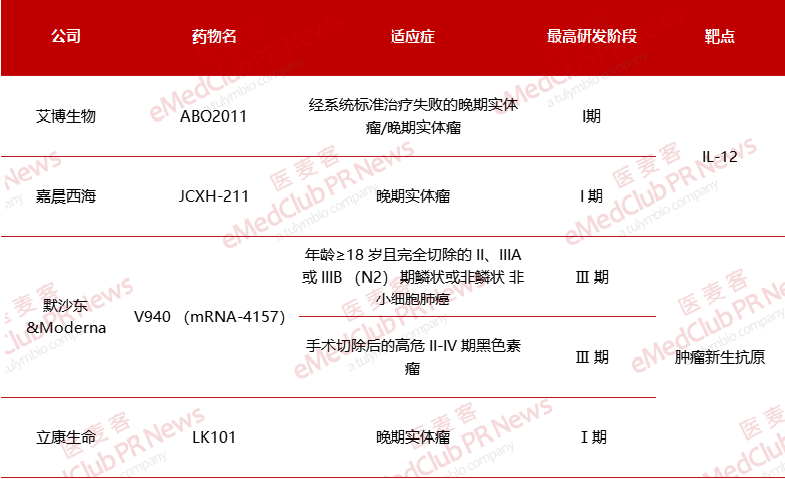
▲Overview of mRNA Therapies Included in the ASCO2024 Abstract
mRNA Tumor Vaccine Encoding IL-12
About Interleukin-12 (IL-12)
IL-12 is a naturally occurring cytokine that plays a crucial role in the immune response against cancer. In multiple preclinical studies, IL-12 has demonstrated significant anti-tumor effects by effectively stimulating activated T cells and NK cells, enhancing their anti-tumor functions, thereby destroying solid tumors. However, systemic administration of IL-12 may lead to severe toxic reactions, even life-threatening conditions. To mitigate this risk, researchers have adopted lipid nanoparticle (LNP) technology for localized delivery of IL-12-mRNA, thus avoiding drug toxicity.
Since IL-12 acts locally through paracrine and autocrine mechanisms, it is crucial to increase the local concentration of IL-12 within the tumor tissue. Therefore, mRNA vaccines encoding IL-12 currently primarily use intratumoral administration to ensure their therapeutic efficacy.
Indications:ViaStandardAdvanced Solid Tumors with Systemic Treatment Failure / Advanced Solid TumorsProgress:Phase Ⅰa clinical trial data show: ABO2011 is safe and well-tolerated in patients with advanced solid tumors. Further research on the combination of ABO2011 with immune checkpoint inhibitors can be conducted.ABO2011 is a therapeutic mRNA tumor vaccine developed by Abogen, which encodes human IL-12 mRNA. It exerts anti-tumor activity by expressing the IL-12 protein and activating immune cells.In June 2023, ABO2011 received the clinical trial implied permission from the China National Medical Products Administration (NMPA), with the indication for advanced solid tumors that have progressed or metastasized after systemic standard treatment.The abstract accepted by this year's ASCO conference is for the Phase Ia clinical trial (NCT05392699) of ABO2011 in adult patients with advanced solid tumors. The data shows that ABO2011 has good safety with no serious adverse events reported. Among the 17 subjects, 5 maintained stable disease, with progression-free survival durations of 6.0 months (colorectal cancer), 5.6 months (non-small cell lung cancer), and 4.1 months (pancreatic cancer) across different tumor types.
Indications:Advanced Malignant Solid TumorsProgress:Phase Ⅰa clinical trial data show: JCXH-211 has good safety and anti-tumor activity was observed in patients with advanced tumors.JCXH-211 is a novel self-replicating mRNA (srRNA) independently developed by Immorna (Hangzhou) Biotechnology Co., Ltd. that encodes the IL-12 protein.Is the first lipid nanoparticle (LNP) encapsulatedsrRNA。Compared with normal tissues, srRNA is more translatable in the immunosuppressive tumor microenvironment, which can further limit the off-target toxicity of IL-12.In March 2022, JCXH-211 received the Investigational New Drug (IND) approval from the U.S. Food and Drug Administration (FDA), becomingThe first mRNA drug in China to receive IND approval from major Western countries.On November 9, 2022, JCXH-211 injection was approved by the China National Medical Products Administration (NMPA) to conduct Phase I clinical trials.The abstract accepted by this year's ASCO reports the results of a Phase Ia clinical study on intratumoral injection of JCXH211 in patients with advanced solid tumors. The data shows that, in the 5 μg, 25 μg, and 50 μg cohorts, the lesions in three subjects decreased by 13.0% (breast cancer), 33.3% (head and neck cancer), and 43.0% (melanoma) after receiving the injection; a 31% reduction in tumor size was also observed in non-injected lesions of head and neck cancer patients treated with 25 μg JCXH-211, indicating an abscopal effect of JCXH-211. Additionally, histopathological analysis showed that the infiltration levels of T cells and NK cells within the tumor tissues of treated patients increased significantly.138Times, showing strong immune microenvironment regulation capabilities.Recommended Thematic Forums
Swipe up and down to view more
Limited Time Offer
Free Tickets
mRNA Tumor Vaccines Encoding Neoantigens
Tumor neoantigens refer to those in tumor cellsSpecific ExpressionThe protein can be recognized and killed by the T cells of the immune system, making it an ideal target for tumor immunotherapy.The distinguishing feature of neoantigen tumor vaccines compared to other anticancer drugs is "personalization," which meansEach patient's vaccine is derived from their own genetic mutations, and thus, each one is unique.The current common production process for personalized tumor neoantigen vaccines is as follows: 1) Extraction of tumor and normal tissues; 2) Next-generation sequencing to analyze tumor somatic mutations and mutation gene expression levels; 3) Prioritization and selection of tumor neoantigens; 4) Vaccine design and GMP manufacturing; 5) Vaccine administration and immune response monitoring.Enterprise:Merck & ModernaIndications:Resected Early-Stage Non-Small Cell Lung Cancer / High-Risk Melanoma After Surgical ResectionProgress:Phase Ⅱb Clinical Trial 3-Year Follow-Up Data Released, Phase Ⅲ Clinical Trial Currently UnderwayV940 is an mRNA cancer vaccine co-developed by Merck and Moderna. It belongs to the mRNA personalized neoantigen therapy and consists of synthetic mRNA encoding up to 34 neoantigens, aiming toBased on the unique mutational signature of the patient's tumor DNA sequence, generating specific T-cell responses to train and activate anti-tumor immune responses, thereby achieving the purpose of fighting cancer.Results of the Phase IIb clinical trial (KEYNOTE-942) for mRNA-4157 (V940) in combination with pembrolizumab (Keytruda) for high-risk stage III/IV melanoma were presented at the 2023 ASCO meeting: The combination of V940 and pembrolizumab reduced the risk of distant metastasis or death in patients with high-risk stage III/IV melanoma.65%, the risk of recurrence or death was reduced44%, significantly improving the survival period of patients. Based on this remarkable result, the mRNA-4157 vaccine has been granted Breakthrough Therapy Designation by the US FDA.This year, V940 has three abstracts selected for ASCO, respectively:Three-Year Follow-Up Data of KEYNOTE-942 Releasedas well as pembrolizumab combined with V940 adjuvant therapy for resected early-stage non-small cell lung cancer (INTerpath-002) and high-risk melanoma post-surgical resection (INTerpath-001).Phase III Clinical Trial Study DesignThe 3-year follow-up data from KEYNOTE-942 showed that the combination of mRNA-4157 vaccine with pembrolizumab reduced the risk of distant metastasis or death in high-risk stage III/IV melanoma patients.62%, the risk of recurrence or death was reduced49%。Enterprise:Likon Life TechnologyIndications:Advanced Solid TumorsProgress:Phase I clinical trial for advanced solid tumors initiated in October 2023, data not yet disclosedLK101 is an innovative product independently developed by Beijing LK Life Technology Co., Ltd.It combines the dual advantages of mRNA vaccines and dendritic cell (DC) vaccines.LK101 utilizes mRNA encoding tumor neoantigens for the ex vivo transfection of DC vaccines, combining the advantages of both mRNA vaccines and DC vaccines: personalized mRNA sequences can be designed based on the patient's tumor neoantigen information and rapidly prepared; meanwhile, the mRNA is fully expressed within DC cells, which is more conducive to antigen presentation.In March 2023, the IND application for LK101 Injection was approved for the treatment of advanced solid tumors.The First in ChinaApproved for clinical entry, the personalized neoantigen vaccine is alsoThe First in ChinaPersonalized mRNA tumor vaccine approved for clinical use.The abstract accepted by this year's ASCO conference is from an investigator-initiated clinical study (NCT03674073) on LK101, aiming to evaluate the safety and efficacy of LK101 combined with regular ablation therapy in treating hepatocellular carcinoma (HCC) patients at Hong Kong Liver Cancer (HKLC) stage IIa. The research data showed that the median follow-up times for the vaccine group and the control group were 48.4 months and 38.8 months, respectively, with a significant increase in survival rate; after vaccination, both CD4 and CD8 positive effector memory T cells in the peripheral blood of patients showed an increasing trend, while PD-1 positive T cells decreased. Additionally, LK101 demonstrated excellent safety, with no serious adverse events of grade 3 or higher occurring throughout the trial.With the continuous advancement of biotechnology, mRNA tumor drugs have become a research hotspot in the field of cancer immunotherapy. Looking ahead, mRNA tumor drugs are expected to achieve significant breakthroughs in multiple aspects, bringing revolutionary changes to cancer treatment.2. Related Public InformationStatement and Copyright Notice
Disclaimer: This article aims to convey industry development information and explore the frontiers of biopharmaceutical progress. The content represents the author's views and does not reflect the position of EurekaMed, nor does it constitute any value judgment, investment advice, or medical guidance. For any specific needs, please consult a professional for investment or visit a正规 hospital for medical advice.
Copyright Notice:This article is from the content team of Yima Guest. Individuals are welcome to share it on their social media platforms, but unauthorized reproduction by media or institutions in any form to other platforms is prohibited. For reprint authorization, please leave a message at the bottom of the article.
DianDian "Share”、“Like" and "In View", charge me up a bit~"